Behaviour Change Counselling for “non violent” men…
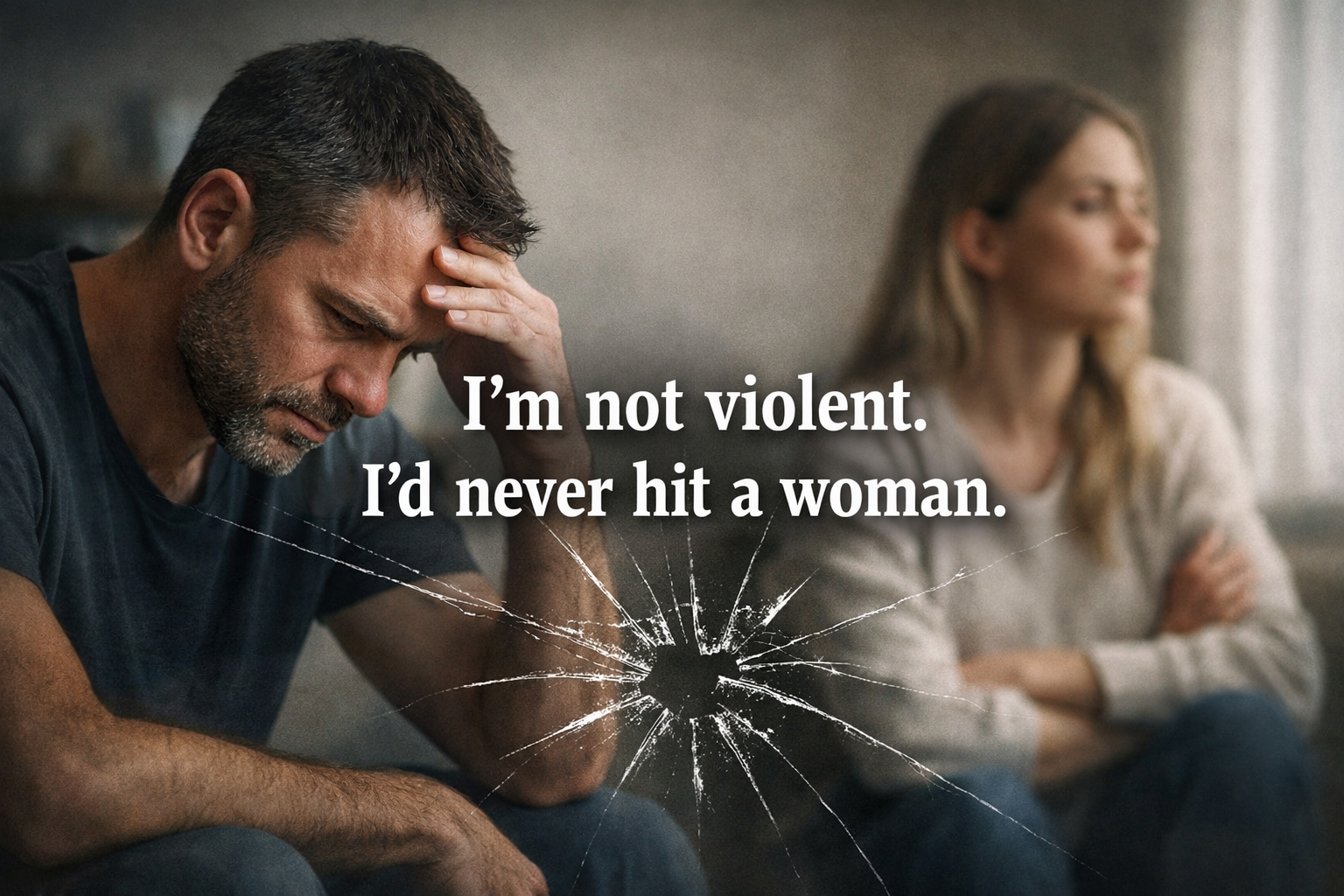
“I’m Not Violent. I’d Never Hit a Woman.” – So Why Consider Men’s Behaviour Change Counselling?
It is common for men to say, “I’m not violent. I would never hit a woman.”
Sometimes they say it defensively. Sometimes with genuine confusion. Sometimes with relief, as though that one line settles the matter.
And to be clear: not hitting your partner matters. Physical assault is serious, harmful, and never acceptable. But many relationships are damaged, controlled, and made unsafe without a fist ever being raised. So when a man says, “I’m not violent,” what he often means is:
“I am not the worst kind of man I can imagine.” That may be true. But it is not the same as asking:
Do the people close to me feel safe with me?
Do they feel free around me?
Do they have to manage my moods, my reactions, my jealousy, my criticism, my silence, or my anger?
Does my behaviour leave fear behind, even if I never intended it to?
These are harder questions. But they are the questions that matter.
Violence is not only physical
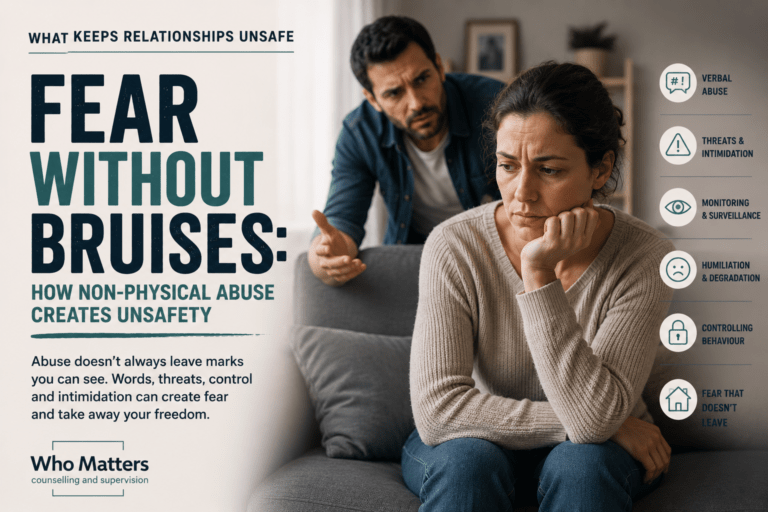
Many men were taught to think about abuse in very narrow terms. If there are no punches, no broken bones, no police, no obvious terror, then surely it does not count. But relationships can be harmed by far more than physical force.
A man may never hit his partner and still:
- intimidate her with anger
- punch walls, slam doors, or throw objects
- stand over her during arguments
- monitor where she goes or who she speaks to
- pressure her for sex
- control money
- belittle, humiliate, or ridicule her
- make her feel constantly “on edge”
- threaten self-harm if she leaves
- use silence, withdrawal, or contempt to punish her
- repeatedly accuse her of cheating
- expect her to organise life around his emotional state
- minimise her experience and insist she is overreacting
Some men do these things and still tell themselves, “But I never hit her.” That sentence often becomes a shield against deeper self-examination.
Sometimes the issue is not what you intended, but how you impact others
A lot of men are not walking around thinking, I want to terrify my partner. Many would be horrified to hear themselves described as abusive or controlling. But intent is only part of the picture.
You may intend to “get your point across,” but your partner experiences intimidation.
You may intend to “defend yourself,” but your partner experiences blame, reversal, and exhaustion.
You may intend to “need reassurance,” but your partner experiences surveillance and pressure.
You may intend to “cool off,” but your partner experiences punishing withdrawal.
You may intend to “be honest,” but your partner experiences repeated degradation.
If the effect of your behaviour is that other people shrink themselves around you, tread carefully around you, or stop raising concerns because it is never worth the fallout, then something important is happening. Whether or not you call it violence, it is causing harm.
“I just get angry” is not a small thing
Another common response is:
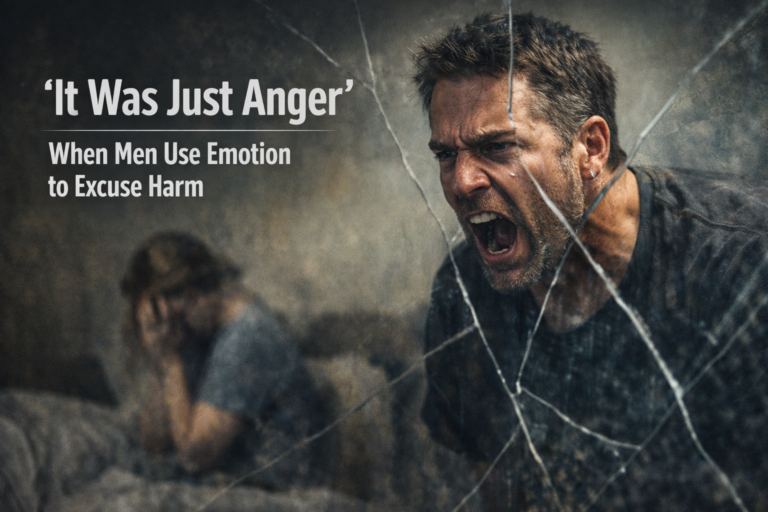
“I don’t abuse her. I just get angry sometimes.”
But anger is not harmless just because it feels justified from the inside.
For many men, anger becomes the emotional centre of the relationship. Everyone else has to orient around it. A partner learns when not to speak, what not to bring up, how to avoid escalation, when to placate, when to back down, when to apologise first, when to let things go.
That is not mutual safety. That is adaptation.
And often, the man himself feels misunderstood. He may focus on the moment he snapped rather than the environment that has formed around his snapping. He remembers the argument; she remembers the dread before it.
Men’s behaviour change counselling can help unpack this difference. Not to shame men, but to help them understand the lived impact of their behaviour on others.
You do not have to be a monster to need help
One of the biggest barriers for men is this belief: Men’s behaviour counselling is for “those men,” not me. But that thinking keeps many men stuck.
If the only men who seek help are those already willing to admit to severe abuse, then many others will never examine patterns that are destructive, coercive, entitled, or frightening. They will keep comparing themselves to a more extreme stereotype and conclude they are fine.
The truth is, a man does not need to be the worst-case scenario to benefit from support.
He may benefit if:
- arguments regularly become intimidating
- his partner says she feels scared, shut down, or unheard
- he becomes verbally abusive when distressed
- he blames his partner for his reactions
- he struggles with jealousy, control, or entitlement
- he feels ashamed after conflict but repeats the same patterns
- his children withdraw from him when he is angry
- former partners have made similar complaints
- he tells himself, “That’s just how I am when I’m triggered”
- he wants to repair the way he relates before more damage is done
Counselling is not only for crisis. It is also for accountability, insight, and change.
“But she does things too”
This is where many men turn next.
“I’m not the only one.”
“She yells too.”
“She pushes my buttons.”
“She can be aggressive.”
“Why am I the one who needs counselling?”
In many relationships, both people may behave badly at times. Conflict can be messy. People can be reactive, hurtful, and emotionally immature. But not all harmful behaviour in relationships operates in the same way.
A key question is not simply: Who said what?
It is: Who is creating fear? Who is setting the emotional terms of the relationship? Who feels entitled to control, punish, dominate, or make the other person submit?
Men’s behaviour change counselling is not about pretending men are always the only problem in every relationship. It is about helping men take responsibility for their own behaviour without hiding behind mutual blame.
Even if your partner has her own issues, that does not remove your responsibility to examine how you show up.
“I’m under a lot of stress” may be true, but it is not an excuse
Stress, trauma, anxiety, depression, grief, alcohol, childhood wounds, and fear of abandonment can all shape the way men behave. These things matter. They deserve compassion and careful attention.
But they do not make controlling or harmful behaviour harmless.
A man can be suffering and still be causing harm. In fact, many men who use coercive, intimidating, or degrading behaviours feel deeply distressed themselves. They may feel flooded, ashamed, desperate, rejected, or emotionally out of control.
That does not mean they are beyond help. It means the work needs depth. It means they may need support not only with behaviour, but with emotional regulation, attachment wounds, entitlement, defensiveness, shame, and relational skills.
Men’s behaviour counselling is useful precisely because it does not stop at, “Just don’t do that.”
At its best, it asks:
- What happens in you before these moments?
- What story do you tell yourself about your partner?
- What do you feel entitled to?
- What do you do when you feel powerless, criticised, ignored, or abandoned?
- How do you regain control?
- What does your partner or family have to do in response?
- What would accountability look like here?
- What would safety look like?
Change begins when a man becomes willing to be honest
The hardest step is often not behaviour change itself. It is honesty. Honesty sounds like:
- “I may not be physically violent, but I can be intimidating.”
- “I do use anger to take control.”
- “I expect too much emotional management from my partner.”
- “When I feel insecure, I become controlling.”
- “I minimise the impact of my behaviour.”
- “I focus on whether I meant harm rather than whether I caused it.”
- “I tell myself I’m a good man, but I’m not looking closely enough at how I behave when I’m hurt, ashamed, or challenged.”
That kind of honesty is not weakness. It is maturity. And for many men, it is the beginning of becoming safer, steadier, and more trustworthy in relationships.
Men’s behaviour counselling is not about labelling you
Some men avoid counselling because they fear being condemned, pathologised, or permanently defined by their worst moments. They fear being told they are simply “an abuser” and nothing more.
Good counselling should not flatten a person into a label. But neither should it collude with denial. The task is to look clearly at behaviour, name it accurately, understand its function, and take responsibility for changing it. That is different from shame-based attack. It is also different from comfort that asks nothing of you.
Real change requires both compassion and accountability.
Why consider counselling if you have never hit a woman?
Because you may still be hurting the people you love.
Because your partner may be carrying fear, even if you tell yourself she should not be.
Because your children may be learning to read your moods before they learn to speak honestly.
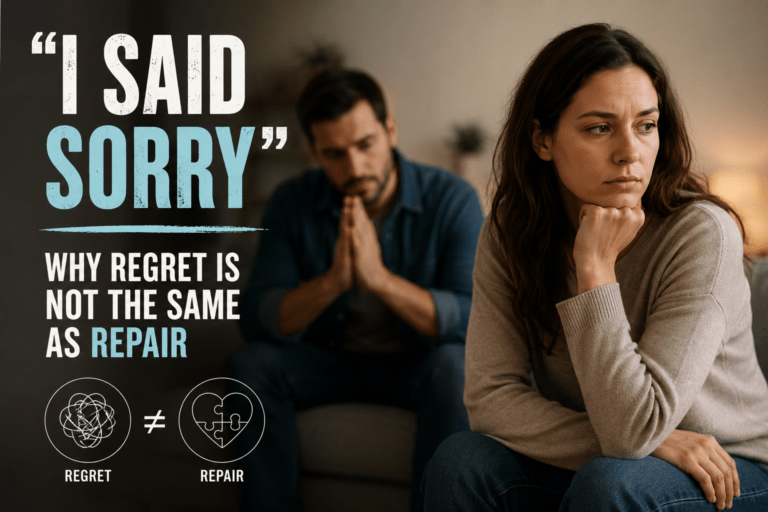
Because apologising after the fact is not the same as changing the pattern.
Because you may be repeating dynamics that cost you intimacy, trust, respect, and connection.
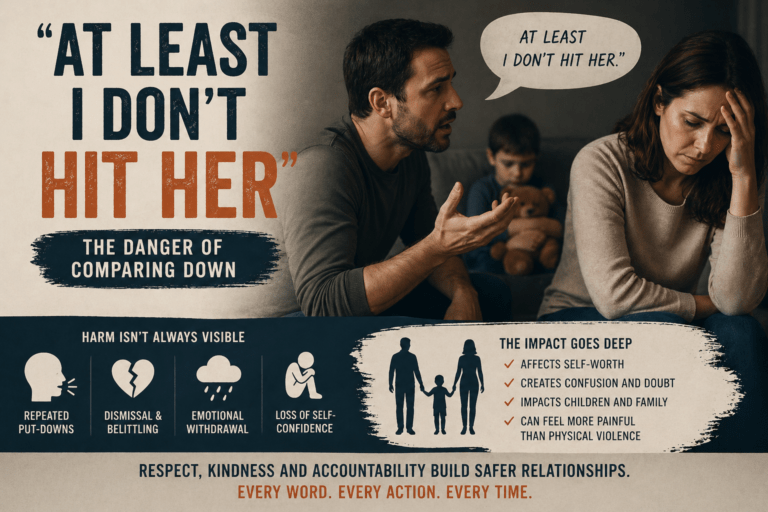
Because the standard is not merely, “I didn’t hit her.”
The standard is: Am I safe to live with, love, challenge, disagree with, and leave boundaries with? That is a much higher standard. And it should be.
A final word to men who are unsure
You do not need to wait until everything falls apart. You do not need a court order, a police charge, or a partner leaving before you take a serious look at yourself. And you do not need to think of yourself as a monster to recognise that something in the way you relate needs to change.
If you have ever said, “I’m not violent, I’d never hit a woman,” it may be worth asking what sits underneath that statement. Is it true accountability? Or is it the narrowest possible definition of harm?
A man willing to ask that question is already closer to change than a man who only defends himself. And that is often where meaningful work begins.