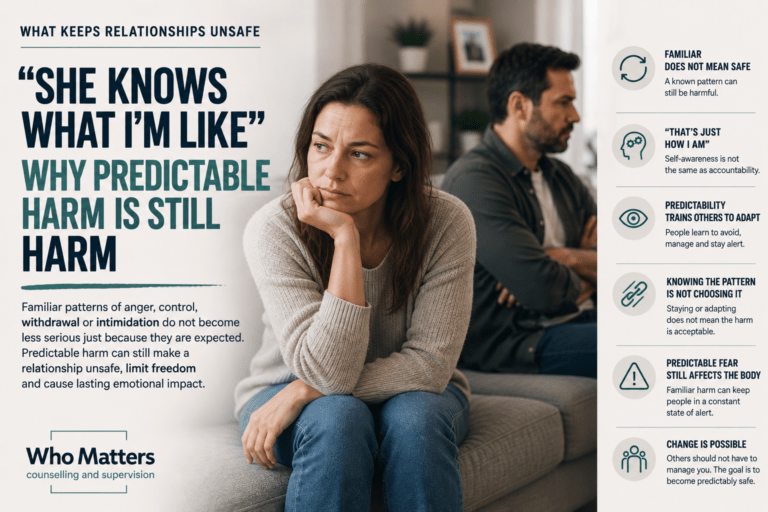

Fear and Aggression – Men and Women
When Fear Turns Into Aggression:
Is There a Difference Between Men’s and Women’s Use of Violence when experiencing fear?
Sometimes men say:
“I wasn’t trying to control her. I panicked.”
“I thought she was going to leave.”
“I just lost it.”
And sometimes women say similar things. So the question becomes:
Is violence ever driven by fear? And if so, is it different for men and women?
The short answer is this: Fear can drive aggression in anyone.
But the impact, meaning, and risk profile are often very different.
The Amygdala Override: When the Threat System Takes Over
The amygdala is part of the brain’s threat detection system.
When someone perceives:
- Abandonment
- Rejection
- Betrayal
- Loss of control
- Humiliation
the nervous system can shift into fight, flight, or freeze.
In that moment:
- Thinking narrows
- Reasoning reduces
- Urgency increases
- Emotional intensity spikes
This is sometimes described as “amygdala hijack.” It is real. But it does not remove responsibility. It explains activation — not behaviour.
Fear of Abandonment as a Trigger
Attachment insecurity can heighten reactivity.
For some men, perceived abandonment can activate:
- Panic
- Shame
- Loss of identity
- Fear of inadequacy
If emotional regulation skills are low, that fear may convert into:
- Intimidation
- Pursuit
- Blocking exits
- Phone monitoring
- Threats
- Property damage
- Physical aggression
The internal driver may be fear. The external behaviour may be control.
What About Women?
Women can also react aggressively when feeling:
- Abandoned
- Betrayed
- Unheard
- Powerless
In some cases, women may:
- Throw objects
- Hit
- Yell
- Scratch
- Engage in reactive violence
Fear-driven aggression is not male-exclusive. But this is where nuance matters.
The Power Context Changes the Meaning
While both men and women can experience amygdala override, three contextual differences are often present:
1. Physical Disparity
On average, men have greater physical strength.
Even if both partners are activated, the level of threat experienced is not symmetrical.
Fear-driven male aggression often carries greater risk of serious injury.
2. Coercive Control Patterns
Research consistently shows that men are more likely to engage in patterns of coercive control — ongoing behaviours that restrict, intimidate, or dominate.
In those contexts, fear of abandonment can trigger escalation within an existing pattern of power.
Whereas women’s violence is more frequently:
- Reactive
- Situational
- Occurring in self-defence or response to ongoing intimidation
This does not mean women cannot use coercive control. But statistically and structurally, the patterns differ.
3. Socialisation of Emotion
Many men are socialised to:
- Suppress vulnerability
- Avoid expressing fear
- Experience shame around dependence
So fear often converts quickly into anger. Anger is culturally more permissible for men than vulnerability.
For some women, fear may convert into:
- Protest behaviour
- Emotional escalation
- Clinging or pursuing
But again — context matters.
The Danger of “It Was Just Fear”
Sometimes men say:
“I was scared she would leave.”
That may be true. But fear does not justify:
- Intimidation
- Physical restraint
- Threats
- Coercion
- Violence
Fear explains activation. It does not excuse harm.
The key difference in behaviour change work is this: Are you willing to regulate your fear without making someone else responsible for calming it?
The Real Question
Instead of asking:
“Is men’s violence different from women’s?”
It may be more useful to ask:
- Is this behaviour part of a pattern of control?
- Who holds more power physically or structurally?
- Who is experiencing fear?
- Who is at greater risk of harm?
- Is the violence defensive, retaliatory, or coercive?
Those questions shift the conversation from biology to accountability.
What Behaviour Change Requires
If fear of abandonment triggers aggression, the work involves:
- Attachment awareness
- Emotional regulation skills
- Tolerance of rejection
- Tolerance of uncertainty
- Grief processing
- Identity work beyond relationship status
Most importantly: Learning that fear is survivable — and that no one else is responsible for managing it for you.
Final Reflection
Anyone can experience amygdala override. Not everyone uses that activation to dominate, control, or harm. The difference is not simply gender. It is power, pattern, and responsibility.
Fear may light the fuse. But choice still determines what happens next.
Further Reading
You may also find these articles helpful:
• Is It Really Just an Anger Issue? – Understanding how anger can mask patterns of control.
• Self-Regulation Tools for Conflict. – Practical grounding and breathing techniques to prevent escalation.