“I’m Not Like Her Ex”
Why Safety in Relationships Is About More Than Not Being Aggressive
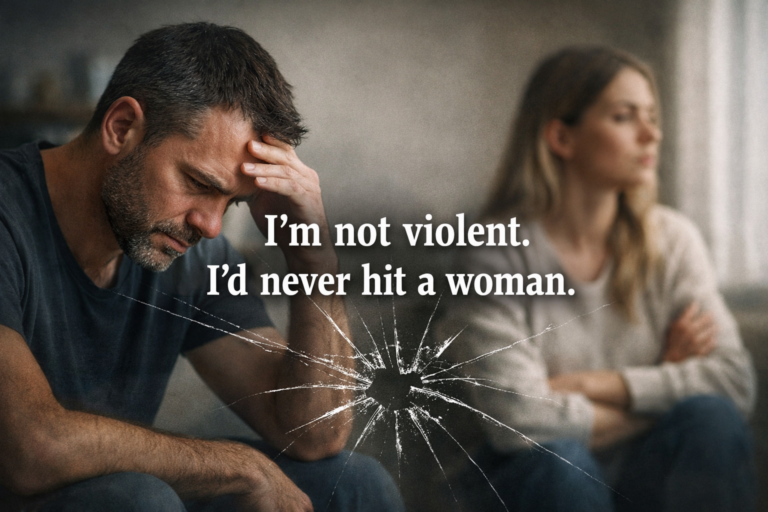
One of the more understandable, and often more defensive, things a man may say in relationships is this: “I’m not like her ex.”
Sometimes what he means is: “I don’t yell.”; “I don’t threaten her.”; “I don’t control her finances.” ;“I’ve never hit her.”; or “I’m not trying to dominate her.” And sometimes that may all be true.
He may not be overtly aggressive. He may not be coercive in the obvious ways. He may genuinely see himself as calmer, safer, and more respectful than the men who have hurt her before. So when she still seems guarded, fearful, mistrustful, or easily activated, he can feel confused. Sometimes resentful. Sometimes unfairly compared. Sometimes helpless.
He may think: “What more does she want from me?”, or even, “Why am I paying for what someone else did?”, and wondering “Why does she act like I’m dangerous when I’m not like that?”
These are real questions. But they can also become the beginning of a serious misunderstanding. Because safety in relationships is about more than the absence of obvious aggression. And being “not like her ex” is not, by itself, the same as being someone with whom she can deeply feel safe.
Not being the worst man she has known is not the same as being safe
This is one of the hardest truths for some men to accept.
A man may not be abusive in the way her previous partner was. He may not be violent. He may not scream, threaten, smash things, stalk her, or terrorise her. He may be far more restrained than the men who shaped her fear.
And still, she may not feel safe with him.
That does not necessarily mean he is doing something intentionally cruel. But it does mean that safety cannot be measured only by what he is not doing. Many men rely on a narrow internal defence: “I’m not aggressive, therefore I’m safe.”
A woman’s nervous system does not respond only to whether he has crossed some extreme line. It also responds to tone, pressure, unpredictability, entitlement, defensiveness, emotional withdrawal, contempt, impatience, and the subtle ways power moves through a relationship.
A man may not be “like her ex” and still:
- become punishing when hurt
- shut down or withdraw to make a point
- become cold when he does not get what he wants
- respond defensively when she raises concerns
- pressure her for reassurance
- become sulky or resentful around boundaries
- minimise her fear because it feels unfair to him
- treat her trauma responses as accusations against his character
- expect trust before he has helped build it
None of these things may look like overt aggression. But they can still make safety difficult.
Trauma does not disappear just because the current partner is calmer
A woman who has lived with coercion, intimidation, betrayal, contempt, chronic criticism, or violence often carries more than memories into a new relationship. She may carry an altered nervous system.
Her body may have learned to scan for danger before her mind has fully named it. She may notice shifts in tone, tension, silence, facial expression, disappointment, sexual pressure, or emotional distance long before she can explain why they affect her so strongly.
This does not mean she is irrational. It means she has learned, often through painful experience, that danger does not always arrive loudly at first.
Sometimes it begins with:
- walking on eggshells
- feeling watched
- not being able to say no without fallout
- having emotions turned against you
- being blamed for another person’s reactions
- sensing that care is conditional
- realising that one person’s hurt always becomes the central emergency
A past relationship may have taught her that “small” signs matter. So may a childhood spent around rage, volatility, addiction, criticism, emotional unpredictability, or fear.
If a man does not understand trauma, he may interpret her caution as mistrust, unfairness, or emotional baggage she should fix on her own. Trauma often lives in the body before it becomes language. It lives in hesitation, vigilance, startle, appeasement, over-explaining, self-doubt, and difficulty settling fully into closeness.
A new partner may not have caused those responses. Regardless, he still has to decide what kind of man he will be in the presence of them.
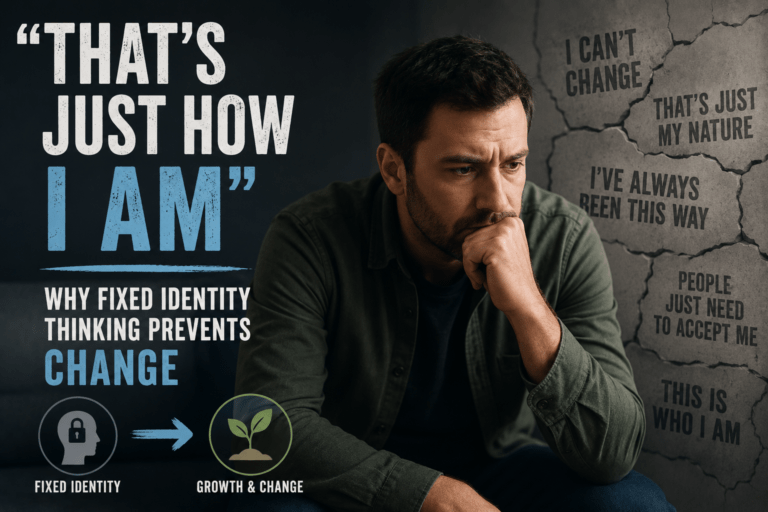
The wrong response is: “That’s your trauma, not me”
This is where many men lose the opportunity for maturity. When a woman becomes fearful, guarded, or overwhelmed, a man may protect himself with some version of:
“That’s about your past, not me.”
At one level, he may be partly right. Her past likely does matter. However, when said defensively, this sentence often functions as dismissal rather than understanding. It says: Your reaction is inconvenient to me. Your fear is misdirected. And, I should not have to examine my impact because I did not create the original wound. That stance may protect his innocence, but it does not build safety.
Because even if he did not create the trauma, he is now participating in the relational environment in which that trauma is being reactivated, soothed, deepened, or healed.
The more mature question is not: How do I prove I’m not the problem?
It is: What happens in me when her fear shows up?
Do I become offended? Do I demand reassurance? Do I need credit for not being abusive? Do I collapse into self-pity? Do I become impatient because her pain is not moving on my timeline? or Do I subtly pressure her to trust me faster than she can?
These are relational questions. And they matter.
Some men want trust without understanding what trust requires
A man may genuinely believe he deserves trust because he is better than the men who came before him. Trust is not built by comparison. It is built by repeated experiences of safety.
A woman with trauma may not be able to relax simply because a man tells her he is different. She may need to experience, over time, that:
- her boundaries are respected without punishment
- her no remains safe
- difficult conversations do not become retaliatory
- her emotions are not mocked or managed
- his hurt does not become coercive
- his kindness does not vanish when he feels insecure
- he can tolerate misunderstanding without becoming dangerous
- he does not make her responsible for proving his goodness
This can be humbling for men, especially those who think of themselves as the “good guy.” But humility is often exactly what is needed.
A man’s frustration may sound like: I’m doing everything right and it’s still not enough.
However, often what he means is: I’m not getting quick recognition for not being overtly harmful.
Safety asks for more than that.
Why men’s behaviour change counselling can still be helpful
This is exactly where some men become confused about whether counselling is relevant. They may think: Men’s behaviour change counselling is for violent men, controlling men, abusive men. That’s not me. I’m just in a relationship with someone who has trauma.
That framing is often too limited.
Men’s behaviour change counselling can be valuable not only for men who are overtly abusive, but for men who need to better understand power, impact, accountability, emotional regulation, defensiveness, entitlement, and what relational safety actually requires.
A man may benefit from this work if:
- he becomes defensive when his partner feels unsafe
- he uses “I’m not like her ex” to avoid examining his own behaviour
- he struggles to tolerate her boundaries without taking them personally
- he becomes resentful about the time trust is taking
- he pressures for closeness or reassurance when she is dysregulated
- he interprets her fear as an insult rather than information
- he withdraws, punishes, or sulks when he feels unfairly judged
- he wants credit for not being violent while overlooking more subtle impacts
This is not about unfairly labelling a man as “the same” as an abusive ex. It is about recognising that being in relationship with trauma requires more than good intentions. It requires steadiness, humility, patience, self-reflection, and the ability to be accountable for impact without collapsing into shame or defence.
A woman’s trauma history does not cancel a man’s responsibility
This is the nuance that matters most. Yes, a woman may feel unsafe partly because of what happened before this relationship. And, yes, her nervous system may react strongly even when a current partner is not overtly aggressive. Past trauma may make safety slower to build.
But none of that means the man’s role becomes irrelevant.
In fact, a man’s response to her fear may tell us a great deal about how safe he actually is.
- Does he get curious, or offended?
- Does he slow down, or apply pressure?
- Does he listen, or argue the facts?
- Does he respect her pacing, or insist she is being unfair?
- Does he make room for her experience, or turn it into a conversation about his innocence?
- Does he become steadier, or more punishing when he feels misread?
These questions matter because trauma survivors are often exquisitely sensitive to whether another person can tolerate not being immediately trusted.
A man who needs to be seen as safe, rather than becoming safe in practice, may end up reproducing pressure in a different form.
Safety is not built by demanding that the fear disappears
Some men respond to trauma in relationships as though the goal is simply to get rid of the woman’s fear as quickly as possible. They want reassurance that they are not the problem. They want a cleaner emotional atmosphere. And, they want to move past the discomfort of being met with caution.
Fear does not disappear on command. And when a man becomes impatient with it, he often adds another layer of unsafety. Safety is built more slowly than that.
- It is built when he does not retaliate for her caution.
- It is built when he remains respectful during her boundaries.
- It is built when he can hear hurt without immediately defending his intentions.
- It is built when his care remains intact even when he is disappointed.
- It is built when his emotional pain does not become an obligation she must manage.
- It is built when she learns, repeatedly, that honesty with him will not cost her.
The paradox is that the more a man tries to force trust, the less trustworthy he often feels.
Men do not need to be the cause of trauma to become part of the healing or the harm
This may be one of the most important things to say. A man does not need to have caused the original wound in order to affect whether it deepens or heals. He may not be responsible for what happened in her childhood. He may not be responsible for her abusive ex. He may not be responsible for the fear her body carries into the present.
He is responsible for how he responds to all of that now. He can become part of a different relational experience. Or he can become another person who demands that his own comfort take priority over her sense of safety. He can help create conditions where her nervous system gradually learns: I can speak here. I can say no here. I can bring up hurt here. I can be uncertain here. I do not have to manage him in order to stay connected.
Or he can reinforce an older lesson: His feelings matter more than my safety. I must make him comfortable before I can be honest.
That is why this work matters.
A better question for men to reflect on
Instead of asking:
“Why doesn’t she see that I’m not like her ex?”
A better question may be:
“What is it like for her to be close to me?”
Does she feel pressure from me? Does she have to manage my reactions? Do I become cold when I feel insecure? Can she tell me the truth without fallout? Do I treat her fear as information, or as an accusation? Am I patient enough to let trust grow at the speed of safety? Can I be accountable for my impact without needing to be cast as a villain first?
Those are the questions that move a man beyond self-defence and into maturity.
Final reflection
“I’m not like her ex” may be true. It may even matter a great deal. It is not the whole story.
Because safety in relationships is not built only on the absence of obvious aggression. It is built on how a person responds to vulnerability, fear, boundaries, hurt, difference, and uncertainty. It is built on what happens when trust is not automatic. It is built on whether another person can remain fully themselves in your presence without paying a relational price.
A man does not need to be overtly aggressive to have work to do. And men’s behaviour change counselling can be deeply helpful for men who want to understand this more honestly.
Not because they are necessarily the same as the men who came before them.
But because “not being him” is not the same as becoming someone truly safe.
And for many men, that is where the deeper work begins.