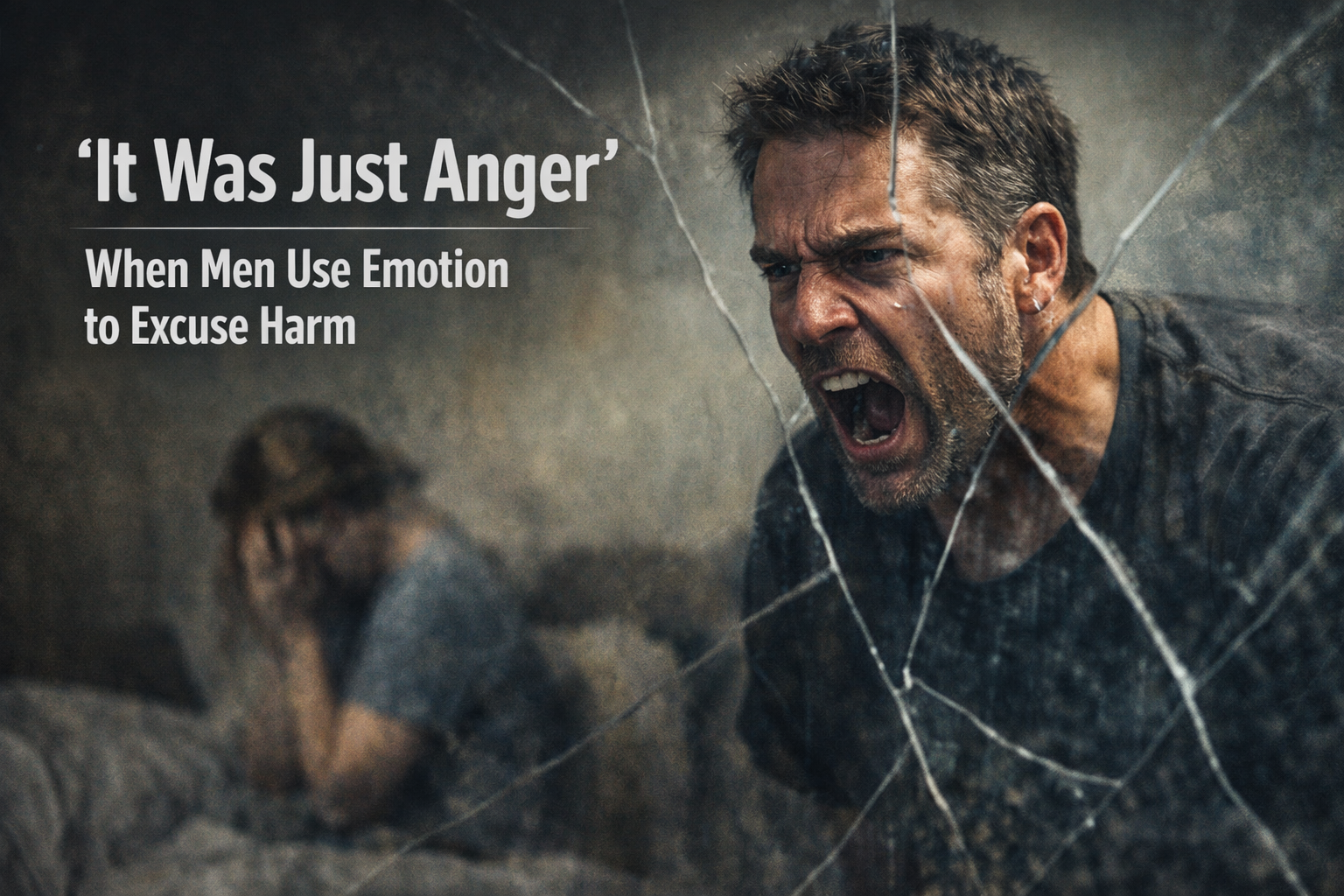
“It Was Just Anger”: When Men Use Emotion to Excuse Harm
“It was just anger.”; Men say this in many different ways. Sometimes “I was frustrated.”; “I snapped.”; “I lost it.”; “I was under pressure.”; “I was overwhelmed.”; “I didn’t mean it.”; “I was just angry.” – regardless the underlying meaning is the same…
Often, this story is used to explain behaviour after the damage has already been done. After the yelling. After the intimidation. After the insults. After the threats. After the smashed door, the punched wall, the reckless driving, the fear in the room, the silence from a partner, or the look on a child’s face.
Anger is real. It is a human emotion. Everyone feels it. But anger is not a free pass.
And one of the most common ways men avoid looking closely at harmful behaviour is by treating anger as if it caused the harm all by itself.
It didn’t.
Anger may be present, but anger alone does not explain abuse, intimidation, control, or cruelty. And it certainly does not excuse them.
Anger is a feeling. Harm is a choice!
This is one of the most important distinctions many men have never properly been taught.
Anger is an emotion. Harmful behaviour is action.
Feeling angry is not the same as yelling at someone. Feeling hurt is not the same as threatening someone. Feeling rejected is not the same as cornering, blaming, interrogating, or controlling a partner. Feeling overwhelmed is not the same as making everyone else in the house manage your moods.
The story “it was just anger” blurs that distinction. It turns behaviour into something accidental, almost unavoidable, as though the emotion itself climbed into the driver’s seat and took over. But that is rarely the full truth.
Many men who say they “lost control” during conflict still make selective choices in those moments. They may scream at their partner but not at their boss. They may smash their own property but not damage something they value. They may terrify the people closest to them but regain composure when police arrive, when visitors knock, or when they are in public.
That does not mean the anger was fake. It means the behaviour was not as uncontrollable as they want to believe.
“I was angry” often hides more than it reveals
Sometimes anger is treated like the whole story, when really it is just the surface. Underneath anger there may be entitlement, or a value or belief we hold that we may, or may not, be aware of.
A belief that:
- a partner should not speak to him that way
- he should not be questioned
- he should not be challenged
- he should not be expected to tolerate discomfort
- his needs should come first
- his partner should calm him down, reassure him, or comply
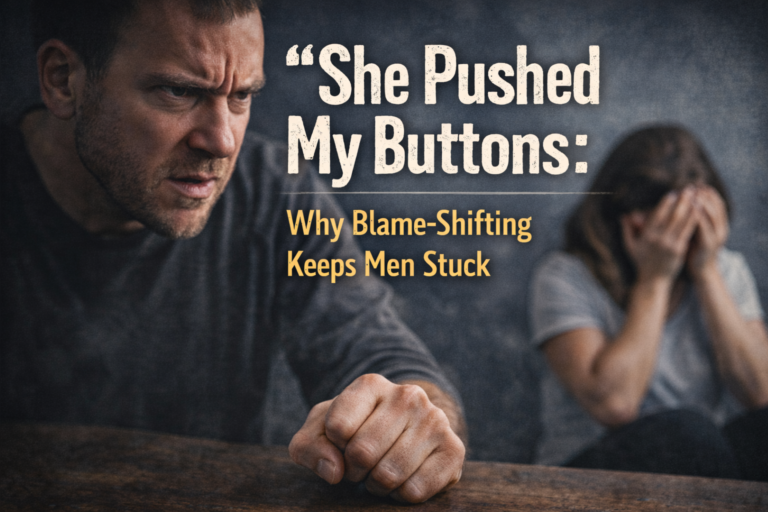
Underneath anger there may be blame. Comments like “She knows how to push my buttons.”; “She wouldn’t let it go.”; “She disrespected me.”; “She kept nagging.”; “She should’ve stopped.”Underneath anger there may be an expectation that other people must carry the burden of his emotions.
That is where anger becomes dangerous in relationships. Not because anger exists, but because it gets used as a shield for patterns of power, blame, intimidation, and avoidance of responsibility.
Anger is often used to make harm sound smaller
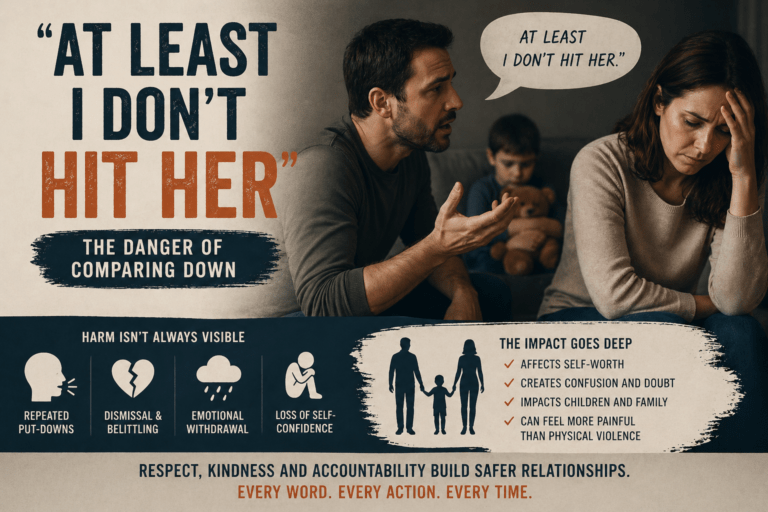
“It was just anger” sounds temporary. Almost harmless. Almost normal. But what does “just anger” actually look like in a relationship?
Sometimes it looks like:
- yelling in someone’s face
- swearing and name-calling
- punching walls or slamming doors
- looming over a partner
- throwing objects
- demanding answers
- blocking someone from leaving
- threatening to take the children
- driving aggressively during arguments
- sending dozens of angry messages
- giving the silent treatment as punishment
- blaming a partner for his outburst
- expecting immediate forgiveness because he has “calmed down now”
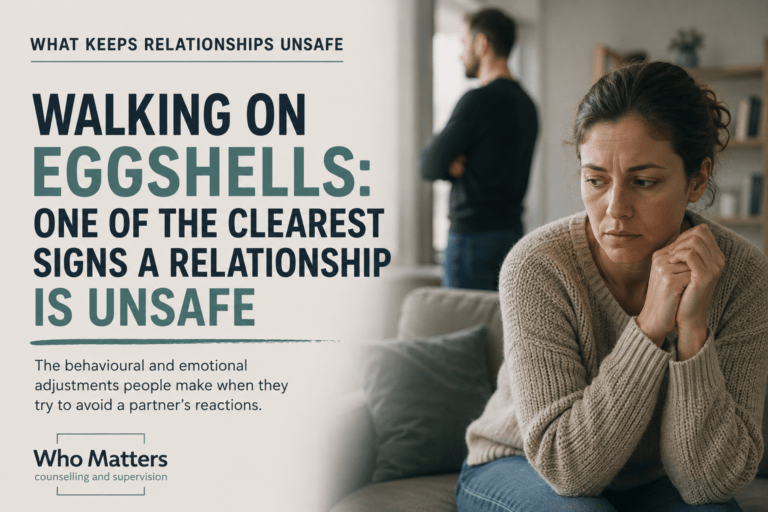
Calling this “just anger” minimises the impact. For the person on the receiving end, it may feel like fear. It may feel like intimidation. It may feel like walking on eggshells. It may feel like having to monitor tone, timing, facial expressions, and every word in order to avoid setting him off again.
So while the man may describe the event as anger, the family may have experienced it as threat. And that difference matters.
Intent does not erase impact
Many men defend themselves by pointing to intention. “I wasn’t trying to scare her.”; “I was just venting.”; “I didn’t mean what I said.”; “I would never actually do anything.”; “I just needed to let it out.” But people do not experience us based only on what we meant. They experience us based on what we do.
You may not have intended to frighten your partner, but if she goes quiet when your voice changes, that matters. You may not have intended to intimidate your children, but if they freeze, hide, or become hyper-alert when you are upset, that matters. You may not have intended to control the relationship, but if everyone rearranges themselves around your moods, that matters.
Impact tells the truth that intention often tries to soften.
“I lost control” is often not the whole story
A lot of men genuinely believe this line. And sometimes anger can feel explosive, fast, and overwhelming. But behaviour change work often asks a difficult question:
Did you lose control, or did you give yourself permission?
That question can be confronting because often, what men call loss of control is actually a collapse of restraint in the place where they feel most entitled to let go. The partner becomes the safest target. The family becomes the emotional dumping ground. Home becomes the place where he believes he should not have to regulate himself.
That is not the same as losing all control. In fact, many men still show signs of selectivity:
- they stop short of certain actions
- they adjust the intensity depending on the audience
- they save the behaviour for private settings
- they recover quickly when consequences appear
Again, this does not mean the emotion is invented. It means anger is being used in a patterned way, not simply erupting at random.
Anger management is not always enough
Some men hear feedback about their behaviour and quickly conclude, “I just need anger management.” Sometimes they do need support with emotional regulation. Learning to notice escalation, slow down, tolerate frustration, and step away safely can be useful. The question to really ask yourself is “Do I ‘lose control’ with other people” (work colleagues, Friends)?
But many relationship problems described as “anger issues” are not only about anger. They are about:
- entitlement
- control
- defensiveness
- disrespect
- jealousy
- blame
- rigid beliefs about gender and authority
- expecting a partner to absorb emotional fallout
- using anger to dominate conflict
If the underlying pattern is about power and control, then anger management alone will not reach the core of the problem. A man can learn breathing exercises and still be coercive. He can learn to count to ten and still be degrading. He can stop shouting and still punish, monitor, manipulate, or intimidate.
Real change often requires more than calming down. It requires examining what sits underneath the anger and how he uses it in the relationship.
Some men use anger to avoid more vulnerable truths
Anger can also be a cover for shame, fear, insecurity, rejection, grief, humiliation or powerlessness.
Many men are socialised to express only a narrow range of emotion safely. Sadness may feel weak. Fear may feel humiliating. Hurt may feel unbearable. So those feelings come out sideways, through anger.
That may help explain the emotion. It still does not excuse what is done with it. In fact, part of maturity is learning to say: “I felt rejected.”; “I felt ashamed.”; “I felt scared.”; “I felt out of my depth.”; “I felt helpless.” without turning those feelings into punishment for someone else.
That is strength. Not the performance of anger. The capacity to stay responsible inside difficult emotion.
Children learn from a man’s anger even when he says it is not about them
Men sometimes minimise their behaviour around children because they tell themselves: “I never touched them.”; “They weren’t involved.”; “They were in the other room.”; “They’re too young to understand.”; “It was between me and their mother.” But children do not need a full explanation to feel the atmosphere in a house. They hear tone. They notice tension. They watch faces. They learn when to stay quiet. They learn whether home feels calm or unpredictable.
A father’s anger teaches children powerful lessons about relationships, safety, and power. It teaches sons what manhood can look like. It teaches daughters what they may have to accommodate. It teaches all children whether love comes with intimidation, volatility, or fear.
Saying “it was just anger” does nothing to reduce that impact.
Taking responsibility means saying more than “I was angry”
There is a difference between explanation and accountability.
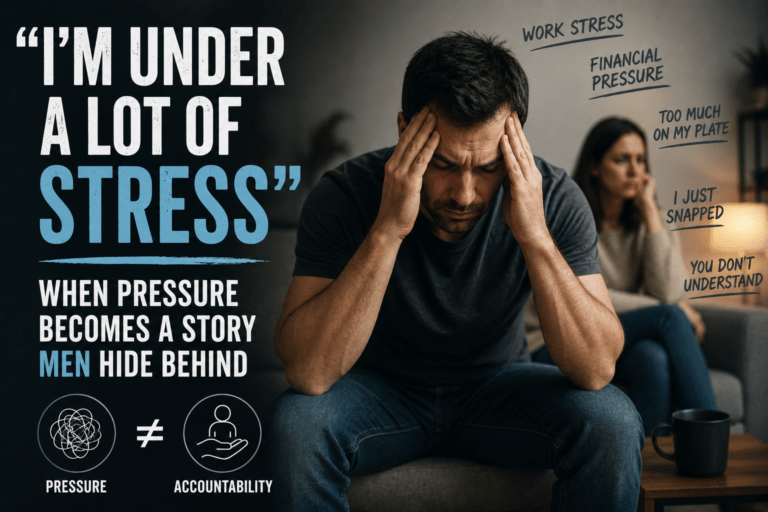
An explanation sounds like: “I was stressed.”; “I’d had a lot going on.”; “I was angry.”; “I didn’t mean it.”
Accountability sounds more like: “I used my anger in a way that frightened and harmed people.”; “I blamed my emotions instead of owning my behaviour.”; “I expected others to absorb the impact of my distress.”; “I minimised what happened by calling it just anger.”; “I need to understand the pattern and change it.”
That second kind of language is harder. It is also more honest, because change does not begin when a man proves he had reasons for being upset. It begins when he stops using those reasons to excuse what he did.
What real change looks like
Real change is not simply promising to “work on my anger.”
It looks more like:
- recognising escalation earlier
- stepping away before intimidation begins
- refusing to blame a partner for your feelings
- learning to tolerate frustration without punishing others
- identifying entitlement and control beneath the anger
- listening to the impact without arguing about intent
- repairing through consistent changed behaviour, not apologies alone
- becoming a person whose emotions do not make others unsafe
That is the work. Not suppressing emotion. Not pretending never to get angry. But learning that anger does not entitle you to harm.
A final reflection
If you have ever said, “It was just anger,” it may be worth asking what that sentence protects.
Does it protect you from shame or accountability? Or maybe from looking at patterns you do not want to name? Or seeing the fear, caution, or exhaustion your behaviour creates in others?
Anger is real. Stress is real. Pain is real. But none of those things make harmful behaviour disappear.
The question is not whether you were angry. The question is what you did with that anger, who carried the cost of it, and what story you keep telling yourself so you do not have to look too closely. Sometimes the most important shift a man can make is this one:
From
“I was angry, so of course it happened.”
to
“I was angry, and I am still responsible for what I chose to do.”
That is where honesty begins. That is where safety begins. And that is where real behaviour change starts.