Being Calm Is Not the Same as Being Safe
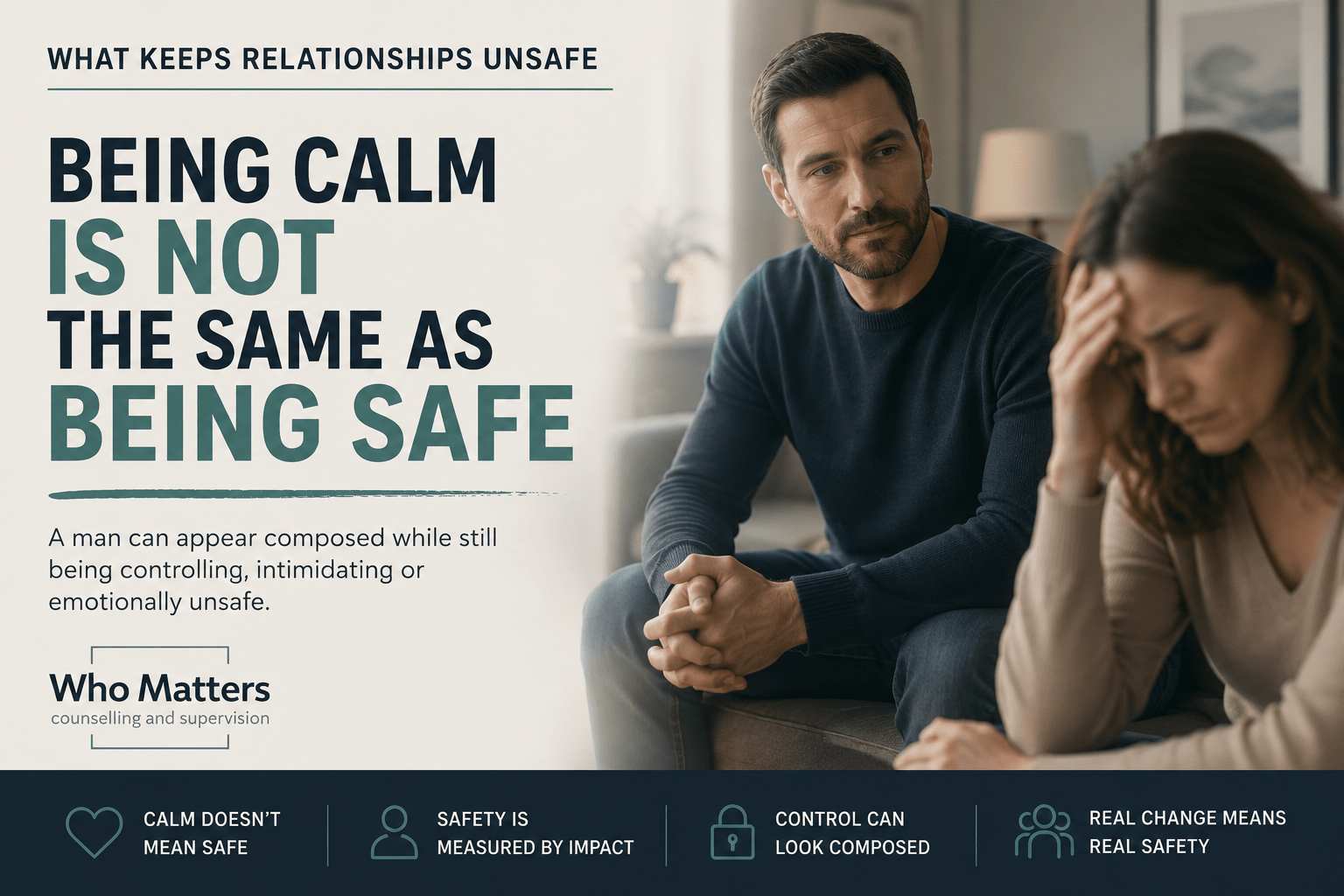
A man can be calm and still be unsafe. He may not yell. He may not swear. He may not punch walls, slam doors, throw objects, or make obvious threats. He may speak quietly, appear rational, and describe himself as the reasonable one. But calmness is not the same as safety.
This matters because many people misunderstand what unsafe behaviour looks like in relationships. They imagine abuse as explosive, chaotic, aggressive, and visibly out of control. Sometimes it is. But sometimes unsafe behaviour is controlled, deliberate, quiet, and difficult to name. A man can be composed while still being controlling. He can be calm while still being intimidating. He can be polite while still making his partner feel trapped, small, confused, or afraid.
Safety is not measured by how controlled a man appears on the outside. Safety is measured by the impact his behaviour has on the people closest to him.
Calm Can Still Be Controlling
There is a type of calmness that is healthy. It helps people slow down, listen, take responsibility, and respond with care. But there is also a type of calmness that functions as control.
This can look like:
- speaking in a measured tone while refusing to let the conversation end
- calmly questioning someone until they doubt themselves
- quietly correcting, criticising, or undermining a partner’s perspective
- using silence to punish or create anxiety
- presenting as reasonable while making the other person appear irrational
- saying “I’m calm, you’re the one escalating”
- withholding affection, money, help, information, or cooperation
- using legal, parenting, or system language to pressure or intimidate
- staying emotionally flat while the other person becomes increasingly distressed
In these situations, the issue is not volume. The issue is power. A man may believe he is being safe because he is not yelling. But if his partner feels unable to speak freely, leave the conversation, disagree, say no, or hold a different view, then the interaction may still be unsafe.
Calmness does not cancel out control.
The “Reasonable Man” Position
Some men learn that looking calm gives them credibility. They may say: “I was calm the whole time.”, “She was the one yelling.”, “I didn’t threaten her.”, “I was only asking questions.”, or “I don’t know why she reacted like that.” From the outside, this can sound convincing. He may appear thoughtful, articulate, and composed. His partner, meanwhile, may look anxious, angry, overwhelmed, avoidant, or emotional.
But her reaction may not be evidence that she is unsafe. It may be evidence that she does not feel safe. If someone has been pressured, monitored, manipulated, blamed, intimidated, or worn down over time, their body may respond before they can explain why. They may become tearful, defensive, shut down, or angry because the pattern has taught them that the conversation is not truly safe.
A man who has used control may focus on the visible reaction rather than the behaviour that created it. He may say, “Look how upset she is,” instead of asking, “What have I done over time that means she now feels this way around me?” That shift is central to behaviour change.
Emotional Unsafety Is Not Always Loud
A relationship can feel emotionally unsafe even when there is no shouting.
Emotional unsafety can be created through:
- dismissing feelings
- minimising harm
- turning every concern into a debate
- making the other person prove their pain
- becoming cold or distant when challenged
- using shame, guilt, or disappointment to control
- making repair conditional on the other person dropping the issue
- focusing on intent while avoiding impact
- using counselling language without genuine accountability
A man may say, “I was just explaining myself,” when the actual impact is that his partner feels exhausted, unheard, and pressured to let it go. He may say, “I didn’t raise my voice,” while ignoring that he followed her from room to room, blocked the conversation from ending, sent repeated messages, or refused to accept her boundary. He may say, “I was calm,” while using his calmness to make her distress look unreasonable.
This is why safety has to be understood from the perspective of the person experiencing the behaviour, not only the person describing it.
Intimidation Can Be Quiet
Intimidation is not only shouting, threatening, or physical aggression. Intimidation can be conveyed through posture, proximity, facial expression, silence, timing, repetition, or history. A man may not need to say much at all for his partner to understand the message. A look across the room may be enough. A pause before answering may be enough. A calm statement like “We’ll talk about this later” may be enough. A text saying “I know where you are” may be enough.
A man who has previously used violence, threats, rage, punishment, or control cannot assume that a calm tone makes his behaviour neutral. The history of the relationship changes how his behaviour is experienced. If someone has learned that disagreement leads to consequences, they may feel unsafe even when the current interaction looks quiet. This does not mean he is responsible for every feeling his partner has. It means he is responsible for understanding that his past behaviour has shaped the present relationship.
Trust does not reset because he is calm today.
The Difference Between Regulation and Control
Healthy calmness comes from emotional regulation. Unsafe calmness often comes from control.
Regulation says:
- “I can feel uncomfortable and still respect your boundary.”
- “I can pause without punishing you.”
- “I can listen without needing to win.”
- “I can accept that you see it differently.”
- “I can take responsibility without making you manage my shame.”
Control says:
- “I will stay calm so I can stay in charge.”
- “I will keep questioning until you give in.”
- “I will make you look irrational.”
- “I will decide when this conversation is finished.”
- “I will appear reasonable while still getting my way.”
The difference is not always obvious from the outside. But it is usually felt inside the relationship. A regulated man creates more room for honesty, choice, and repair.
A controlling man narrows the other person’s options, even if he does it quietly.
Calm Apologies Can Still Be Unsafe
An apology can sound calm and still avoid responsibility. For example: “I’m sorry you felt that way.” or “I’m sorry, but I wouldn’t have reacted if you hadn’t pushed me.”, and then maybe “I’ve already apologised. I don’t know what else you want.” or “I’m trying, but you keep bringing up the past.”
These statements may be delivered softly. They may even sound mature. But they shift the focus away from accountability and toward ending the discomfort for him. A safe apology does not pressure the other person to move on. A safe apology does not demand trust. A safe apology does not make the harmed person responsible for the repair.
A safer apology sounds more like:
- “What I did was not okay.”
- “I understand that my behaviour affected your sense of safety.”
- “I am not asking you to trust me because I apologised.”
- “I need to show change consistently over time.”
- “I will respect your boundaries even if I feel disappointed.”
The tone matters, but the structure matters more.
A calm apology that avoids accountability is not safer than an emotional apology that takes genuine responsibility.
When Calmness Becomes Image Management
Some men are very invested in being seen as “not that kind of man.” They may want workers, family, friends, courts, or services to see them as calm, cooperative, and misunderstood. They may present well in appointments. They may use the right language. They may describe insight, growth, and regret.
Those things may be genuine. But they can also become image management. Image management happens when a man is more focused on how he is perceived than on the impact of his behaviour. He may want others to know he is doing counselling, working on himself, or even not becoming angry anymore.
But the more important questions are:
- Is he respecting boundaries when no one is watching?
- Is he accepting consequences without retaliation?
- Is he allowing his partner freedom and privacy?
- Is he parenting without using the children as a pathway to control?
- Is he telling the full truth about his behaviour?
- Is he changing when he does not get praise, access, reassurance, or forgiveness?
Real safety is not performed. It is lived.
What Safety Actually Requires
Safety requires more than appearing composed. It requires a change in entitlement; a change in beliefs; a change in how a man responds when he feels rejected, criticised, ashamed, jealous, powerless, or afraid. It requires him to stop using his emotions as a reason to control someone else. It requires him to understand that his partner’s boundaries are not an attack. It requires him to accept that her fear, distance, anger, or lack of trust may be a consequence of his behaviour. It requires him to stop measuring change by how calm he feels and start measuring change by how safe others are to be honest around him.
A safer man does not just stop yelling. He stops pressuring. He stops punishing. He stops monitoring. He stops manipulating. He stops making himself the victim of the consequences of his own behaviour.
He becomes more interested in the truth than in being seen as good.
Questions Men Can Ask Themselves
If you are a man trying to change, it may be useful to ask:
- Can my partner say no to me without consequences?
- Can she end a conversation without me following, texting, calling, or escalating?
- Can she disagree without me trying to wear her down?
- Can she have privacy without me becoming suspicious or punitive?
- Can she express hurt without me defending myself immediately?
- Can she make choices I do not like without me trying to control the outcome?
- Can I stay accountable even when I feel misunderstood?
- Can I accept that being calm does not automatically mean I am being safe?
These questions are uncomfortable. They are also necessary. Because the goal is not to look calm.
The goal is to become safe.
Safety Is Measured by Impact
In relationships, calmness can be valuable. It can help slow conflict down. It can create space for listening, reflection, and repair.
But calmness is only safe when it is connected to respect, freedom, honesty, accountability, and care.
A calm man who still controls is not safe.
A calm man who still intimidates is not safe.
A calm man who still manipulates the story is not safe.
A calm man who still punishes boundaries is not safe.
Being safe means the people close to you have more room to breathe, speak, choose, disagree, and be themselves. That is the measure. Not whether you raised your voicer you stayed composed. Not whether you believe your intentions were good. But whether your behaviour increases or decreases the freedom, dignity, and safety of the people around you.