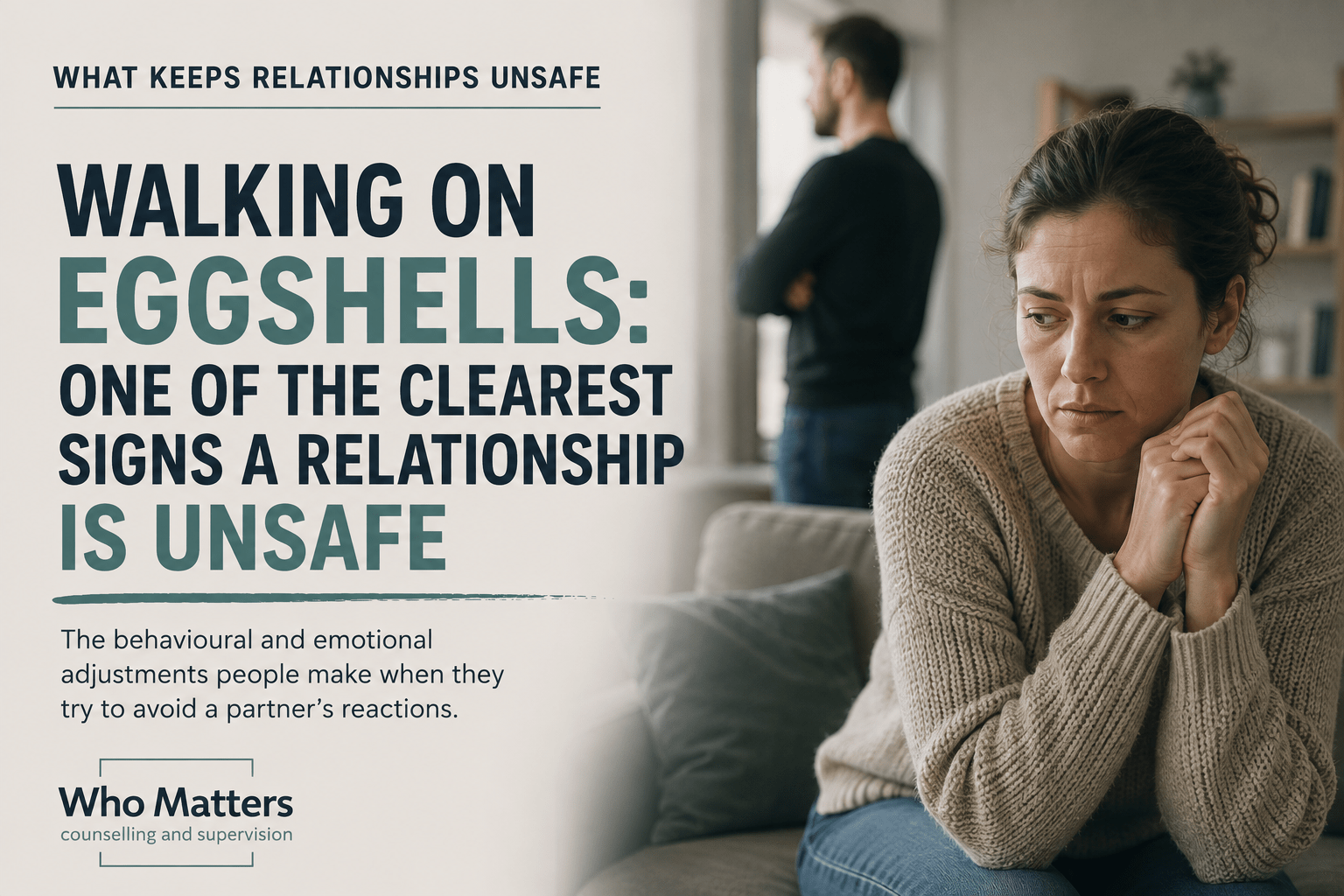
Walking on Eggshells: One of the Clearest Signs a Relationship Is Unsafe
One of the clearest signs that a relationship has become unsafe is when one person starts walking on eggshells.
This does not always mean they are physically afraid. It can mean they are emotionally exhausted. It can mean they are constantly monitoring the other person’s mood. It can mean they are choosing words carefully, avoiding certain topics, hiding normal feelings, or changing their behaviour to prevent a reaction.
Walking on eggshells is what happens when someone learns that honesty, independence, disagreement, or ordinary needs may come with consequences. Those consequences might be obvious, such as yelling, threats, intimidation, insults, or violence. But they may also be quieter: withdrawal, sulking, interrogation, blame, guilt, coldness, repeated questioning, accusations, emotional shutdown, or making the other person feel responsible for restoring peace. Either way, the pattern is the same. One person becomes less free so the other person does not react.
That is not safety.
What Walking on Eggshells Can Look Like
Walking on eggshells is not always visible from the outside. Friends, family, workers, or colleagues may not see it. The relationship may even look calm. There may be no obvious arguments in public. The person causing fear or tension may appear reasonable, helpful, polite, or composed. But inside the relationship, the other person may be constantly adjusting.
They may think carefully before speaking. They may rehearse how to raise an issue. They may wait for the “right time” to talk, even though the right time never really comes. They may avoid saying no. They may agree to things they do not want. They may hide messages, purchases, plans, feelings, mistakes, or ordinary decisions.
Over time, walking on eggshells can become so normal that the person may not describe it as fear. They might say: “I just don’t want to set him off.”, “It’s easier if I don’t bring it up.”, “It’s not worth it.”, or “I’ll just deal with it myself.”
These are not signs of a healthy relationship. They are signs that someone has learned to manage another person’s reactions.
The Behavioural Adjustments People Make
When someone is walking on eggshells, they often make practical changes to reduce the chance of conflict. They may change what they say, where they go, who they see, what they wear, how they parent, how they spend money, or how much information they share.
They may avoid friends or family because it causes tension. They may keep their phone nearby so they do not miss a call. They may stop raising concerns because every issue becomes a bigger issue. They may clean the house a particular way, manage the children’s behaviour, or organise routines around the other person’s mood.
They may become overly apologetic. They may explain themselves in too much detail.
This can look like cooperation from the outside. It may even be mistaken for care, loyalty, or being “easygoing.” But the difference is choice. In a safe relationship, people make adjustments because they want to care for each other. In an unsafe relationship, one person makes adjustments because they are trying to avoid consequences.
That is a very different emotional reality.
The Emotional Adjustments People Make
Walking on eggshells is not only about behaviour. It also changes a person’s internal world. They may start to doubt themselves. Maybe they become hyper-alert to tone, facial expression, silence, movement, or timing. Perhaps, they may feel anxious when their partner comes home or seem relieved when their partner leaves.
They may think, “I should have said it differently,” rather than, “He is responsible for how he responded.”
This is one of the damaging effects of unsafe relationship patterns. The person who is being impacted often ends up doing the emotional labour of preventing harm, repairing harm, and explaining harm. Meanwhile, the person causing the harm may say: “I didn’t do anything.”, or shift the blame by saying “You’re too sensitive.”, “You always make me the bad guy.”, “I only reacted because you pushed me.”
Statements like these shift responsibility. They train the other person to focus less on the behaviour itself and more on how to avoid it next time.
That is how walking on eggshells becomes a pattern.
“I’m Just Trying to Avoid Conflict”
Many people walking on eggshells describe their behaviour as conflict avoidance. They may not initially identify the relationship as unsafe. They may say they are just trying to keep things calm. But there is an important difference between choosing your battles and losing your freedom.
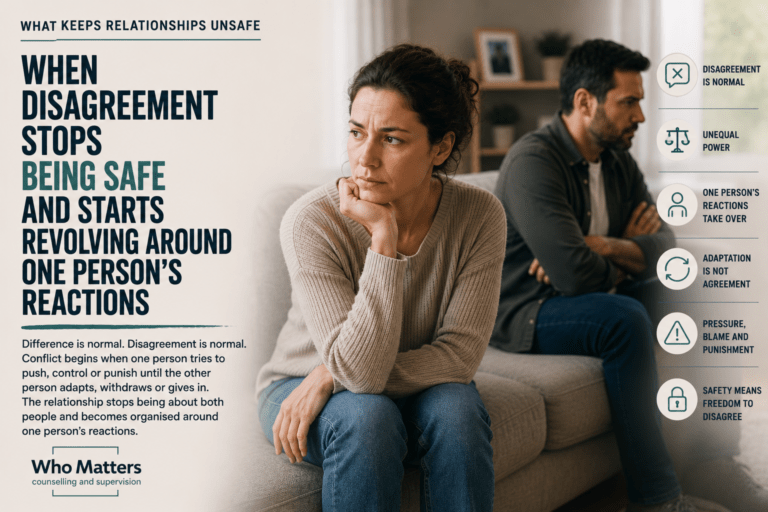
In every relationship, people sometimes let small things go. That is normal. It becomes unsafe when one person repeatedly silences themselves because the other person’s reaction feels too costly. It becomes unsafe when peace depends on one person not having needs. It becomes unsafe when the relationship only feels okay when one person is managing, placating, reassuring, or complying.
Avoiding conflict may reduce tension in the short term. But over time, it often increases fear, resentment, disconnection, and exhaustion.
The relationship may look calmer on the surface, but the safety has not improved.
The silence is not peace.
It is adaptation.
Walking on Eggshells and Coercive Control
Walking on eggshells is often connected to coercive control. Coercive control is not only about isolated incidents. It is about patterns of behaviour that limit another person’s freedom, confidence, choices, and sense of self.
A person may walk on eggshells because they have learned that certain choices lead to consequences. Seeing friends may lead to suspicion. Spending money may lead to interrogation. Raising concerns may lead to blame. Saying no may lead to punishment. Needing space may lead to accusations. Ending the relationship may lead to escalation.
Starting a new relationship may lead to threats, rage, stalking, legal pressure, parenting conflict, or other forms of retaliation. When this pattern exists, the affected person’s choices are no longer fully free. They may technically be “allowed” to do things, but they know there will be a cost. That cost is what controls them.
A man may not see this if he focuses only on whether he gave a direct order. He may say, “I never told her she couldn’t go.”
But the real question is: “What happens when she does?”
If the answer is punishment, pressure, suspicion, interrogation, withdrawal, threats, or emotional consequences, then the relationship is not safe.
Why Men Often Miss This
Men who use harmful behaviours often focus on their own intention.
They may say:
- “I didn’t mean to scare her.”
- “I was just frustrated.”
- “I only wanted to talk.”
- “I wasn’t trying to control her.”
- “I didn’t stop her from doing anything.”
- “I never touched her.”
But safety is not measured only by intention. It is measured by impact. If your partner is adjusting her behaviour to avoid your reactions, that matters. If she is afraid to be honest with you, that matters. If she waits until you are in the right mood before raising something, that matters. If she tells you what you want to hear because the truth does not feel safe, that matters. If she has become smaller, quieter, more compliant, more anxious, or more disconnected in the relationship, that matters.
A man may believe the relationship is improving because there are fewer arguments. But sometimes there are fewer arguments because the other person has stopped trying to be heard.
That is not progress. That is a warning sign.
The Role of Children
Children are often affected by eggshell relationships, even when adults think they are protecting them.
Children notice tension. They notice silence. They notice who everyone has to be careful around. They notice when conflict is avoided rather than resolved.
A child may also start walking on eggshells. They may become overly well-behaved, hypervigilant, protective, withdrawn, angry, or responsible for other people’s emotions. They may learn that love means managing someone else’s mood. They may learn that safety means staying small.
This is why behaviour change is not only about the couple relationship. It is also about the emotional climate of the home. A safer home is not just a home without physical violence.
It is a home where people can breathe, speak, make mistakes, ask for help, and exist without fear of someone’s reaction.
What Responsibility Looks Like
For men who want to change, the question is not simply:
“Did I mean to make her walk on eggshells?”
A better question is:
“Has my behaviour taught her that she needs to?”
Taking responsibility means being willing to look at the pattern, not just the most recent incident.
It means asking:
- Does she seem more relaxed or more guarded around me?
- Can she say no without me punishing her?
- Can she raise concerns without me becoming defensive, cold, angry, or overwhelming?
- Can she take space without me escalating?
- Can she disagree without me trying to win, correct, pressure, or wear her down?
- Can she make choices I dislike without consequences from me?
- Can the children be noisy, emotional, or imperfect without everyone becoming tense?
- Do people in my home feel safe to be honest with me?
These questions require humility.
They also require accepting that the other person may not immediately trust your answers.
If someone has spent months or years walking on eggshells, they may not relax just because you have had a calm week. They may need time, consistency, and repeated evidence that the pattern has changed.
What Safer Behaviour Looks Like
Safer behaviour is not only the absence of anger. It is the presence of respect.
It looks like allowing conversations to pause, accepting “no”, listening without immediately defending, taking responsibility without demanding reassurance.
It looks like allowing your partner or ex-partner to make choices without retaliation. It looks like parenting in ways that do not place children in the middle.
It looks like understanding that repair takes longer than apology.
Most importantly, safer behaviour gives other people more freedom.
Freedom to speak. Freedom to disagree. Freedom to rest. Freedom to have boundaries. Freedom to have their own reality. Freedom to stop managing you.
The Goal Is Not Silence. The Goal Is Safety.
A relationship is not safer because there are fewer arguments. It is safer when both people have more freedom to be honest. It is safer when concerns can be raised without fear. It is safer when boundaries are respected. It is safer when conflict does not become punishment, control, intimidation, or emotional harm. It is safer when one person no longer has to monitor the other person’s mood to get through the day.
Walking on eggshells is not a personality trait. It is not just anxiety. It is not simply being sensitive. Often, it is an adaptation to a relationship environment where honesty, independence, or disagreement has not felt safe.
For men who want to change, this is one of the clearest areas to examine. Do the people closest to you feel free around you? Or have they learned to be careful?
The answer matters.
Because safety is not measured by how calm things look on the outside.
It is measured by how much freedom, dignity, and honesty people have inside the relationship.