The Measure of a Successful Relationship
Imagine If We Measured a Successful Relationship by the Safety People Feel in Our Presence
We are given many ways to measure a relationship.
People talk about longevity, Compatibility, Chemistry, Shared goals, Sexual compatibility, Commitment, Communication, How long you stay together, Whether you buy a home, Whether you raise children, Whether others see you as a “good couple.”
I think there is another measure that matters deeply, and perhaps more than most:
How safe do people feel in your presence?
Not impressed, attached, dependent, loyal, obligated, or careful.
Safe.
Imagine if that became one of our central measures of relational success. Imagine if, instead of asking, “How long have you been together?” we also asked, “How free is this person to be themselves with you?”
Imagine if, instead of admiring control, intensity, or emotional dependence, we paid closer attention to whether the people around us can breathe, speak honestly, disagree, rest, and remain fully themselves.
That would change a great deal.
Safety is easy to overlook when we define relationships too narrowly
Many people assume a relationship is successful if it continues. Endurance is not the same as health.
A relationship can last many years and still be organised around fear, emotional management, self-silencing, control, or inequality. Two people can remain together while one of them becomes smaller and smaller. A family can stay intact while everyone learns to adjust themselves around one person’s moods, anger, fragility, criticism, or need for power. From the outside, it may still look like commitment, stability, loyalty.
Inside the relationship, safety may be missing.
And when safety is missing, people adapt. They become vigilant. They monitor their tone. They rehearse conversations in their head. They decide what is not worth raising. They learn when to stay quiet, when to soften the truth, when to placate, when to retreat, when to absorb, when to keep the peace.
This adaptation is often mistaken for relationship skill. It is not. It is survival.
What does it mean to feel safe in someone’s presence?
Feeling safe with someone is not merely about believing they will not physically hurt you. Safety is emotional as well. It is knowing you can speak honestly without being punished, criticised or chastised.
It is knowing disagreement will not be turned into intimidation.
It is knowing your boundaries will not be mocked, pushed through, or held against you.
It is knowing the other person does not need to dominate in order to feel secure.
It is knowing their care is not conditional on your compliance.
It is knowing you do not have to become smaller for the relationship to remain stable.
A person may feel safe in your presence when they know:
- they can say no
- they can change their mind
- they can bring up hurt
- they can be imperfect
- they can ask for space
- they can disagree
- they can have needs and limits
- they will not be humiliated for being vulnerable
- they do not have to manage your reactions before they speak
That kind of safety is not sentimental. It is not vague. It is one of the clearest signs of relational maturity.
Safety reveals the true use of power
Every relationship contains power. This is true whether we admit it or not.
Power lives in physical presence, personality, financial control, emotional intensity, social confidence, cultural privilege, parental roles, gender expectations, and the ability to reward or withdraw affection. It lives in who speaks most, who gets deferred to, who sets the emotional tone, whose needs dominate the room, and who is expected to adjust.
So perhaps one of the most important questions in any relationship is this:
What happens to other people when we have power?
Do they feel freer, or more constrained? More settled, or more watchful? More able to be honest, or more careful? More respected, or more managed?
It is possible to love someone and still use power badly. It is possible to care and still intimidate. It is possible to be committed and still make others feel unsafe.
This is why safety is such an important measure. It tells us something about the quality of our impact, not just the sincerity of our intention.
Some people feel loved by us, but not safe with us
This can be difficult to accept. A person may know you love them and still not feel safe with you. They may know you work hard. They may know you provide. They may know you would defend them from others. They may know you want the relationship to work.
And still, they may dread your anger, they may hide parts of themselves, they may carefully time difficult conversations, they may fear your criticism, defensiveness, contempt, or emotional collapse.
This is one of the painful truths of relational life: love, by itself, is not always enough to create safety. Because safety is not measured only by affection. It is also measured by regulation, humility, accountability, respect, and the ability to remain non-punishing when challenged.
It is measured by what people have to do around us in order to stay connected to us.
Children understand this long before adults name it
If you want to understand relational safety, sometimes it helps to watch children.
Children know, often with extraordinary precision, who is safe to approach, who is safe to disappoint, who is safe to tell the truth to, and who is not. They know which adult can hold their distress without escalating it. They know which adult turns small mistakes into shame.
Children know who must be approached carefully. They know who has to be managed. They know whose bad mood can fill the whole house.
A child may love a parent deeply and still organise themselves around that parent’s unpredictability. So may a partner. This is why “they love me” is not the same as “they feel safe with me.”
Sometimes the people who love us most are also the people who have become most skilled at adapting to us.
A successful relationship should not require one person to disappear
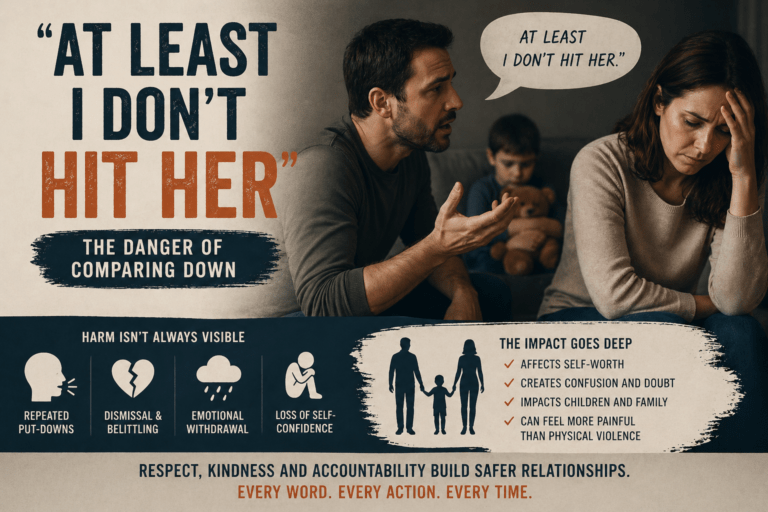
One of the saddest things that can happen in a relationship is not a dramatic ending. It is the slow erosion of one person’s selfhood. It happens quietly. They stop bringing things up. They stop expecting repair. They stop asking for what they need.
They begin editing their tone, their opinions, their friendships, their clothes, their goals, their emotions. They become less spontaneous, less expressive, less certain of their own reality.
Outwardly, the relationship may appear calm. There may be fewer arguments. Less tension on the surface. Sometimes that “peace” has been purchased through one person’s shrinking.
That is not success.
A successful relationship should not be measured by how little conflict there is if the absence of conflict comes from fear. It should not be measured by how agreeable someone becomes if their agreeableness is built on emotional exhaustion. It should not be measured by how much one person gives up in order to keep the other stable.
A better question is:
Can both people remain fully human here?
Safety is created in ordinary moments
When people think of unsafe relationships, they often picture dramatic incidents. Explosive fights. Obvious intimidation. Severe abuse. Safety is often built or damaged in smaller, repeated moments. It is built when someone tells the truth and is met with curiosity instead of retaliation. It is built when hurt is acknowledged without immediate self-defence. It is built when someone says no and the relationship does not become hostile. It is built when power is restrained rather than exercised. It is built when apologies are followed by changed behaviour. It is built when someone’s feelings are not automatically treated as accusations.
And safety is damaged in the opposite moments. When honesty is punished. When vulnerability is used as ammunition later. When anger fills the room. When contempt replaces respect. When silence is used to control. When affection is withdrawn to make a point. When one person’s distress becomes everyone else’s responsibility.
These moments may seem small when viewed one by one. But together they create the emotional architecture of the relationship.
Imagine the shift this would create in men especially
For many men, relationship success has been tied to being respected, desired, needed, obeyed, or not left.
But what if the measure became different? What if a man asked himself:
- Does my partner feel safe bringing me bad news?
- Does she feel safe disagreeing with me?
- Do my children relax when I walk into the room?
- Can people set boundaries with me without paying a price?
- Do others feel more like themselves around me, or less?
- Am I someone people can be honest with, or someone they must manage?
These questions reach deeper than image. They move beneath performance and into character.
They ask not whether a man sees himself as loving, but whether the people around him experience him as safe.
That is a much more demanding standard. And a much more meaningful one.
Safety does not mean comfort with everything
It is worth being clear that safety does not mean there is never conflict, frustration, disappointment, or pain. A safe relationship still includes limits. It still includes being able to have hard conversations. It still includes accountability. It still includes moments of rupture.
But in a safe relationship, these moments do not become opportunities for domination or punishment. You can be safe and still be confronted. You can be safe and still hear no. You can be safe and still be held accountable. You can be safe and still need to change.
In fact, safety is often what makes honest accountability possible. Without safety, truth gets buried under fear.
The question this leaves us with
Perhaps the most confronting part of this reflection is that it turns the focus back on us.
Not: Do I feel misunderstood?
Not: Do I have good intentions?
Not: Do I love deeply?
But:
What is it like to be close to me?
What does my presence do to other people?
Do they expand, or contract?
Do they become more honest, or more careful?
Do they feel free, or managed?
These are not questions for self-condemnation. They are questions for maturity.
Because if we began measuring success by the safety people feel in our presence, we would likely become more humble, more accountable, and more serious about the everyday ways we affect those we claim to love.
Final reflection
Imagine if we measured a successful relationship not by how long it lasts, how good it looks, or how tightly people hold on, but by the degree of safety it creates.
By whether people can tell the truth there.
By whether they can rest there.
By whether they can remain whole there.
By whether love there makes them larger, not smaller.
That would not be a shallow measure. It would be a deeply ethical one.
Because perhaps one of the greatest relational achievements is not that someone stayed, but that in our presence they felt safe enough to fully exist.
And that may be one of the truest measures of love we have.