“I’m Not a Violent Man”: The Story That Stops Men Looking Closely at Their Behaviour
A lot of men hear the words men’s behaviour change counselling or domestic violence support and immediately think: “I don’t belong there.”, “I’m not that kind of man.”, “I’m not violent.”
For many, that thought ends the conversation before it even begins.
It is one of the most powerful stories men tell themselves, not always because they are trying to avoid responsibility in a deliberate way, but because the word violent feels too extreme, too loaded, too far removed from how they see themselves.
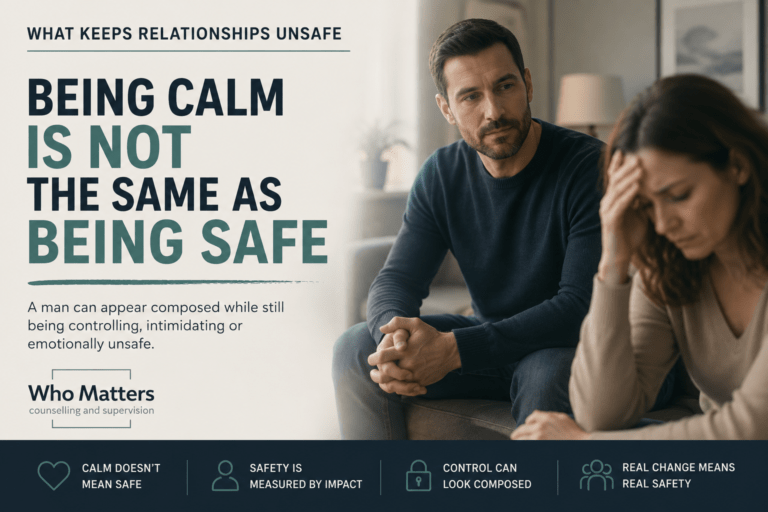
They may never have punched a partner. They may never have been charged by police. They may not see themselves as angry all the time. They may believe they are a good father, a hard worker, a loyal partner, a decent man. And yet, their relationship may still be shaped by fear, control, intimidation, emotional harm, blame, and repeated patterns that leave the other person walking on eggshells.
This is where the story becomes dangerous.
Not because every man who says “I’m not violent” is lying, but because that sentence can become a shield against deeper honesty.
The problem with the word “violent”
Many men reduce violence to its most obvious form: physical assault. If they have not hit, punched, kicked, or strangled a partner, they conclude they are not violent. End of story.
But harm in relationships is often broader than that. A man may not use physical force and still create an environment of fear through:
- yelling
- intimidating
- smashing objects
- punching walls
- blocking doorways
- driving aggressively during conflict
- threatening self-harm to stop a partner leaving
- constant criticism or humiliation
- controlling money
- monitoring whereabouts
- pressuring for sex
- blaming a partner for his reactions
- using size, tone, silence, or intimidation to dominate
Some men dismiss these behaviours because they do not fit their definition of violence. But for the person living with them, the impact can still be profound.
A partner does not need to be hit to feel unsafe. A child does not need to see an assault to be affected by a father’s intimidation, volatility, or controlling behaviour.
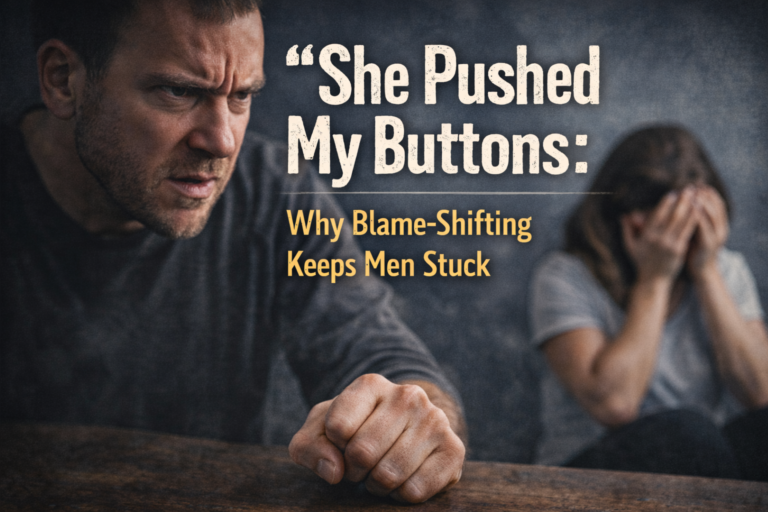
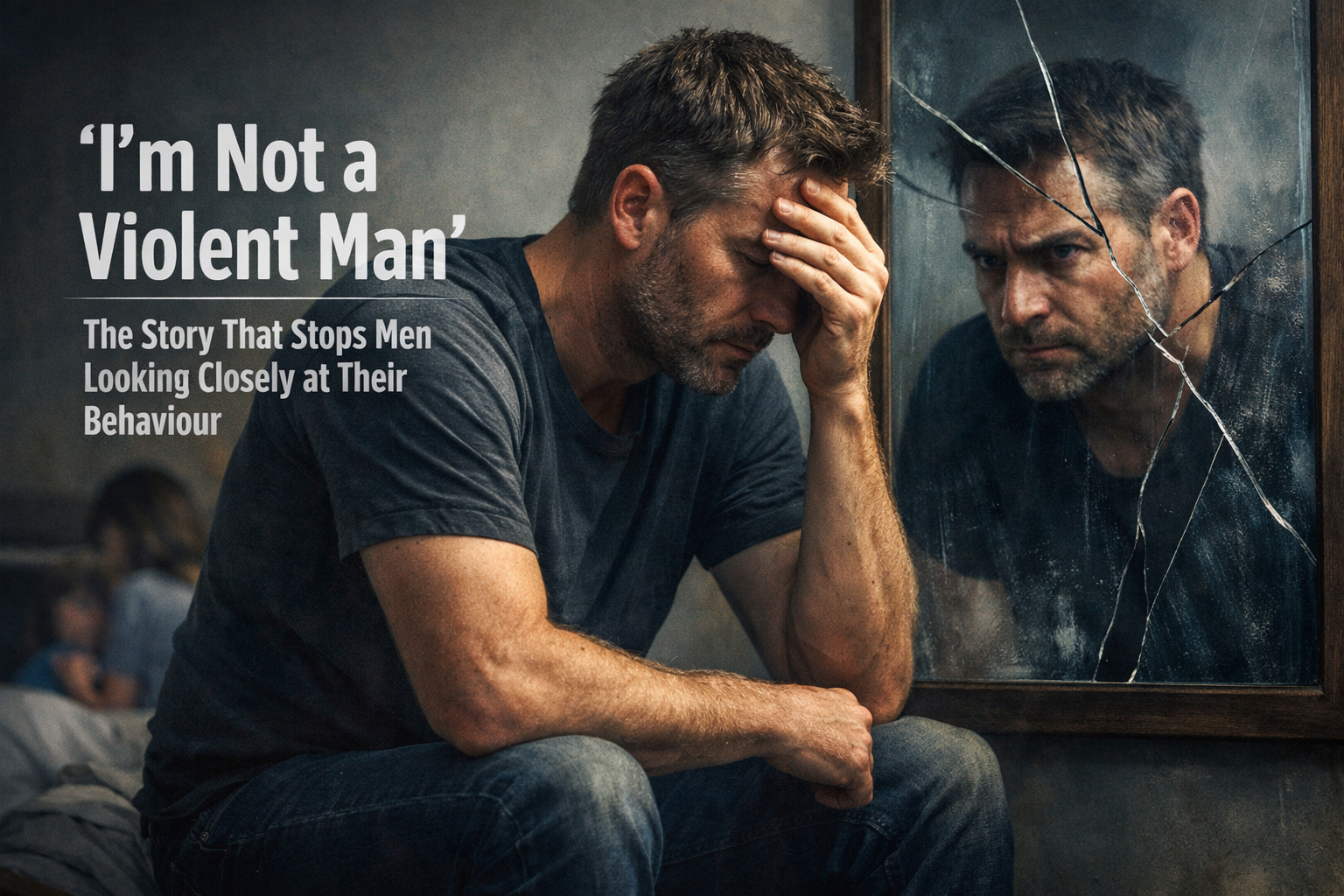
“I’m not violent” can mean “I don’t want to look”
The statement itself is often less important than what it prevents. Sometimes “I’m not a violent man” really means:
“I don’t want to be compared to men who are worse.”
“If I admit there’s a problem, I’ll feel ashamed.”
“If I question my behaviour, I might have to change.”
“If I look closely, I may not like what I find.”
That is understandable. Shame is powerful. Most men do not want to see themselves as abusive, controlling, or unsafe. Many were raised to believe that being a good man means being strong, stoic, providing financially, and staying out of trouble. Very few were taught how to examine power, entitlement, defensiveness, or coercive patterns in intimate relationships.
So instead, men often compare themselves to a caricature:
“I’m not a monster.”
“I’m not a wife basher.”
“I’m not some out-of-control drunk every night.”
Maybe not. But that is not the only question that matters.
A more useful question is:
How does it feel to be in relationship with me? Does the other person feel safe disagreeing with you? Do they feel free to say no? Do they feel respected when you are frustrated? Do they have to manage your moods? Do they change their behaviour to avoid your reactions? Do your children feel calm around you, or careful around you?
These questions often reveal much more than whether a man identifies with the label violent.
Intent is not the same as impact
One of the reasons this story survives is that many men judge themselves by their intentions.
“I didn’t mean to scare her.”
“I was just angry.”
“I only raised my voice because I was hurt.”
“I didn’t touch her.”
“I was trying to get my point across.”
“I was stressed.”
But relationships are not shaped by intention alone. They are shaped by impact, pattern, and meaning. A man may not intend to frighten his partner, but if she becomes quiet, compliant, apologetic, or hyper-aware whenever he is upset, then something important is happening.
A man may not intend to control, but if every disagreement ends with him dominating, sulking, interrogating, withdrawing, or exploding until he gets his way, the impact is still controlling.
A man may not intend to harm his children, but if they hear their mother being belittled, blamed, or intimidated, they are learning what power looks like in the home.
Looking at impact is not about unfairly condemning men. It is about stepping out of self-protection long enough to ask what life is actually like for the people around us.
The story often protects identity, not truth
For some men, “I’m not a violent man” is deeply tied to identity.
They may see themselves as:
- a protector
- a provider
- a good bloke
- a family man
- someone who has been through a lot
- someone who is trying his best
And all of that may be true.
But none of those identities automatically make a man safe. A man can love his family and still frighten them. A man can work hard and still be controlling. A man can be generous in public and cruel in private. A man can see himself as protective while behaving possessively. A man can feel like the victim in arguments while repeatedly using intimidation or blame.
This is one of the hardest truths for many men to face: good intentions and positive qualities do not cancel out harmful behaviour.
You do not have to be all bad to be causing harm.
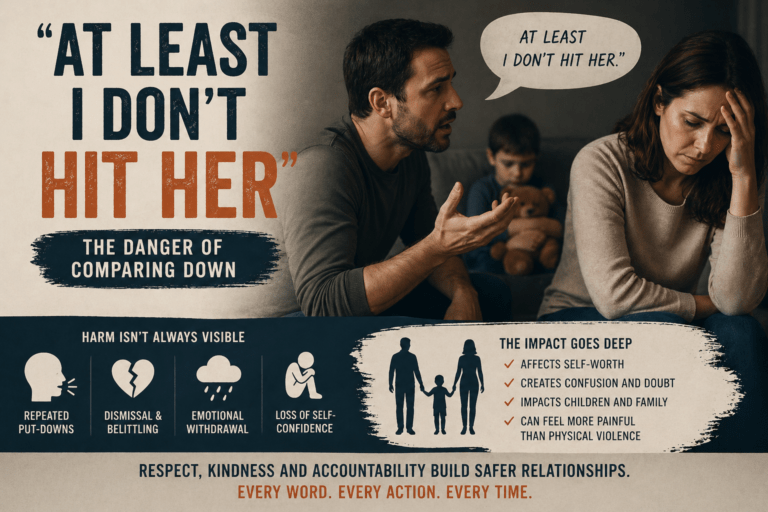
“At least I don’t hit her” is a very low bar
Many men reassure themselves with comparison.
“I’ve never hit her.”
“At least I’m not like my father.”
“At least I don’t drink like other blokes.”
“At least I come home.”
“At least I don’t cheat.”
But “at least” thinking keeps the focus on whether a man is bad enough to worry about, rather than whether his behaviour is healthy, respectful, and safe. That is a very low bar for relationships.
The goal should not be merely avoiding the worst possible behaviour. The goal should be becoming a man whose presence creates safety, steadiness, honesty, and respect.
Not a man who says, “Well, I could be worse.”
Why men avoid looking closely
There are many reasons men cling to this story. Some are afraid of being judged. Some are afraid of losing their relationship or access to children. Some are afraid of shame. Some genuinely do not understand the broader dynamics of abuse and control. Some grew up in homes where yelling, intimidation, and put-downs were normal. Some have trauma, alcohol issues, anxiety, depression, or emotional dysregulation that complicate their behaviour. Some have spent years blaming their partner, the relationship, stress, money, work, or mental health.
These factors may help explain behaviour, but they do not excuse it. Explaining is not the same as taking responsibility.
In fact, part of behaviour change is learning to hold both truths at once:
“I have reasons I became this way.”
and
“I am still responsible for the impact of my behaviour.”
That is where real accountability begins.
Looking closely is not weakness
Some men avoid counselling because they think it means admitting they are an abuser, a failure, or weak. But honest self-examination is not weakness. It is maturity.
It takes much more strength to say:
“I may not have seen this clearly.”
“I’ve minimised things.”
“I’ve focused on my intentions and ignored the impact.”
“I’ve told myself a story that lets me off too easily.”
“I need to understand the pattern, not just defend myself.”
That kind of honesty is not humiliation. It is the beginning of change.
Men’s behaviour change counselling is not only for men who have already accepted a label. Often it is for men who are willing, perhaps reluctantly, to become more truthful about how they show up in relationships.
The better question
The question is not simply:
“Am I a violent man?”
For many men, that question leads nowhere. It triggers defensiveness, comparison, and argument about labels.
A better question is:
“What is my behaviour doing to the people I love?”
And after that:
“What stories do I keep telling myself that stop me from seeing it clearly?”
That is where the work starts. Not with performative shame. Not with empty promises. Not with defending your character.
But with honest reflection, accountability, and a willingness to change what needs changing.
A final reflection
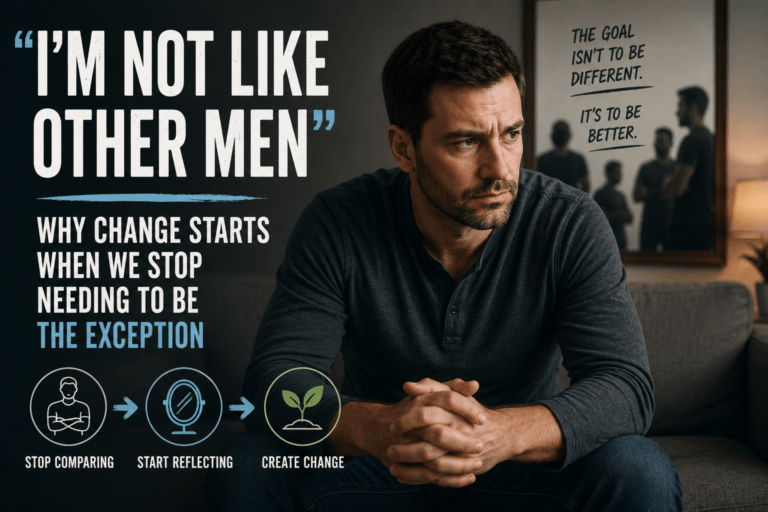
If you find yourself reacting strongly to the idea of men’s behaviour change work because you think, “I’m not violent,” it may be worth pausing there. Not to automatically condemn yourself. Not to accept a label you are not ready to use.
But to get curious.
What if that sentence has become a barrier rather than a truth? What if it has stopped you from looking more closely? What if the real issue is not whether you fit a category, but whether the people around you feel safe, respected, and free in your presence?
Sometimes the story that protects a man’s identity is the very story that prevents his growth.
And sometimes the bravest thing a man can do is set that story down and look honestly at what remains.