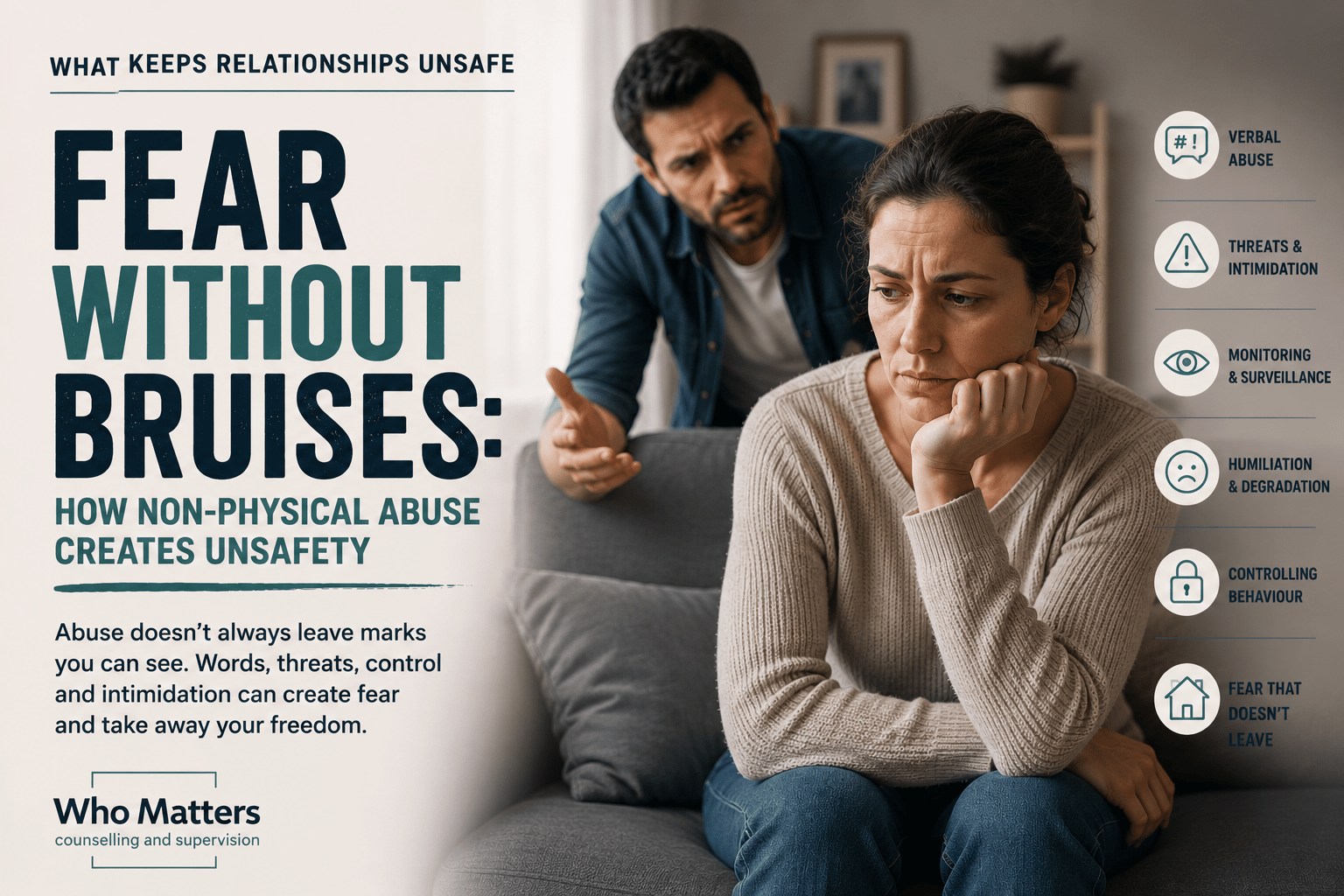
Fear Without Bruises: How Non-Physical Abuse Creates Unsafety
Many people still think of abuse as something that leaves a visible mark: a bruise, a broken object, a hole in the wall, a police report, a hospital visit, or a moment where things became physically violent. Physical violence is serious and should never be minimised, but a relationship can become unsafe long before there are visible injuries. Many people living with abuse spend much of their time managing fear that other people cannot see.
A partner may not be hit, pushed, grabbed, or physically blocked from leaving, but she may still feel unsafe because of what has happened over time. She may know what certain facial expressions mean, what a particular tone is likely to lead to, or what will happen if she says the wrong thing, takes too long to reply, spends money, sees a friend, refuses sex, challenges his version of events, or tries to leave. The absence of bruises does not mean the absence of fear.
This is why non-physical abuse is so important to understand. It may not always be obvious from the outside, but it can shape a person’s choices, confidence, freedom, emotional wellbeing, parenting, relationships, and sense of self. A relationship does not have to be physically violent to be unsafe.
Non-Physical Abuse Is Still Abuse
Non-physical abuse includes behaviours that intimidate, control, humiliate, threaten, monitor, isolate, pressure, manipulate, or emotionally harm another person. It can happen through words, silence, facial expression, body language, digital communication, financial control, parenting conflict, sexual pressure, or repeated patterns that make someone feel afraid to act freely.
This kind of abuse is often minimised because each individual behaviour may be explained away. A man may say he only raised his voice, only asked where she was, only wanted to talk, or did not physically stop her from doing anything. He may focus on the fact that he did not touch her, while overlooking the pressure, fear, and consequences his behaviour created.
Safety is not measured only by whether physical contact occurred. It is also measured by whether the other person feels free to speak, disagree, leave a conversation, make choices, say no, have privacy, maintain relationships, and live without fear of punishment. Non-physical abuse often works by creating a climate of consequences. The person being harmed may technically be “allowed” to do things, but she knows there may be a cost, such as an argument, interrogation, withdrawal, sulking, accusation, threat, humiliation, or days of emotional tension.
Over time, the person learns to avoid the cost by becoming smaller. She may stop raising issues, stop seeing certain people, stop saying no directly, stop expecting repair, or stop trusting her own judgement. This is one of the reasons non-physical abuse can be so damaging: it changes how a person moves through the relationship, even when there are no visible injuries.
Verbal Abuse Is More Than “Just Words”
Verbal abuse is sometimes dismissed as “just words”, but words can be used to dominate, degrade, frighten, confuse, and control. This may include yelling, swearing, name-calling, mocking, sarcasm, insults, belittling, blaming, shaming, or repeated criticism of someone’s intelligence, parenting, body, emotions, culture, family, work, sexuality, or mental health.
It can also be more subtle than obvious insults. A man may use a calm tone while saying things that are designed to cut deeply. He may speak to his partner as though she is stupid, unstable, dramatic, selfish, ungrateful, or incapable. He may correct her constantly, pick apart her words, use private vulnerabilities against her, or make her feel that nothing she says will ever be good enough.
The harm of verbal abuse is not only in the words themselves. It is also in the repeated message underneath them: that her feelings do not matter, her reality is not valid, and he has the right to define her. In a safe relationship, conflict does not become an excuse to degrade someone. People may feel angry, hurt, or frustrated, but they remain responsible for how they speak. Verbal abuse creates unsafety because it teaches the other person that honesty, disagreement, mistakes, or vulnerability may be met with attack.
Threats Do Not Have to Be Direct to Be Real
Some threats are obvious, such as threats to hurt someone, take the children, destroy property, expose private information, ruin someone’s reputation, harm themselves, report someone maliciously, withdraw financial support, or make separation unbearable. Other threats are implied rather than stated directly.
A man may not say, “I will hurt you,” but he may say, “You’ll regret this.” He may not directly say, “You can’t leave,” but he may make it clear that leaving will lead to consequences. He may not explicitly threaten the children, but he may use parenting arrangements, legal processes, child support, or contact with services as ways to create fear and pressure.
Threats can also rely on history. If someone has previously exploded, intimidated, stalked, damaged property, driven dangerously, used self-harm threats, or punished boundaries, they may not need to say much in the present for their partner to understand what could happen. This is why “I didn’t threaten her” may not tell the whole story. The question is not only whether a threat was spoken clearly. The question is whether the behaviour caused the other person to feel there would be consequences if she did not comply.
Intimidation Can Be Quiet
Intimidation is often imagined as loud and aggressive, but it can also be quiet, controlled, and difficult to explain. It may include standing too close, staring, blocking pathways, following someone from room to room, driving aggressively, clenching fists, pacing, using a particular tone, refusing to leave, turning up unexpectedly, sending repeated messages, or creating a sense that the other person cannot relax.
Property damage can also be intimidating. Punching walls, smashing objects, slamming doors, throwing phones, breaking belongings, or damaging the home sends a message even when no one is physically touched. The message may be that he is willing to create fear to get a response, or that the violence could move from objects to people.
A man may describe this as “losing control”, but intimidation often functions to gain control. After an intimidating incident, the other person may become more careful. She may stop raising issues, stop saying no, stop asking questions, stop going out, or stop expecting respectful communication. If his behaviour results in her becoming more compliant, silent, anxious, or careful, that does not mean the relationship has improved. It may mean she has learned to manage fear.
Monitoring and Surveillance
Monitoring is one of the clearest ways non-physical abuse restricts freedom. This can include checking someone’s phone, reading messages, demanding passwords, tracking location, questioning social media activity, checking call logs, monitoring spending, driving past places, contacting friends or family to verify information, or expecting immediate replies.
Sometimes monitoring is framed as care or concern. A man may say he just wants to know she is safe, that he only asks because he worries, or that she should not mind if she has nothing to hide. However, care respects freedom, while monitoring reduces it. The impact of monitoring is that the other person begins to live as though she is being watched.
She may stop contacting people, change what she posts, delete messages, avoid normal interactions, rush home, explain every movement, or keep her phone visible to prevent suspicion. Even if no direct order is given, her world becomes smaller. Monitoring often comes from jealousy, insecurity, entitlement, or fear of losing control. Those feelings may be real, but they do not justify invading another person’s privacy or making them prove loyalty through constant access.
A safe relationship allows privacy, independence, and trust to be built through respectful behaviour rather than surveillance.
Humiliation and Degradation
Humiliation is a powerful form of control because it attacks a person’s dignity. It can happen privately or publicly, and it may involve mocking someone in front of others, sharing private information, making jokes at their expense, or criticising their parenting, appearance, sexuality, intelligence, mental health, family, culture, or past experiences.
Humiliation can also involve contempt. Eye-rolling, smirking, dismissive laughter, disgusted facial expressions, or speaking to someone as though they are beneath you can have a significant impact, especially when these behaviours happen repeatedly. Over time, the person being humiliated may withdraw socially, stop speaking up, avoid asking for support, or accept treatment they would once have recognised as unacceptable.
Humiliation also damages intimacy. People cannot feel emotionally close to someone who uses their vulnerabilities against them. They may remain in the relationship, but they become guarded. They stop sharing honestly because honesty has become unsafe.
For men who want to change, this requires more than stopping insults. It requires developing respect for the other person’s dignity, especially during conflict. If respect is only present when someone agrees with you, reassures you, or meets your needs, then that respect is conditional. Safety requires dignity even when there is tension.
Controlling Behaviour Reduces Freedom
Controlling behaviour is not always dramatic. Sometimes it is a steady pattern of making another person’s choices harder, narrower, or more costly. It can include controlling money, transport, parenting decisions, friendships, clothing, work, study, social activities, sex, communication, household routines, or access to services.
It can also involve creating so many objections, accusations, demands, or emotional consequences that the other person gives up trying to make independent choices. A man may say, “I never told her she couldn’t,” but that is not the only measure of control. If every independent choice leads to conflict, suspicion, guilt, pressure, or punishment, then the other person is not truly free.
Control often hides behind explanations that sound reasonable. Couples do need to discuss money, parenting, trust, safety, time, and shared responsibilities. However, discussion becomes control when one person’s preferences consistently dominate and the other person pays a price for disagreeing. A safe relationship does not require one person to surrender their independence to keep the peace.
The Impact of Living in a State of Alert
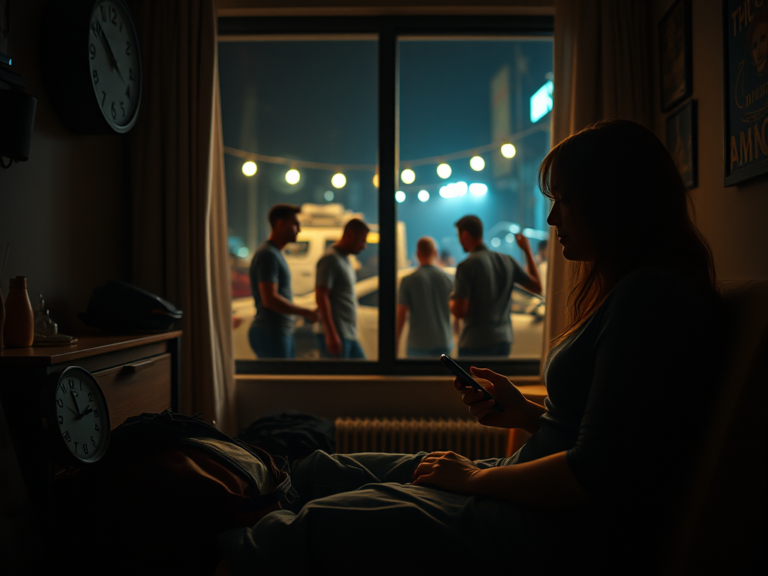
Non-physical abuse can leave a person living in a constant state of alert. She may monitor tone, timing, facial expression, footsteps, messages, silence, alcohol use, stress levels, or small changes in mood. She may plan her day around avoiding conflict, rehearse conversations, delay decisions, soften requests, hide normal information, or manage the children’s behaviour so nothing “sets him off”.
This level of vigilance is exhausting. It can affect sleep, concentration, parenting, work, friendships, physical health, and emotional wellbeing. It can also make it difficult for the person to explain what is happening, because each incident may sound small when described separately.
One incident may involve checking a phone. Another may involve anger about seeing a friend. Another may involve repeated questioning, accusations, or days of coldness. When described separately, each behaviour may be minimised. But together, they create a pattern of unsafety. The pattern is what matters, because the pattern is what teaches the person how careful she has to be.
Why Physical Violence Is Not the Only Measure
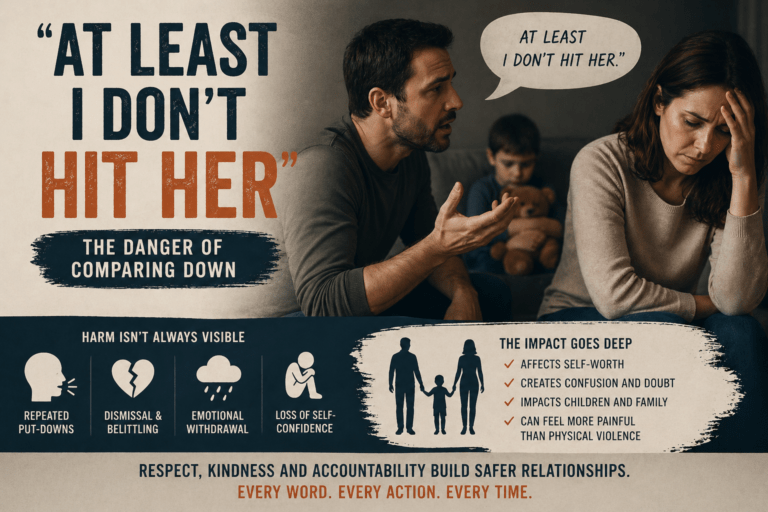
Some men measure their behaviour by the worst thing they did not do. They may focus on the fact that they did not hit their partner, did not touch her, did not smash anything this time, walked away, or kept their voice calm. Those things may be relevant, but they are not enough.
A person can avoid physical violence and still create fear. A man can keep his hands to himself while still using threats, pressure, humiliation, control, intimidation, monitoring, and emotional punishment. When the measure is only physical violence, many harmful behaviours remain invisible. The person using them may believe he is doing well because he is not being physically aggressive, while his partner or ex-partner continues to feel trapped, anxious, watched, degraded, or afraid.
Real behaviour change requires a broader measure. A man needs to ask whether his behaviour increases or decreases the other person’s safety, freedom, dignity, and ability to make choices. This question is much harder to avoid than simply asking whether physical violence occurred.
Responsibility Without Excuses
Non-physical abuse is often explained through stress, trauma, alcohol, anxiety, jealousy, separation, financial pressure, mental health, parenting conflict, or fear of abandonment. These factors may be part of the picture, and some may need support in their own right, but they do not excuse harmful behaviour.
Stress does not justify monitoring a partner. Shame does not justify humiliating another person. Jealousy does not create entitlement to passwords, location tracking, or constant reassurance. Fear of losing the relationship does not justify threats, pressure, or control.
Taking responsibility means being honest about the function of the behaviour. A man may need to ask whether his behaviour was about getting reassurance, stopping his partner from leaving, making her agree, punishing her, avoiding shame, regaining control, or making her responsible for his emotions. These questions are uncomfortable, but they are necessary. Without honesty about function, change often stays at the surface.
A man may stop one behaviour while continuing the same pattern in another form. He may stop yelling but start using silence. He may stop checking her phone but increase questioning. He may stop threatening to leave but start threatening court action. He may stop calling her names but speak with contempt. The behaviour may look different, while the control remains.
What Safer Behaviour Requires
Safer behaviour requires more than avoiding physical violence. It requires giving up the belief that another person should organise themselves around your emotions, needs, jealousy, insecurity, or expectations.
It means respecting privacy without demanding proof, accepting no without punishment, allowing conversations to pause, speaking without degradation, managing disappointment without threats, and parenting without using the children as leverage. It also means allowing an ex-partner to have independence, including relationships and choices you may not like.
Safer behaviour also requires honesty. This means being able to describe your behaviour without minimising, blaming, or making yourself the victim of the consequences. It means understanding that the other person may not feel safe just because you are not being physically violent. If there has been a pattern of non-physical abuse, trust may recover slowly or not at all.
The work is not to demand that she feel safe. The work is to become consistently safer, whether or not the relationship continues.
Questions for Men Who Want to Change
If you are trying to understand whether your behaviour has created fear without bruises, it may help to reflect on whether your partner or ex-partner feels free to say no, whether she changes her behaviour to avoid your reactions, whether she seems anxious when raising concerns, and whether she hides ordinary things because honesty feels unsafe.
It is also worth asking whether she has privacy, independence, and relationships outside of you, and whether you have used threats, pressure, monitoring, humiliation, withdrawal, or blame to get your way. Consider whether you treat boundaries as something to respect or something to overcome, and whether you have used children, money, legal processes, or emotional distress to maintain influence.
These questions are not comfortable, but they are part of accountability. A relationship cannot become safer while harm is being minimised.
Fear Without Bruises Still Matters
A person should not need visible injuries for their fear to be taken seriously. If someone is constantly monitoring your mood, avoiding your reactions, explaining themselves, shrinking their life, hiding ordinary choices, or feeling afraid to disagree, then something important is happening. This remains true even if you have not touched them, even if you see yourself as calm, and even if you believe your intentions were good.
Non-physical abuse creates unsafety because it reduces freedom. It teaches another person that their choices, body, privacy, voice, feelings, and independence are only safe when they do not challenge your control. For men who want to change, the work is not only to stop physical violence. It is to stop creating fear in all the ways fear can be created.
Becoming safer means becoming someone whose presence allows the people around you to breathe, speak, choose, disagree, rest, and live with dignity. Safety is not proven only by the absence of bruises. It is shown in the presence of freedom.