Why “No” Is One of the Most Important Words in Any Relationship
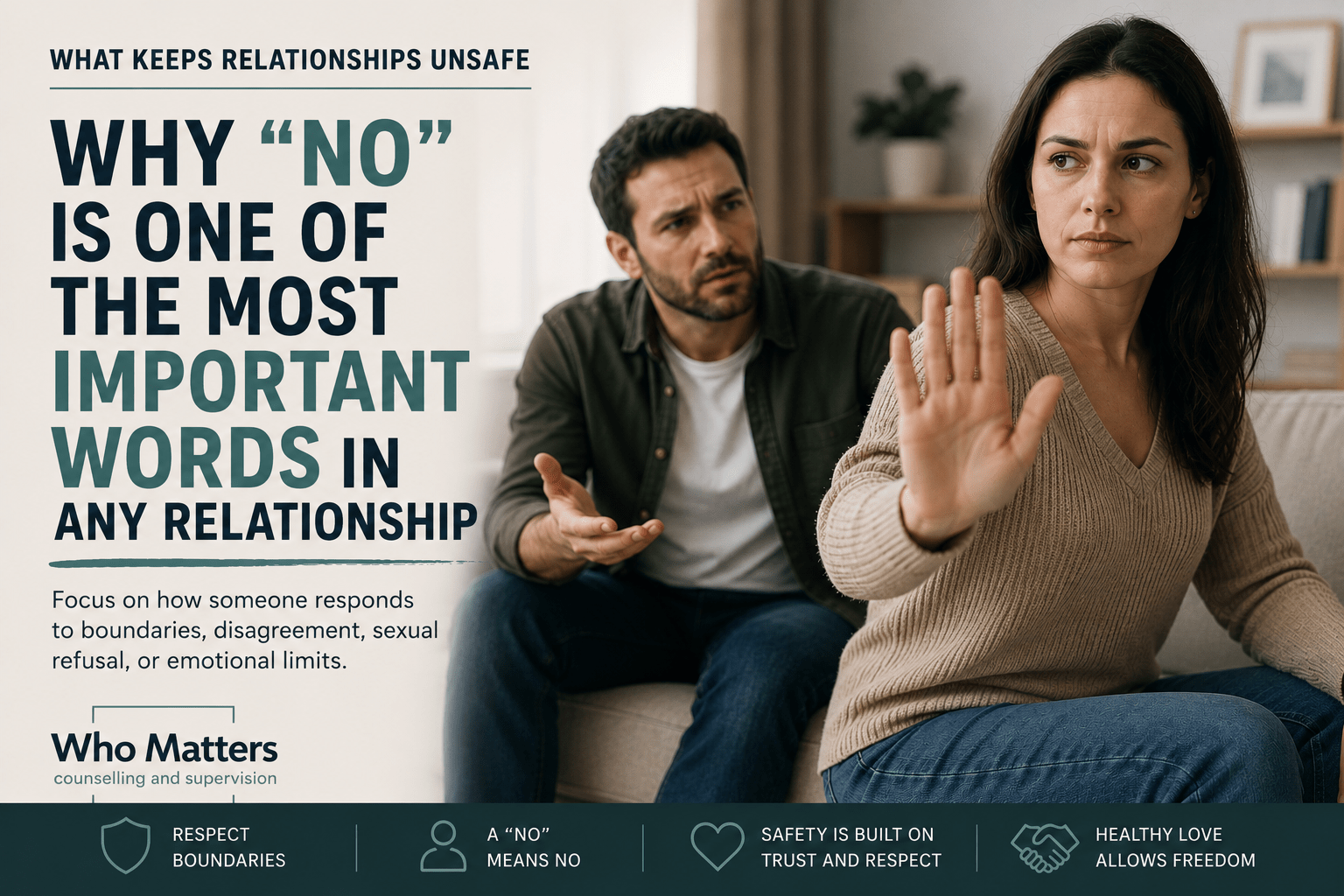
One of the clearest ways to understand safety in a relationship is to notice what happens when someone says “no”.
Not just in major moments, but in ordinary, everyday situations. No, I do not want to talk about this right now. No, I do not want sex. No, I am not comfortable with that. No, I do not agree. No, I need space. No, I am not ready to forgive. No, I do not want to explain myself again. No, I am making a different decision.
In a safe relationship, “no” may feel disappointing, frustrating, or uncomfortable, but it is still respected. One person may feel rejected, hurt, confused, or ashamed, but those feelings do not become a reason to pressure, punish, intimidate, guilt, manipulate, or retaliate against the other person.
This is why “no” matters so much. It reveals whether the relationship has room for two people, or whether one person is expected to organise themselves around the other person’s wants, emotions, and reactions.
“No” Is About More Than Refusal
When people hear the word “no”, they often think of rejection. In relationships, however, “no” is usually much broader than that. It is a boundary, a limit, a preference, a protection, a disagreement, a pause, or an expression of autonomy.
A partner may say no because they are tired, overwhelmed, uncertain, hurt, afraid, uninterested, busy, not ready, emotionally full, physically uncomfortable, or simply because they do not want to do something. They should not have to justify their no until it becomes acceptable to the other person.
In a healthy relationship, both people are allowed to have their own body, mind, feelings, needs, pace, and limits. That does not mean every no feels easy to hear. It means the person hearing it understands that disappointment is theirs to manage, not something to hand back as pressure or punishment.
For men who have used control, intimidation, coercion, or emotional pressure, this is often one of the most important areas of behaviour change. The issue is not only whether you accept a direct refusal. It is whether your partner feels free to say no to you in the first place.
How Someone Responds to “No” Tells You a Lot
A person’s response to “no” often shows how they understand power in the relationship.
Some responses create safety. These might sound like, “Okay, I hear you,” “We can talk later,” “Thanks for telling me,” “I’m disappointed, but I respect your decision,” or “You don’t have to explain it again.” These responses do not mean the person has no feelings. They mean the person is taking responsibility for their feelings without making the other person responsible for fixing them.
Other responses reduce safety. A person may argue, sulk, withdraw, interrogate, become cold, make accusations, bring up past grievances, demand reasons, insist on talking immediately, threaten consequences, or act wounded in a way that pressures the other person to take the no back. Sometimes the pressure is obvious. At other times it is subtle enough that the person using it can say, “I didn’t force you,” while ignoring the emotional cost they created.
This is where many unsafe patterns live. Not always in the first no, but in what follows it.
If saying no leads to hours of conflict, emotional withdrawal, repeated questioning, guilt, suspicion, accusations, or punishment, then the person saying no may eventually stop saying it directly. They may start avoiding, placating, giving in, lying, going quiet, or trying to manage the other person’s mood before the issue even comes up. Over time, the relationship may appear calmer, but only because one person has learned that honesty is too costly.
Boundaries Are Not Attacks
Many men experience boundaries as rejection, criticism, or disrespect. A partner needing space may be interpreted as abandonment. A sexual refusal may be interpreted as humiliation. A disagreement may be interpreted as disloyalty. A request to pause a conversation may be interpreted as being ignored, dismissed, or controlled.
Those feelings may be real, but they are not always accurate. More importantly, they do not give someone permission to override the other person’s limit.
A boundary is not an attack. It is information about what another person needs, wants, can tolerate, or is willing to participate in. If a man responds to boundaries as though they are threats, the relationship can quickly become unsafe because his partner then has to manage both the original issue and his reaction to her limit.
A safer response involves slowing down enough to separate the boundary from the story he is telling himself about it. “She needs space” is not the same as “she does not care about me.” “She does not want sex” is not the same as “she is humiliating me.” “She disagrees with me” is not the same as “she is against me.” “She is not ready to forgive” is not the same as “she is punishing me.”
This distinction matters because unsafe behaviour often begins when a man treats his interpretation as fact and then reacts to that interpretation.
Sexual Refusal Must Be Respected Without Consequence
One of the most important places where “no” must be respected is around sex and intimacy.
Sexual consent is not meaningful if someone feels they will be punished for refusing. A partner may say yes with words while their body, behaviour, or emotional state is communicating fear, pressure, exhaustion, or resignation. A person may comply because they want to avoid conflict, coldness, sulking, accusations, infidelity threats, emotional withdrawal, or another long conversation about why they “never want to be close”.
That is not genuine safety.
A sexually safe relationship is one where no can be said without consequence. It is a relationship where either person can decline sex, pause intimacy, change their mind, or express discomfort without being pressured, guilted, shamed, interrogated, or made responsible for the other person’s self-worth.
This includes more subtle forms of pressure, such as repeated requests after a refusal, acting hurt until the other person gives in, suggesting they must not love you, comparing them to previous partners, accusing them of cheating, or making affection conditional on sexual access. These behaviours may not look like force in the narrowest sense, but they can still create coercion.
For men, this requires a very clear form of accountability: your disappointment, sexual frustration, insecurity, or fear of rejection is yours to manage. It is not your partner’s responsibility to use her body to regulate your emotions or reassure your worth.
Emotional Limits Matter Too
Not every “no” in a relationship is about a practical decision or a physical boundary. Sometimes the most important no is emotional.
No, I cannot keep talking about this tonight. No, I am not ready to process this with you. No, I do not have the capacity to reassure you right now. No, I am not going to keep explaining the same thing. No, I need you to speak with someone else about this. No, I am not able to carry your shame for you.
These limits are often difficult for men who rely heavily on their partner for emotional regulation. If he feels anxious, ashamed, rejected, or afraid, he may want immediate reassurance. He may want the conversation resolved now. He may want his partner to soften, comfort him, explain herself, or confirm that everything is okay.
The problem is that his need for relief can become pressure. A partner who is hurt or exhausted may be required to look after his emotions before her own experience has even been acknowledged. In this pattern, the person who caused harm can become the emotional centre of the repair process.
Respecting emotional limits means accepting that another person may not be available in the way you want, at the exact time you want. It means allowing space without punishment. It means finding other ways to regulate yourself rather than insisting that your partner talk, reassure, forgive, comfort, or reconnect before she is ready.
Disagreement Is Not Disrespect
A relationship cannot be safe if disagreement is treated as a problem to be defeated.
Two people will see things differently. They will remember events differently. They will have different needs, preferences, values, and emotional responses. This is not automatically disrespect. In fact, the ability to disagree without fear is one of the foundations of safety.
Unsafe patterns often emerge when one person cannot tolerate difference. A man may keep arguing until his partner agrees, correct every detail of her experience, demand that she use the “right” words, accuse her of being irrational, or turn the discussion into a test of loyalty. He may say he is trying to understand, while actually trying to get her to accept his version of reality.
Over time, this teaches the other person that disagreement is exhausting or dangerous. She may stop offering her real opinion. She may agree just to end the conversation. She may become vague, noncommittal, or avoidant because direct honesty has not been safe.
A respectful relationship does not require two people to agree on everything. It requires both people to remain free while they disagree.
When “No” Leads to Consequences
One of the most useful questions a man can ask himself is: what happens after someone says no to me? Not what do I think should happen. Not what do I tell myself I am doing.
What actually happens?
Does the other person have to manage my mood? Do they have to reassure me repeatedly? Do they have to explain themselves until I am satisfied? Do they become smaller, quieter, or more careful? Do I withdraw warmth, affection, cooperation, money, parenting support, or practical help? Do I become suspicious, sarcastic, cold, or persistent? Do I bring it up later as evidence against them? Do I make them pay for disappointing me?
These questions are uncomfortable because they move the focus from intention to impact. A man may not think of himself as controlling, but if his partner experiences consequences for having boundaries, then control may be present.
Control does not always sound like “you are not allowed”. Sometimes it sounds like “fine, do what you want” delivered in a way that makes the other person know there will be a cost.
Rebuilding Safety Around “No”
If a relationship has been unsafe, rebuilding safety around no takes time. A partner may not immediately believe that her boundary will be respected simply because a man says he understands now. If she has learned that no leads to consequences, she may continue to soften, over-explain, avoid, or brace herself.
That does not mean she is being unfair. It means her nervous system remembers the pattern.
Rebuilding safety requires consistent evidence that no can exist without punishment. This might mean accepting a pause in conversation, leaving the room when asked, stopping after one refusal, not sending repeated messages, respecting privacy, not using the children as a pathway around a boundary, and not turning disappointment into pressure.
It also means not demanding credit for doing the basics. Respecting a boundary is not a favour. It is a minimum requirement for safety.
Over time, if behaviour is genuinely different, the other person may begin to feel less guarded. But that process cannot be rushed, argued into existence, or demanded as proof that change is working. Trust grows when the person who has caused harm becomes consistently safer when they do not get what they want.
Questions for Men Who Want to Change
A useful way to reflect on this issue is to think about the different kinds of no that occur in your relationships.
Can your partner say no to sex without guilt, pressure, coldness, or repeated requests?
Can she disagree with you without being worn down, corrected, mocked, or accused?
Can she ask for space without you following, messaging, escalating, or punishing her?
Can she set emotional limits without being made responsible for your shame, anxiety, or distress?
Can she make choices you do not like without retaliation?
Can your children say no, express limits, or have feelings without fear of your reaction?
Can your ex-partner maintain boundaries around communication, parenting, or separation without you trying to regain control?
The answers to these questions reveal far more about safety than whether you describe yourself as loving, calm, stressed, or misunderstood.
“No” Protects the Relationship
It can be tempting to see no as something that creates distance. In reality, the ability to say no safely is part of what allows genuine closeness to exist.
When someone can say no without fear, their yes becomes more meaningful. When someone can set a boundary without punishment, trust grows. When disagreement is allowed, honesty becomes possible. When emotional limits are respected, connection is less likely to become obligation.
A relationship where no is not safe may still continue, but it often does so through compliance, avoidance, fear, resentment, or emotional shutdown. That is not the same as intimacy.
Intimacy requires freedom. Consent requires freedom. Trust requires freedom. Love requires freedom.
So one of the most important questions in any relationship is not simply, “Do we love each other?” It is, “Are we both free to say no?”
If the answer is no, then the relationship is not yet safe.
For men who want to change, learning to respect no is not a small skill. It is central to becoming safer. It means accepting that another person’s body, time, emotions, choices, and boundaries belong to them.
Even when you feel disappointed.
Even when you feel rejected.
Even when you want reassurance.
Even when you believe you have a good reason.
Because safety is not proven by how you respond when things go your way. It is shown most clearly in how you respond when they do not.