If Someone Feels Smaller Around You, the Relationship May Not Be Safe
One of the clearest signs that a relationship may not be safe is not always found in the most obvious incidents. It may not be the loudest argument, the harshest words, the broken object, the threat, or the moment that another person can easily describe to someone else. Sometimes the clearest sign is what happens to the other person over time.
Do they become quieter around you? Do they hesitate before speaking? Do they soften their needs, hide their opinions, or give in more quickly than they used to? Do they seem less confident, less relaxed, less playful, less open, or less themselves? Do they appear to be constantly assessing your mood before deciding what they can say, ask, feel, or do?
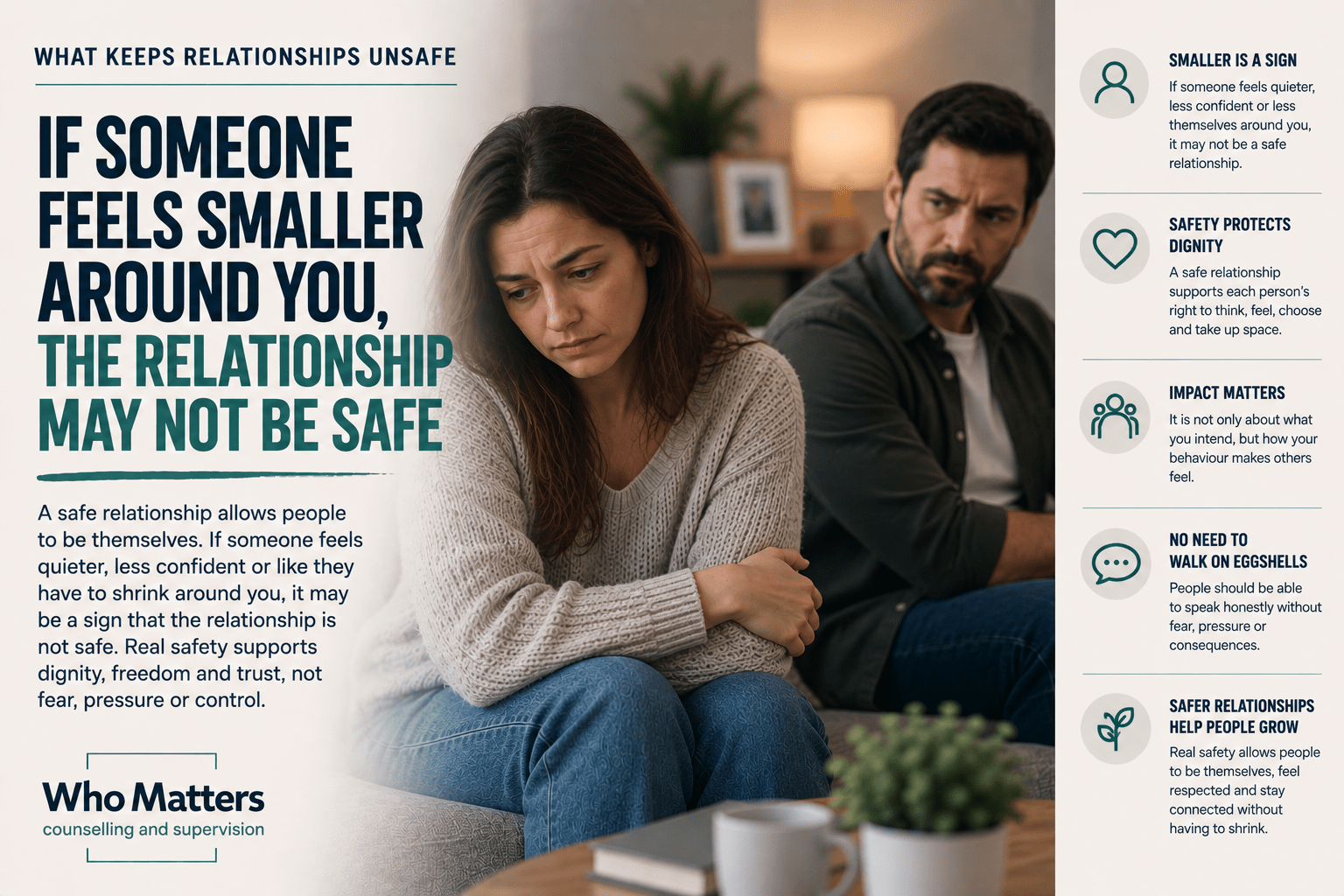
If someone feels smaller around you, the relationship may not be safe.
This does not mean you intended to make them feel that way. It does not mean every feeling another person has is automatically your responsibility. It does mean that if your behaviour, reactions, moods, anger, defensiveness, jealousy, control, withdrawal, or emotional instability have shaped how free someone feels around you, then that impact needs to be taken seriously.
Safety is not only about what you believe you are doing. It is also about what others experience in your presence.
Safety Is Felt in the Other Person
Throughout this series, the focus has been on the felt experience of safety. A relationship may look calm from the outside, but still feel unsafe to the person living inside it. A man may believe he is being reasonable, loving, stressed, misunderstood, or calm, while his partner, ex-partner, children, or family members may be experiencing something very different.
This is one of the hardest parts of behaviour change. It requires a man to become interested in impact, not only intention. Intention asks, “What did I mean?” Impact asks, “What did my behaviour create for the other person?” Both questions may matter, but when safety has been harmed, impact has to become central.
A partner may feel smaller because she has learned that honesty leads to defensiveness. She may feel smaller because disagreement leads to pressure. She may feel smaller because saying no leads to sulking, anger, repeated questioning, or emotional consequences. She may feel smaller because affection, cooperation, parenting support, or calmness feel conditional on keeping you settled.
When this happens, the relationship may continue, but the other person’s freedom has reduced. She may still be physically present, still communicating, still parenting, still trying, or still offering reassurance, but part of her may have withdrawn in order to stay safe.
Feeling Smaller Can Look Like Adaptation
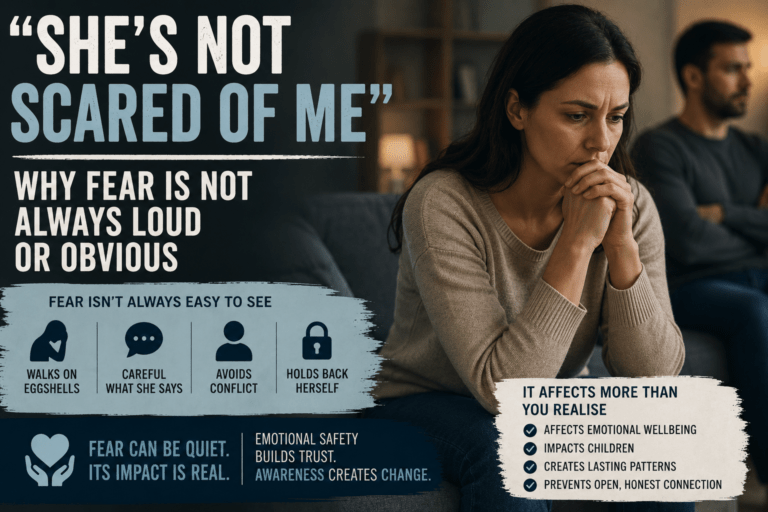
People do not always name their experience as fear or unsafety. Often, they adapt. They learn what creates tension and what reduces it. They learn which topics are too difficult, which questions are not worth asking, which opinions lead to conflict, and which boundaries will be challenged.
This adaptation can look like cooperation from the outside. A partner may become agreeable, careful, organised, patient, or quiet. She may stop raising certain concerns. She may say yes more often. She may communicate in a way that is designed to avoid triggering defensiveness, jealousy, shame, anger, or withdrawal.
The risk is that this can be mistaken for improvement. A man may think the relationship is calmer because he has changed, when it may actually be calmer because the other person has learned to make herself smaller. There may be fewer arguments because she has stopped trying to be heard. There may be less visible tension because she is managing it earlier. There may be fewer boundaries because she has learned they are too costly to hold.
This is why the question is not only whether the relationship is quieter. The question is whether both people are freer.
Dignity Is a Measure of Safety
A safe relationship protects dignity. Dignity means a person can hold their own thoughts, feelings, boundaries, preferences, body, privacy, and choices without being degraded, punished, pressured, or controlled. It means they are treated as a full person, not as an extension of someone else’s needs, insecurity, jealousy, shame, or expectations.
When dignity is undermined, the person affected may start to feel less entitled to take up space. She may become less certain that her feelings matter. She may doubt whether her boundaries are reasonable. She may start explaining herself excessively, apologising quickly, or trying to make her needs easier for the other person to accept.
Dignity is harmed when someone is mocked, humiliated, monitored, interrogated, dismissed, or treated as though their perspective is only valid if it matches yours. It is also harmed when they are made responsible for your emotional state, as though their role is to prevent your anger, manage your shame, reassure your insecurity, or keep the household calm.
For men who want to change, dignity is a useful measure because it moves the focus beyond whether there has been physical violence or obvious abuse. It asks whether the people around you feel respected as separate human beings.
Impact Matters Even When You Did Not Mean Harm
Many men become defensive when impact is discussed because they hear it as accusation. They may want to explain that they did not mean to scare anyone, did not intend to control, did not realise their tone sounded intimidating, or did not understand why their partner reacted so strongly.
Those explanations may be true in some cases. However, lack of intent does not erase impact. If a partner feels smaller, more anxious, less honest, or less free around you, the most important response is not to prove that you did not mean it. The more useful response is to become curious about what has been created and what needs to change.
This does not require self-hatred. In fact, shame often gets in the way of accountability because it pulls the focus back onto the person who caused harm. The work is not to collapse into guilt or demand reassurance that you are a good person. The work is to understand the impact clearly enough that your behaviour becomes safer.
A more accountable response sounds less like, “But I didn’t mean it that way,” and more like, “I need to understand why my behaviour has had that effect, and I need to change the pattern that made you feel that way.”
When Others Manage Your Presence
A useful way to think about safety is to notice whether other people have to manage your presence. Do they check your mood before speaking? Do they wait for the right time to raise ordinary issues? Do they avoid certain words because you might react? Do they give reassurance before you ask for it? Do they keep the children quiet when you are stressed? Do they hide harmless information because explaining it feels too exhausting?
If people around you are organising themselves around your reactions, the relationship may not be safe. This is true even if you are not yelling, even if you are not threatening, and even if you think of yourself as emotionally expressive rather than harmful.
In safe relationships, people still consider each other. They may choose timing thoughtfully, speak with care, and try not to be unnecessarily hurtful. The difference is that consideration is freely given, not required for protection. When people have to manage you in order to avoid consequences, their freedom has reduced.
Over time, this can make others feel smaller because they are no longer simply living alongside you. They are monitoring you.
Children Also Become Smaller
Children are often affected by unsafe patterns even when they are not the direct target. They notice who controls the emotional temperature of the home. They notice which parent adjusts, which parent becomes tense, which topics create danger, and what everyone does to prevent a reaction.
A child may become quiet, compliant, watchful, protective, anxious, irritable, or unusually responsible. They may learn to avoid making noise, asking for things, expressing big feelings, or making mistakes when a parent is in a certain mood. They may learn that love means keeping someone calm, or that safety means staying small.
For fathers, this can be painful to consider, but it is important. Children do not only need a father who provides, attends activities, says “I love you,” or avoids physical violence. They need a father whose presence does not require emotional management. They need to know that mistakes, noise, feelings, questions, and disagreement will not threaten the stability of the home.
If children become smaller around you, that is not simply a parenting issue. It is a safety issue.
The Difference Between Respect and Compliance
Compliance can be easily mistaken for respect. A partner may agree, follow your preference, stop arguing, change plans, share information, provide reassurance, or avoid certain people. A child may obey quickly, stay quiet, or appear well behaved. From the outside, this can look like things are functioning well.
However, compliance is not the same as respect if it is produced by fear, pressure, guilt, intimidation, or emotional consequences. Respect allows the other person to remain whole. Compliance often requires them to give up part of themselves to avoid what might happen.
This distinction matters because some men measure safety by whether others are doing what they want. If people are agreeable, responsive, affectionate, quiet, or cooperative, he may assume things are fine. A more honest measure is whether they can disagree, refuse, delay, question, rest, make mistakes, have privacy, and make independent choices while still being treated with care.
A safe relationship does not require one person to become easier to manage. It requires each person to remain free enough to be real.
If She Has Changed Around You
One of the most confronting questions a man can ask is whether his partner or ex-partner has changed around him. Has she become less confident? Does she laugh less? Does she avoid eye contact during difficult conversations? Does she seem to choose her words carefully? Has she become more anxious, guarded, numb, angry, distant, or resigned?
It is easy to interpret these changes in ways that protect yourself. You may think she is being cold, difficult, unforgiving, secretive, disrespectful, or unwilling to move forward. Sometimes there may be other factors affecting her, and not everything can be reduced to the relationship. But if there has been a pattern of anger, control, pressure, jealousy, withdrawal, intimidation, or emotional harm, it is important to consider whether her changes are connected to what she has had to adapt to.
A person becoming smaller is not always dramatic. It may happen gradually. She may slowly stop bringing her full self into the relationship. She may stop expecting you to understand. She may stop asking for repair. She may stop trusting that honesty is worth the cost.
When that happens, the issue is not how to make her open up again. The issue is how to become someone she does not have to protect herself from.
Accountability Without Demanding a Response
A man may begin to recognise the impact of his behaviour and want the other person to acknowledge his insight. He may want her to see that he understands now, to reassure him that change is possible, or to respond with hope. While that desire is understandable, it can become another form of pressure if he makes his accountability dependent on her reaction.
If someone has felt smaller around you, she may not immediately feel safe because you have named the problem. She may not want to discuss it. She may not be ready to trust it. She may feel angry that it has taken so long. She may need distance. She may maintain boundaries.
Accountability means accepting that. It means continuing the work without requiring the person affected to comfort, encourage, or validate you. It means not turning her caution into evidence that she is unfair, bitter, or unwilling to heal.
If the goal is safety, then her freedom to respond in her own way must be protected as part of the change process.
Becoming Safer Makes Others Larger
One of the signs that safety is increasing is that people around you become more able to take up space. They may speak more honestly, set clearer boundaries, relax more easily, express different opinions, make ordinary choices without over-explaining, or show a wider range of emotions without fear.
This does not happen instantly. If someone has spent a long time adapting, they may continue to be cautious even after some behaviour change has begun. Their body and mind may need repeated experiences of safety before they believe the pattern has changed.
Becoming safer is therefore not only about stopping harmful behaviour. It is about creating the conditions where other people no longer need to shrink. It is about becoming more predictable, respectful, accountable, and emotionally responsible, especially when you feel disappointed, rejected, ashamed, jealous, or powerless.
A safer man does not need others to become smaller so he can feel secure. He learns to manage himself in a way that allows others to remain whole.
Questions for Men Who Want to Change
If this article is difficult to read, it may be useful to approach it with curiosity rather than defensiveness. Consider whether the people closest to you seem more free or less free in your presence. Do they speak honestly, or do they manage your reaction? Do they disagree openly, or do they soften their views? Do they set boundaries, or do they avoid the cost of setting them?
It may also help to ask whether your partner, ex-partner, or children can be tired, emotional, imperfect, independent, or different from you without the relationship becoming unsafe. Can they say no without pressure? Can they have privacy without suspicion? Can they make choices without punishment? Can they raise concerns without the conversation becoming about your hurt, shame, or defensiveness?
These questions are not about proving you are a bad person. They are about understanding whether your behaviour leaves others with enough room to be fully themselves.
A Reflective Close to the Series
The central question running through this series has been simple but challenging: what keeps relationships unsafe? The answer is rarely limited to one incident or one behaviour. Unsafety can be created through calm control, walking on eggshells, non-physical abuse, unequal power, unpredictability, predictable harm, possessiveness, pressure for reassurance, punished disagreement, broken promises, and patterns that reduce another person’s freedom.
These behaviours may look different on the surface, but they often have a similar effect. They make someone smaller. They teach another person to monitor, adjust, explain, placate, hide, comply, withdraw, or surrender parts of themselves in order to avoid consequences.
For men who want to change, this means the work has to go deeper than avoiding the worst behaviour. It requires asking whether your presence increases or decreases the dignity of the people around you. It requires becoming honest about the ways your emotions, reactions, beliefs, and choices may have shaped someone else’s freedom.
A safer relationship is one where people do not have to become smaller to stay connected. They can disagree, rest, speak, choose, refuse, make mistakes, have privacy, hold boundaries, and remain fully human.
If someone feels smaller around you, the task is not to convince them that they should feel safe. The task is to become safer in ways that are consistent enough, humble enough, and accountable enough that they no longer have to shrink.