“She’s Not Scared of Me”: Why Fear Is Not Always Loud or Obvious
“She’s not scared of me.”
It’s often said with certainty. As proof that things aren’t that bad. Because when people think of fear in relationships, they imagine something obvious—someone visibly frightened, shrinking back, trying to escape.
But fear in relationships is rarely that clear. More often, it’s quiet. Subtle. Easy to miss—especially for the person whose behaviour is contributing to it.
And that’s where the misunderstanding begins.
The Problem with How We Picture Fear
Most people associate fear with extremes:
- Crying
- Flinching
- Avoidance
- Panic
So if those signs aren’t present, it’s easy to conclude: “She’s fine. She’s not scared.” We make our own assumptions based on these extremes. But fear doesn’t always look like fear.
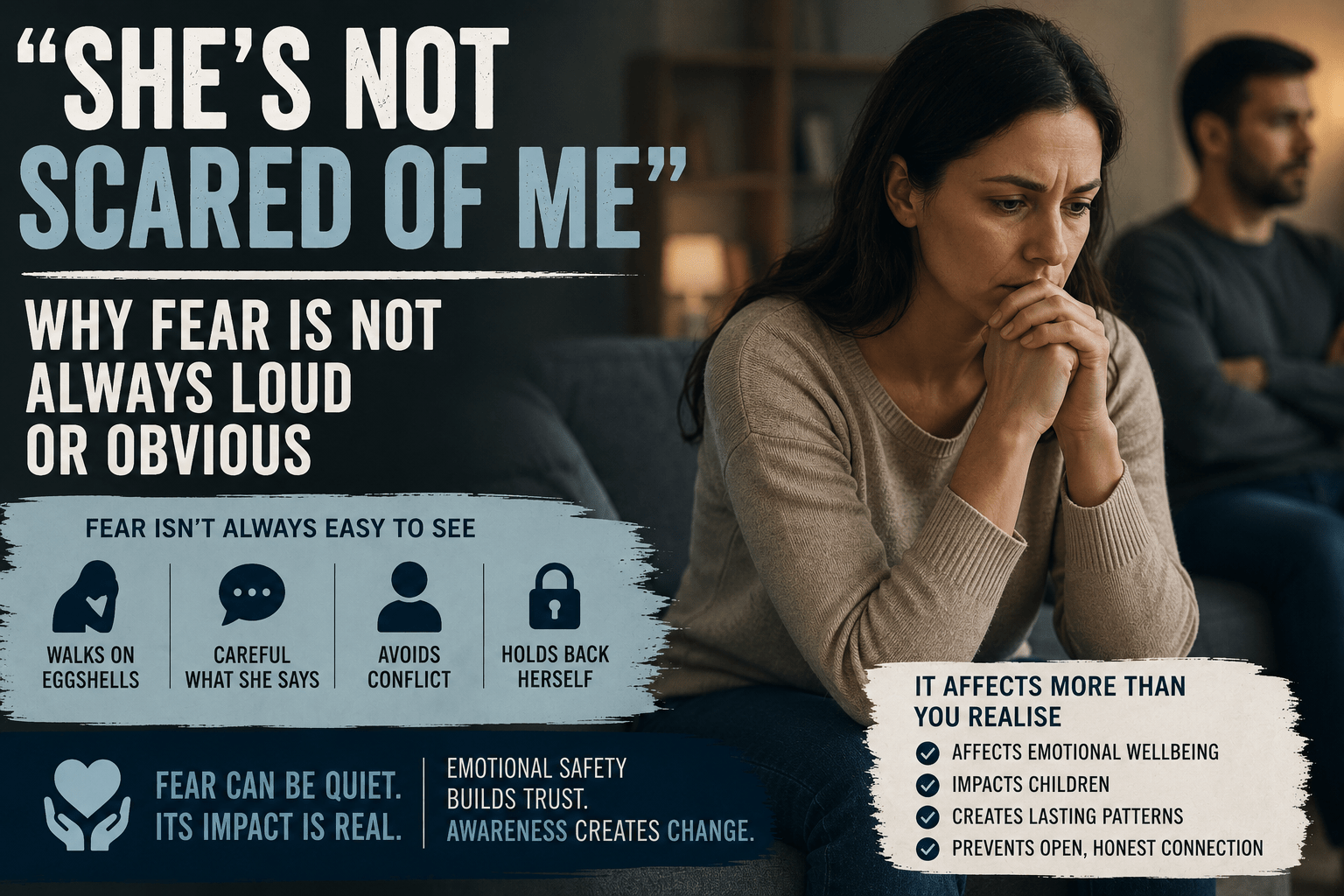
It can look like:
- Going quiet during conversations
- Agreeing quickly to avoid escalation
- Choosing words carefully
- Withholding opinions
- Monitoring mood and tone
- Avoiding certain topics altogether
These aren’t signs of comfort.
They’re signs of adaptation.
They’re signs of fear!
Fear as Adjustment, Not Reaction
In many relationships, fear doesn’t show up as a dramatic reaction—it shows up as ongoing adjustments, adaptations and compromises.
The other person learns:
- What sets you off
- What tone to avoid
- When to back down
- How to keep things “smooth”
Over time, this becomes automatic.
From the outside, it can look like cooperation, calmness, even harmony. It can seem that they are a couple that are in-sync with one another and the “perfect” couple. But underneath, it may be driven by a simple calculation: “What do I need to do right now to prevent this from escalating?”
That’s not safety.
That’s management.
“She Would Tell Me If There Was a Problem”
Another common assumption is that fear would be expressed directly. “If she was scared, she’d say something.” But this overlooks an important reality:
People don’t always speak up when they feel unsafe—especially if past experiences have shown that speaking up leads to being dismissed, argued with, blamed or even making things worse. They may also question their own experiences as being insignificant, or a wife’s role, because there hasn’t been physical violence or her upbringing showed that is her responsibility as a wife.
If raising an issue increases tension rather than resolving it, or reinforces beliefs that she is expected to make adjustments, silence can feel like the safer option. So instead of confronting the behaviour, the person adapts around it.
The Cumulative Effect of Behaviour
Fear in relationships is often less about a single moment and more about a pattern over time.
It can be shaped by:
- Repeated anger or intensity
- Sudden shifts in mood
- Harsh tone or language
- Persistent criticism
- Pressure to agree or comply
Even if none of these behaviours involve physical violence, they can still create an environment where the other person feels on edge, uncertain, careful or even restricted
The impact isn’t always immediate—but it accumulates.
How Children Experience This Environment
Children are often the most sensitive observers in these dynamics. They don’t need explicit fear to understand what’s happening. They read:
- Tone
- Body language
- Timing
- Silence
In environments where one parent’s reactions are unpredictable or intense, children may:
- Become hyper-aware of emotional shifts
- Try to “keep the peace”
- Avoid drawing attention to themselves
- Mirror the same patterns in their own behaviour
They learn not just from what is said—but from what is felt. And what they feel is whether the environment is consistently safe or not.
Why This Is Easy to Miss
From your perspective, you might not feel threatening.
You may think:
- “I’m just expressing myself.”
- “I’m passionate, not aggressive.”
- “I calm down quickly—it’s not a big deal.”
But impact isn’t determined by intention. It’s determined by how your behaviour is experienced by the other person. And when fear is quiet, it doesn’t provide obvious feedback.
There’s no clear signal that says: “This is too much.”
Instead, there’s adjustment. Accommodation. Silence. Which can easily be misread as everything being okay.
A More Useful Question
Rather than asking: “Is she scared of me?”
A more accurate question is: “Does my behaviour ever make it harder for her to be fully herself around me?”
That includes:
- Speaking freely
- Disagreeing openly
- Expressing needs without hesitation
- Feeling relaxed, not watchful
If the answer is uncertain, that’s worth paying attention to.
Moving Toward Clarity
Recognising subtle fear isn’t about labelling yourself as a bad person. It’s about becoming more precise in how you understand the impact of your behaviour.
That means noticing:
- When conversations shift because of your tone
- When the other person withdraws or changes approach
- When agreement comes too quickly
- When issues stop being raised altogether
These are not signs that things are working. They’re often signs that something has been learned.
Final Reflection
Fear in relationships doesn’t always shout.
Sometimes it whispers.
Sometimes it adapts.
Sometimes it disappears into behaviour that looks like cooperation.
But its presence is felt in what’s missing:
- Openness
- Ease
- Honesty
- Freedom to disagree
“She’s not scared of me” might feel reassuring.
But the more important question is:
Does she feel fully safe to be herself around you—without managing your reactions?
That’s the standard that matters.