“I Was Drunk”: Why Alcohol Explains Less Than Men Think
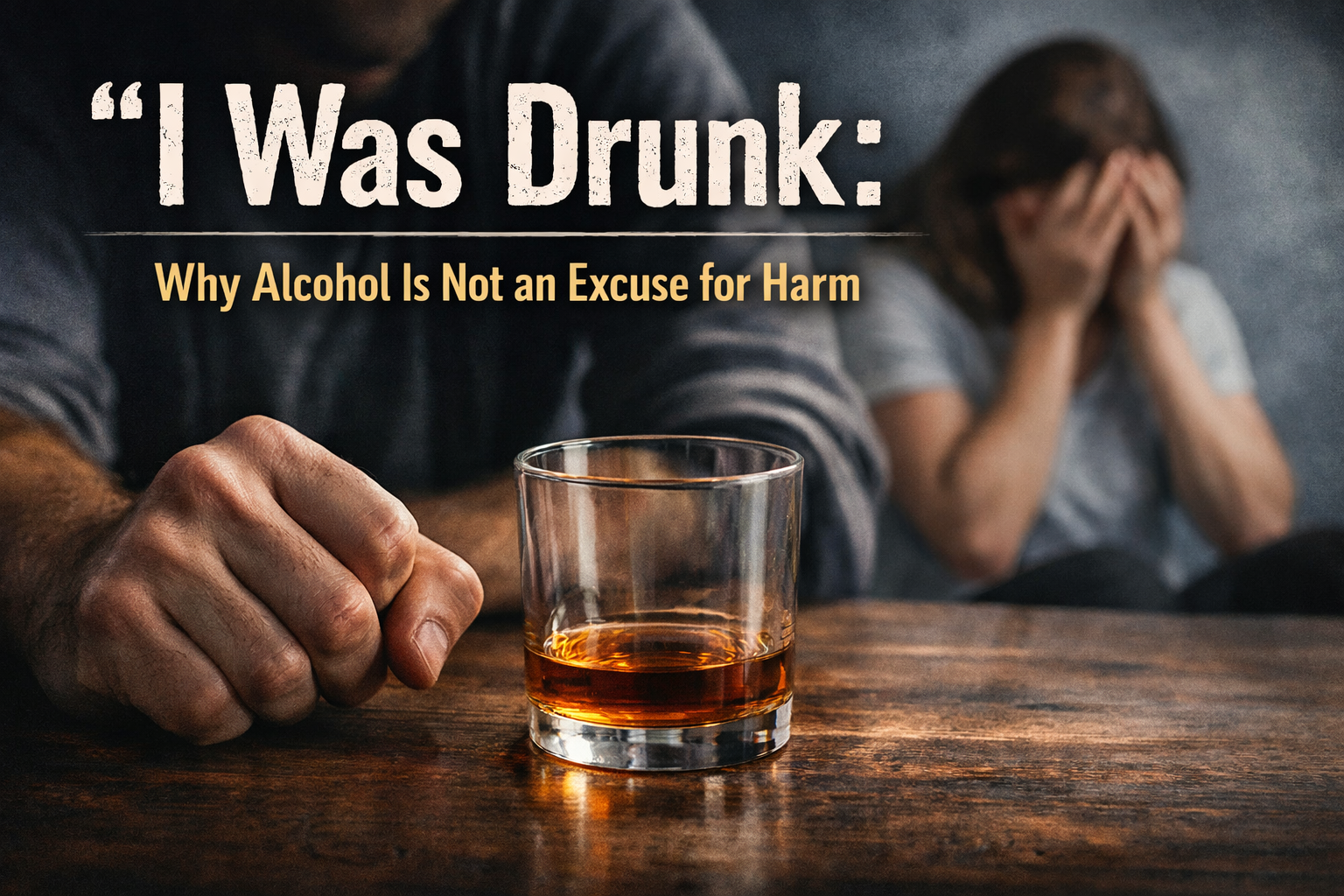
“I was drunk.”
For many men, those three words feel like an explanation. Sometimes they are offered as an apology. Sometimes as a defence. Sometimes as a way of saying, that wasn’t really me.
But alcohol explains less than many men think.
It may lower inhibitions. It may intensify emotion. It may make someone louder, rougher, less thoughtful, and more impulsive. But alcohol does not create values, entitlement, or coercive patterns out of nowhere. More often, it exposes them. It gives permission to attitudes and behaviours that are already sitting underneath the surface.
That matters, because if a man believes alcohol is the real problem, he may never look closely enough at himself.
And if he never looks closely enough at himself, nothing important changes.
Alcohol can be part of the picture without being the whole story
It is true that alcohol is often present when harm happens in relationships and families. Men may become more verbally abusive, intimidating, sexually pressuring, controlling, reckless, or physically aggressive when drinking. Arguments escalate more quickly. Small frustrations become excuses for outbursts. Boundaries are ignored. Fear grows in the home.
But the presence of alcohol does not automatically mean alcohol caused the behaviour in the way men sometimes suggest.
Many men drink and do not abuse their partner. Many men get drunk and do not threaten, intimidate, corner, humiliate, monitor, smash objects, drive dangerously, pressure for sex, or use violence.
So when a man says, “It was the alcohol,” it is worth asking harder questions:
Why did the alcohol come out in this way?
Why did it come out against her?
Why did it involve control, blame, intimidation, or entitlement?
Why did the behaviour keep serving the man’s needs while costing someone else their safety?
Those questions are uncomfortable. But they are the questions that actually matter.
Alcohol does not invent a sense of entitlement
One of the most common mistakes men make is to treat alcohol like a switch that temporarily turned them into somebody else. But in many cases, alcohol does not invent the behaviour. It strips away restraint around beliefs that are already there.
Beliefs like:
- “I should not be questioned.”
- “When I’m upset, everyone else needs to deal with it.”
- “My anger is more important than her fear.”
- “If I feel rejected, I have a right to punish.”
- “If I’ve had a hard week, I deserve to let off steam.”
- “She should know not to push my buttons when I’m drinking.”
These beliefs are rarely spoken this plainly. But they often sit underneath the behaviour.
That is why alcohol-focused explanations can be so misleading. They keep attention on the drink instead of the deeper issue: the man’s way of thinking, his responses to frustration, his expectations of his partner, and the permission he gives himself when he feels hurt, angry, ashamed, ignored, or challenged.
“I don’t even remember” is not the same as “I’m not responsible”
Another common response is memory loss. A man says he blacked out. He says he only remembers parts of the night. He says he woke up ashamed and confused. He says he cannot believe what he said or did. Sometimes that is true. Not remembering harm is not the same as not causing harm.
For the person on the receiving end, the impact is still real. She remembers the yelling. She remembers the threat in his face. She remembers how he stood over her, blocked the doorway, grabbed her phone, insulted her, demanded sex, drove dangerously, woke the children, smashed the wall, or made her feel like she had to manage him all night to keep things from getting worse.
Her body remembers, even if his mind is foggy.
And this is part of why alcohol can be so damaging in relationships. It allows the man to feel distance from the very behaviour she is still carrying in her nervous system.
He says, “I barely remember it.”
She thinks, “I haven’t stopped thinking about it.”
The pattern after drinking often tells you more than the drinking itself
If a man really wants to understand whether alcohol is just a factor or part of a broader pattern of abuse, one of the most important places to look is what happens afterwards.
Does he:
- minimise what happened?
- argue about details?
- focus on whether she “provoked” him?
- expect quick forgiveness because he was drunk?
- become self-pitying instead of accountable?
- promise to stop drinking, then avoid talking about the behaviour?
- act like the real issue is her reaction, not his actions?
- become affectionate the next day and expect that to reset everything?
If so, the problem is not just alcohol. The problem is the system around the behaviour: minimising, blame-shifting, entitlement, image management, and avoidance of accountability.
A man who is serious about change does not only say, “I need to drink less.”
He also says, “I need to understand what I give myself permission to do when I drink. I need to face the impact I had. I need to look at the attitudes and patterns that alcohol has been helping me excuse.”
Stopping alcohol may reduce incidents, but it does not automatically create safety
This is an important distinction. Some men do stop drinking and see an immediate drop in explosive incidents. That can be significant. It can reduce risk. It can create some breathing room. But sobriety alone does not equal safety. A man can be sober and still be controlling. He can be sober and still emotionally abusive.
He can be sober and still monitor, punish, intimidate, sulk, manipulate, pressure, isolate, undermine, or make his partner feel afraid of his reactions. He can be sober and still expect the household to revolve around his moods.
This is why some partners say, “Things are better since he stopped drinking, but I still don’t feel safe.” That feeling matters. Because safety is not just the absence of alcohol-fuelled incidents. It is the presence of respect, consistency, accountability, emotional regulation, and freedom from coercion.
Sometimes alcohol is used as an excuse before the first drink is poured
In some relationships, alcohol becomes a ready-made defence long before anything happens.
Everyone knows the script:
“He gets like that when he drinks.”
“Just leave him alone tonight.”
“Don’t argue with him, he’s had too much.”
“He didn’t mean it, he was wasted.”
Over time, alcohol becomes built into the couple’s reality as though it is a separate character in the relationship. The drink gets blamed. The man gets excused. The partner adapts. The children learn to read the signs. Everyone starts organising themselves around his intoxication.
This is deeply unsafe.
Because once alcohol becomes the explanation everyone reaches for, the man is protected from a more confronting truth: his behaviour is still his behaviour.
Yes, drinking may make things worse. But other people should not have to become smaller, quieter, more careful, more accommodating, or more afraid because a man has been drinking.
Shame can keep men stuck in shallow explanations
Some men cling to alcohol explanations not because they are deliberately manipulative, but because the alternative feels unbearable. If alcohol is the reason, then maybe he is not “that kind of man.” If alcohol is the reason, then maybe the incident was out of character. If alcohol is the reason, then maybe he does not have to ask himself whether there is something more troubling in the way he handles power, resentment, humiliation, or rejection. This is where shame can get in the way of accountability.
Shame says: If I look too closely, I’ll discover I’m a monster.
Accountability says: If I don’t look closely, I’ll keep causing harm.
Men’s behaviour change work is not about branding men as irredeemable. It is about helping them tell the truth. Not the easiest truth. The useful truth. And often the useful truth is not simply, “I drink too much.”
It is more like:
“I use alcohol to avoid responsibility for how I behave.”
“I become more dangerous when I feel entitled, aggrieved, or challenged.”
“I expect others to absorb the consequences of my emotional state.”
“I have been focusing on my intention and ignoring my impact.”
“I have treated alcohol like the problem because that is less confronting than looking at my behaviour.”
That is where change begins.
Children are affected too, even when they are not the direct target
Many men focus narrowly on whether they physically hurt their partner. They overlook the wider impact of alcohol-related behaviour in the home.
Children notice the unpredictability.
They notice tone changes, smashed objects, arguments late at night, the look on their mother’s face, the tension in the house, the next-day silence, the apology cycle, the excuses, the promises, the way everyone becomes alert when dad has been drinking.
Even if a child is never directly yelled at, they are still being shaped by the emotional climate. around them. They may learn that men’s anger must be managed. They may learn that alcohol gives permission for cruelty. They may learn that fear is normal in close relationships. They may learn to become hypervigilant, responsible, quiet, or protective far too early.
A man who wants to be a safe father needs to take this seriously. Not just whether he “crossed a line,” but what atmosphere he creates in his home.
Real accountability sounds different
When a man is still hiding behind alcohol, his language often sounds like this:
- “I was drunk.”
- “I didn’t mean it.”
- “That’s not who I am.”
- “I just need to stop drinking.”
- “It only happens when I’ve had too much.”
- “She knows what I’m like when I drink.”
- “I’m under a lot of stress.”
When a man is moving toward accountability, it starts to sound more like this:
- “Alcohol made it easier for me to act on attitudes I need to confront.”
- “Even if I was drunk, I am still responsible.”
- “I need to understand why my anger and entitlement come out like this.”
- “Stopping drinking may be necessary, but it is not enough.”
- “The impact on my partner and children matters more than my excuses.”
- “I need help to change the pattern, not just manage the image.”
That shift in language matters because it reflects a shift in ownership.
And without ownership, change rarely lasts.
What change usually requires
For some men, reducing or stopping alcohol will be part of real change. Sometimes a substance use response is needed. Sometimes individual counselling, group work, or more structured support is necessary. Sometimes all of those things matter.
But genuine behaviour change also requires:
- honest reflection on beliefs about anger, control, and entitlement
- learning to tolerate frustration without punishing others
- understanding the impact of intimidation, coercion, and unpredictability
- stopping blame-shifting and minimising
- listening to the partner’s experience without defensiveness
- building consistent, respectful behaviour over time
- accepting that apologies are not the same as repair
This is slower work than simply saying, “I need to cut back.”
But it is the work that actually protects people.
The question is not whether alcohol played a role
Often, it did. The more important question is whether alcohol has become a shield against looking at the full picture.
If a man only asks, “How do I stop drinking so this doesn’t happen again?” he may miss the harder question: “What is it about the way I think, feel, and act that alcohol has been helping me excuse?” That question is more confronting.
It is also more hopeful.
Because once a man stops using alcohol as the whole explanation, he can begin to face the real drivers of harm. And when he faces those honestly, change stops being performative and starts becoming meaningful.
Saying “I was drunk” may explain why the mask slipped.
It does not explain away what was underneath it.