Why Unpredictability Makes Relationships Feel Unsafe
Safety in a relationship is not only about what happens during the worst moments. It is also about what people learn to expect from each other over time. A relationship can become unsafe when one person’s mood, reactions, availability, anger, affection, or level of control feels unpredictable, because unpredictability trains the people around them to stay alert.
When someone does not know which version of their partner they will get, they often begin to organise themselves around preventing the next shift. They may monitor tone, facial expression, silence, alcohol use, stress levels, messages, footsteps, or small changes in body language. They may hesitate before speaking, delay raising concerns, keep the children quiet, soften normal requests, or try to predict what will create tension.
This is one of the reasons inconsistency can be so damaging. The person affected may not only be responding to what is happening now; they may be responding to what they have learned could happen next. Even if the man is calm in the present moment, the history of unpredictable reactions can make the relationship feel unsafe.
Unpredictability Changes How People Move Through the Relationship
In a safer relationship, people generally know what to expect from each other. This does not mean everyone is always calm, agreeable, or emotionally steady. It means there is enough consistency that disagreement, disappointment, tiredness, mistakes, and stress do not create fear about what might happen next.
In an unsafe relationship, the emotional climate can shift quickly. A partner may not know whether a simple question will be answered normally or taken as criticism. She may not know whether asking for help will lead to cooperation, defensiveness, irritation, or withdrawal. She may not know whether saying no will be accepted or punished. She may not know whether he will be affectionate, distant, apologetic, suspicious, resentful, calm, or explosive.
Over time, this uncertainty becomes exhausting. The affected person may start living in a state of anticipation rather than ease. She may try to read the room before speaking, adjust her behaviour before any visible problem occurs, or feel anxious even during calm periods because calm has not always lasted.
This is important for men doing behaviour change work to understand. A partner’s guardedness may not mean she is unwilling to move forward. It may mean she has learned that stability can disappear quickly.
Mood Volatility Creates Hyper-Alertness
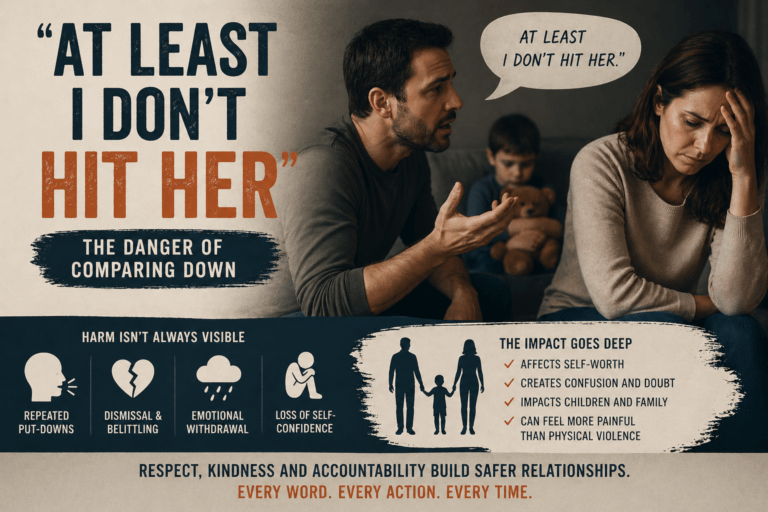
Mood volatility does not have to involve obvious rage to create unsafety. It may include sudden irritation, emotional withdrawal, coldness, sulking, sarcasm, defensiveness, intense sadness, suspicion, panic, or a dramatic shift from affection to distance. When these changes happen repeatedly, the people nearby often become highly tuned to early warning signs.
A partner may notice when his voice changes slightly, when he becomes quiet in a particular way, when his responses become shorter, when he starts pacing, when he drinks more, when he checks his phone differently, or when his face hardens. These details may seem minor from the outside, but in the context of a repeated pattern they can carry meaning.
This kind of hyper-alertness is not simply “overreacting”. It is often an adaptation to uncertainty. The person is trying to detect risk early enough to prevent escalation, criticism, interrogation, withdrawal, or punishment. The problem is that living this way takes a significant emotional toll. It can affect sleep, concentration, parenting, decision-making, physical health, and the person’s ability to feel relaxed in their own home.
For children, mood volatility can also become part of the household climate. Children may learn to scan a parent’s mood before asking for something, making noise, playing, expressing feelings, or approaching for connection. They may not have the language to describe the pattern, but they often feel it.
Inconsistency Can Feel Like a Trap
Inconsistency can be confusing because it is often mixed with positive moments. A man may sometimes be kind, affectionate, remorseful, generous, playful, thoughtful, or calm. There may be good days, meaningful conversations, apologies, promises, or periods where everything seems better.
These moments can be real, but they do not automatically create safety if they are not reliable.
When kindness is unpredictable, the relationship can become emotionally disorienting. The affected person may hold onto the good moments while also fearing the next shift. She may wonder whether she is being unfair by focusing on the harmful behaviour, especially if he has recently been loving or apologetic. She may minimise her own fear because the relationship is not always bad.
This is one of the ways unsafe relationships can keep people stuck. The good moments create hope, while the unpredictable harmful moments create fear. The person may keep adjusting, forgiving, explaining, waiting, or trying harder because she hopes the safer version of him will stay.
For men, this can be difficult to understand. He may see the good moments as evidence that the relationship is safe or improving. She may experience the same good moments differently: as relief, hope, or a temporary pause, but not yet as trust. Trust is not built by occasional calm or kindness. It is built by consistency over time, particularly when the man is disappointed, stressed, rejected, ashamed, or not getting what he wants.
Emotional Instability Can Make Others Responsible
Emotional instability becomes unsafe when one person’s internal state regularly becomes everyone else’s responsibility. This may happen when a man expects his partner, ex-partner, or children to manage his anger, soothe his shame, reassure his insecurity, prevent his jealousy, calm his anxiety, or adjust their behaviour so he does not become overwhelmed.
In this pattern, other people begin organising their choices around his emotional state. They may avoid saying things that could upset him, provide reassurance before he asks for it, apologise quickly to keep things settled, change plans to avoid triggering suspicion, or take responsibility for his feelings before he has taken responsibility for his behaviour.
This is different from mutual care. In healthy relationships, people support each other emotionally. They show compassion, offer comfort, and try to be considerate. But support becomes unsafe when one person’s emotional regulation depends on other people surrendering their needs, boundaries, honesty, or independence.
A man may genuinely feel distressed. He may feel ashamed, afraid, rejected, or out of control. Those feelings may deserve support, but they do not justify making others responsible for preventing his reactions. Emotional safety requires him to develop ways of managing his internal experience without using pressure, blame, withdrawal, control, or intimidation.
The Impact of Never Knowing What Comes Next
One of the most damaging aspects of unpredictability is that it affects people even when nothing obvious is happening. The affected person may appear tense during ordinary moments because she is waiting to see whether the mood will change. She may become careful in a conversation that seems harmless. She may avoid asking a reasonable question because she cannot predict whether it will lead to calm discussion or hours of tension.
This can lead to a relationship where the person no longer responds only to the present. She responds to the pattern. A neutral facial expression may feel threatening because it has previously come before criticism. A quiet evening may not feel peaceful because silence has previously been used as punishment. A request to “talk later” may feel frightening because “later” has previously meant interrogation, blame, or pressure.
When men focus only on the present moment, they can miss this. He may say, “I’m not doing anything right now,” or “I’m calm today,” or “You’re reacting to something that hasn’t happened.” From his perspective, that may feel true. From her perspective, the current moment is connected to the history of what similar moments have meant before.
Safety requires understanding that patterns create expectations. If a pattern has taught someone to brace, she may continue bracing until a different pattern has been demonstrated consistently enough to feel real.
Unpredictability and Control
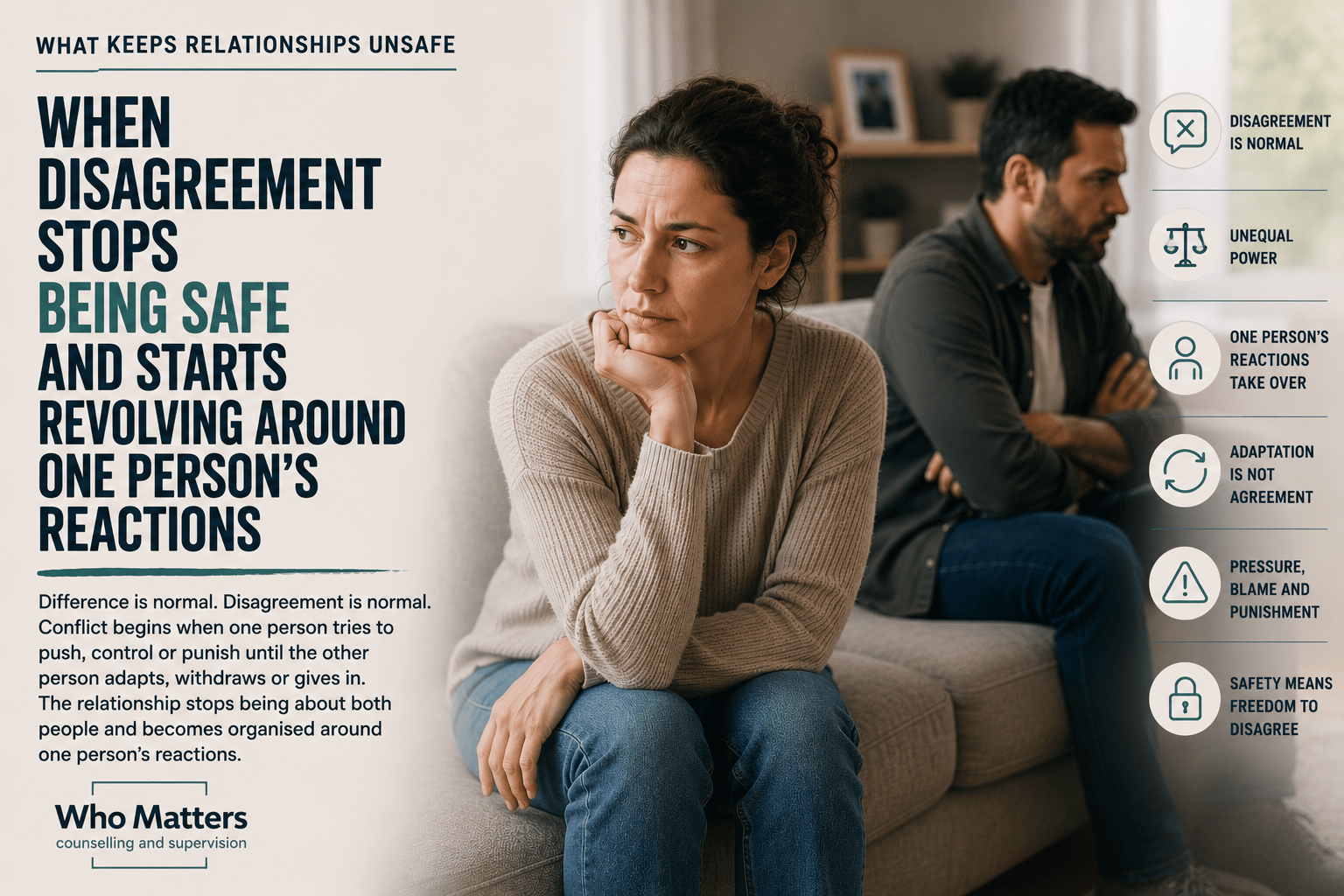
Unpredictability is not always accidental. Sometimes it functions as a form of control, even if the man does not consciously plan it that way. When people cannot predict how someone will respond, they may become more compliant, more cautious, and less likely to challenge them.
A partner may stop raising issues because she does not know whether he will respond with reflection or defensiveness. She may stop seeing certain people because she does not know whether it will lead to suspicion. She may stop asking for support because she does not know whether he will help or make her regret asking. She may agree to things she does not want because the cost of saying no feels uncertain.
In this sense, unpredictability can reduce freedom. The affected person’s choices become shaped by risk calculation. She may not be directly told what to do, but she learns which choices are likely to create emotional consequences. The relationship becomes organised around avoiding the unpredictable reaction.
This is why it is not enough for a man to say he did not mean to be controlling. The important question is whether his inconsistency has caused others to become less free around him.
Apologies Do Not Erase the Pattern
After an unpredictable or harmful reaction, a man may apologise sincerely. He may feel remorse, explain what was happening for him, promise to do better, and appear genuinely upset about the impact. Apologies can matter, but they do not erase the pattern.
If the same cycle repeats, apology can become part of the unpredictability. There may be tension, reaction, harm, remorse, closeness, hope, and then another shift. The affected person may become unsure which part of the cycle is real. She may want to believe the apology, but her body may still prepare for the next change.
This is why rebuilding safety requires more than regret. It requires predictability in behaviour. A man needs to show, repeatedly, that he can respond safely when he is disappointed, challenged, tired, ashamed, jealous, or distressed. He needs to show that his partner or ex-partner can say no, raise concerns, disagree, take space, or set boundaries without being punished by his mood.
The apology may be the beginning of accountability, but consistency is what makes safety possible.
Why Calm Periods May Not Feel Safe
Men can become frustrated when their partner does not relax during a calm period. He may feel that she is holding onto the past, refusing to acknowledge change, or waiting for him to fail. He may think that because there has not been an incident recently, the relationship should feel better.
However, from her perspective, a calm period may not be enough to undo the pattern. If calm has previously been temporary, she may not experience it as safety. She may experience it as the uncertain space before the next shift.
This is not necessarily resentment or unfairness. It may be the nervous system doing what it has learned to do. If the relationship has been unpredictable, the body may continue scanning for risk even when the mind wants to believe things are improving.
For behaviour change to be meaningful, the man must accept that safety is not restored simply because he feels different today. The people around him need time and repeated evidence that his reactions are becoming consistently safer.
Predictability Is Built in Difficult Moments
It is easy to appear safer when things are going well. The real test of predictability happens when something does not go the way a man wants. This may include being told no, feeling criticised, being asked to wait, having a parenting decision challenged, not receiving reassurance, dealing with separation, seeing his ex-partner make independent choices, or feeling ashamed about something he has done.
These moments reveal whether change is becoming reliable. Can he pause without punishing? Can he take space without creating fear? Can he hear feedback without turning the conversation into his own injury? Can he accept a boundary without repeated pressure? Can he manage jealousy without monitoring? Can he stay respectful when he feels rejected?
Predictability is built when the answer becomes increasingly yes, not just once, but repeatedly. It is built when the people around him no longer have to wonder which version of him will appear when he is under emotional pressure.
This does not require perfection. It requires responsibility, repair, and a clear reduction in the patterns that previously created fear.
What Safer Consistency Looks Like
Safer consistency is not about becoming emotionally flat or pretending not to have feelings. It is about becoming more reliable in how those feelings are handled. A safer person can be upset without becoming intimidating, disappointed without punishing, ashamed without making others responsible, jealous without monitoring, and angry without using fear to regain control.
In practice, this may mean using time-out appropriately, respecting a partner’s request for space, returning to conversations when calm, seeking support outside the relationship, being honest about urges to control, and noticing early signs of escalation before others have to manage them. It also means following through on commitments, being predictable with parenting, communicating clearly, and not making affection or cooperation dependent on whether others meet his emotional needs.
For men who have used abusive or controlling behaviours, consistency also means accepting that others may continue to be cautious for a while. Their caution is not the problem to be fixed. The problem is the pattern that made caution necessary.
Questions for Men Who Want to Change
A useful way to reflect on unpredictability is to ask whether the people closest to you can reasonably know what to expect from you. Can your partner or ex-partner raise a concern without wondering whether you will become defensive, cold, angry, or overwhelming? Can your children approach you when you are stressed, or do they wait to see what mood you are in? Can others say no without needing to prepare for the emotional consequence?
It is also worth considering whether your apologies are followed by consistent change, whether your calm periods are reliable enough for others to relax, and whether people around you are becoming freer or more careful over time. If others are monitoring your mood, softening their needs, avoiding ordinary conversations, or changing their behaviour to prevent your reactions, then unpredictability may be part of the harm.
These questions are not about shame. They are about responsibility. Behaviour change requires understanding not only the worst incidents, but the emotional climate created between them.
Safety Requires Reliability
A relationship becomes safer when people know they can be honest without fear of sudden consequences. They do not need to constantly assess the mood of the room, predict the next reaction, manage someone else’s shame, or adjust their behaviour to prevent emotional instability.
Reliability allows people to breathe. It allows children to relax. It allows partners and ex-partners to set boundaries without preparing for punishment. It allows disagreement to remain disagreement rather than becoming a crisis.
For men who want to change, this means recognising that safety is not created by occasional calm, occasional kindness, or sincere apologies after harm. Safety is created through consistent behaviour over time, especially in the moments when old patterns would usually appear.
Unpredictability trains people to stay alert. Consistency helps them slowly learn that they no longer have to.