“She Knows What I’m Like”: Why Predictable Harm Is Still Harm
One of the ways harmful behaviour becomes normalised in relationships is through familiarity. A man may say, “She knows what I’m like,” as though repeated behaviour becomes less serious because it is expected. He may describe his anger, jealousy, withdrawal, pressure, interrogation, intimidation, or controlling behaviour as part of his personality, his stress response, or the normal pattern of the relationship.
At first glance, this may sound like honesty. He may believe he is simply acknowledging something about himself: that he gets worked up, needs reassurance, becomes jealous, shuts down, keeps pushing for answers, or struggles when he feels rejected. But when the phrase is used to excuse behaviour, it becomes a problem.
“She knows what I’m like” can become a way of shifting responsibility. Instead of asking whether his behaviour is safe, respectful, or acceptable, the focus moves to whether she should have expected it. The implication is that because the pattern is familiar, she should know how to avoid it, manage it, tolerate it, or stop being affected by it.
Predictable harm is still harm. In fact, when harmful behaviour becomes predictable, the damage can become more entrenched because the other person starts organising their life around it.
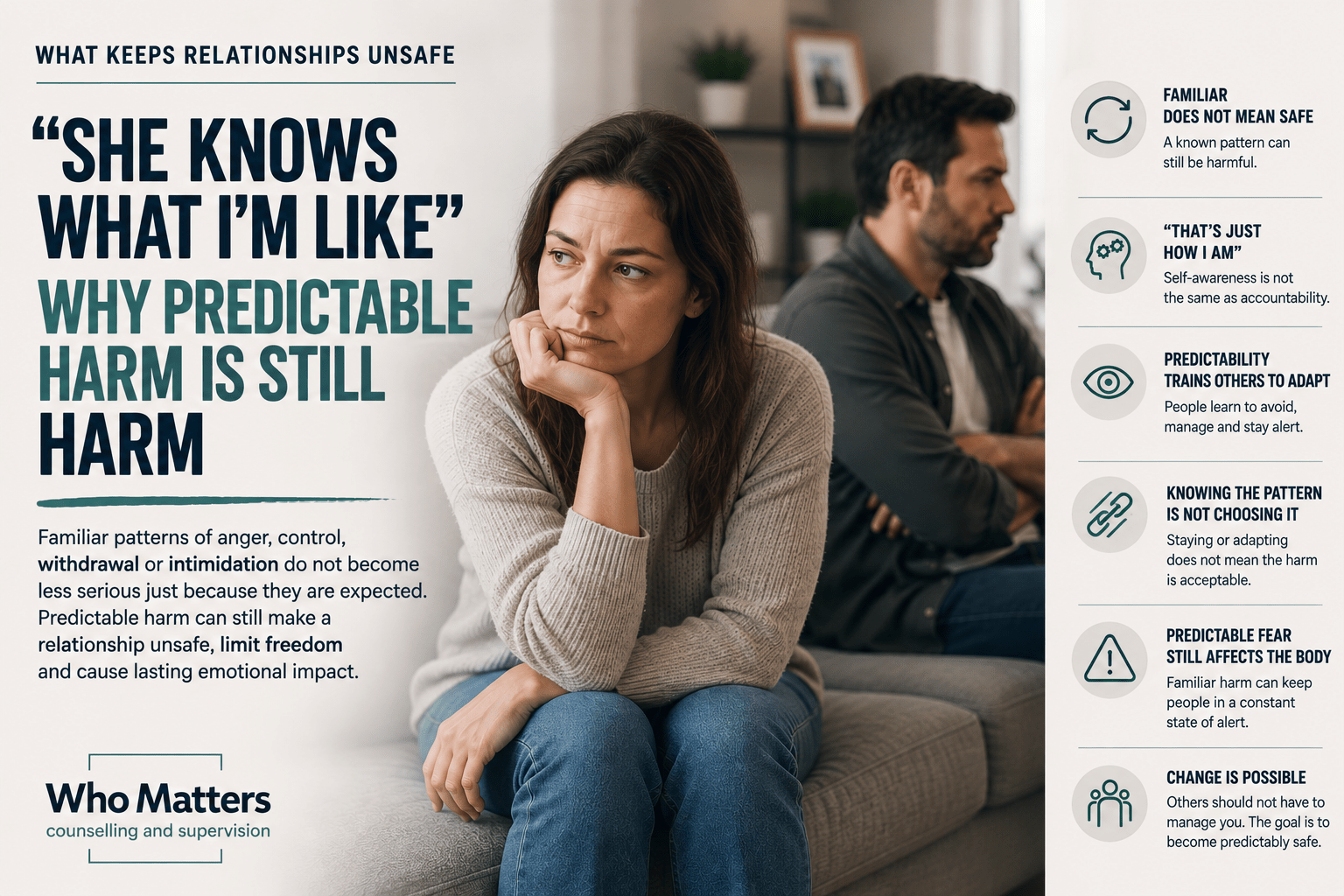
Familiar Does Not Mean Safe
A relationship can become unsafe not only through sudden, unexpected incidents, but also through patterns that become familiar. If someone knows that raising a concern will lead to defensiveness, that saying no will lead to sulking, that seeing friends will lead to suspicion, or that asking for space will lead to pressure, the predictability of the reaction does not make the relationship safer. It often makes the person more careful.
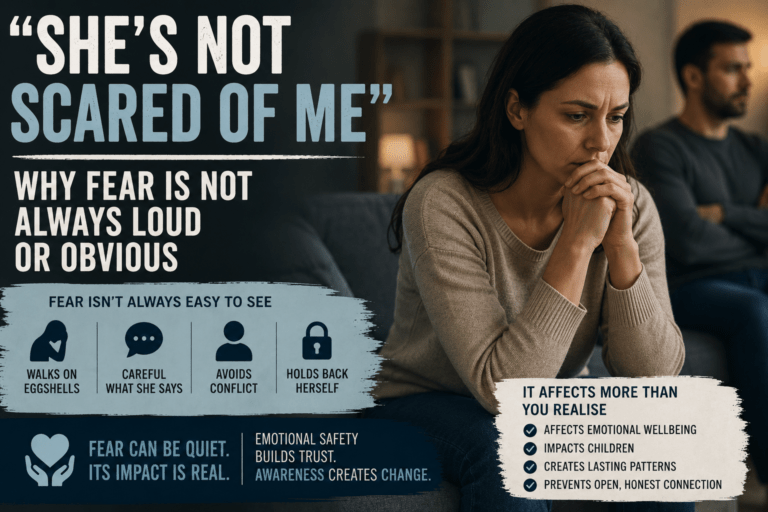
Familiar harm can be especially difficult to name because everyone in the relationship may begin adjusting to it. The affected partner may stop raising certain topics, soften her words, reassure him before he asks, avoid people or places that cause tension, keep the children quiet, hide normal information, or agree to things she does not really want. Over time, these adaptations can become part of the rhythm of the relationship.
From the outside, this may look like stability. There may be fewer obvious arguments because the other person has learned what not to say, when not to speak, and how to reduce the chance of a reaction. But a relationship is not safe simply because the unsafe behaviour has become easier to predict. If one person has to organise themselves around another person’s likely reaction, the relationship is being shaped by fear, pressure, or control.
“That’s Just How I Am” Is Not Accountability
There is an important difference between self-awareness and accountability. Self-awareness might sound like, “I notice I become defensive when I feel criticised, and I need to take responsibility for how I respond.” Accountability includes a commitment to change the behaviour and repair the impact.
“That’s just how I am” does not do that. It turns a behaviour into an identity, which can make change seem optional or unrealistic. If anger, jealousy, control, intimidation, or emotional withdrawal are treated as fixed parts of who someone is, the burden often shifts onto the people around him to manage those behaviours.
A man may say he has always had a temper, always needed things explained clearly, always struggled with trust, always hated being ignored, or always reacted badly when he feels disrespected. These may describe long-standing patterns, but they do not excuse the impact. Having a long history of a behaviour does not make the behaviour acceptable. It simply means the pattern has had more time to affect others.
In behaviour change work, the question is not only, “Where did this pattern come from?” It is also, “What does this pattern do to the people around me, and what am I willing to do differently?”
Predictability Can Train Others to Adapt
When harmful behaviour is predictable, the people around it often become skilled at prevention. A partner may know when to stop talking, how to phrase a concern, which subjects to avoid, how much reassurance to give, when to apologise, when to go quiet, and how to manage the children so they do not become part of the tension.
This kind of adaptation can be mistaken for agreement or acceptance. A man may believe his partner is choosing to go along with things, when she may actually be trying to avoid the predictable consequence of not going along with them. She may appear calm because she has learned that visible distress makes things worse. She may stop saying no because no has previously created pressure, punishment, or emotional fallout. She may stop challenging his version of events because the cost of doing so has become too high.
This is one of the reasons the phrase “she knows what I’m like” is so concerning. It can imply that her knowledge creates responsibility. If she knows he becomes angry when she raises a concern, then she should raise it differently. If she knows he becomes jealous when she goes out, then she should reassure him more. If she knows he shuts down when challenged, then she should be softer. If she knows he keeps arguing until he feels understood, then she should keep explaining.
In this pattern, her awareness of his behaviour becomes another demand placed on her. Instead of his behaviour changing, her life gets smaller.
Knowing the Pattern Does Not Mean Choosing It
One of the most harmful assumptions in unsafe relationships is that if a partner stays, returns, forgives, reassures, or adapts, she must be accepting the behaviour. This misunderstands how unsafe patterns operate.
People stay in difficult relationships for many reasons. They may love the person. They may hope things will change. They may be worried about the children, finances, housing, family reactions, community pressure, legal processes, or what might happen if they leave. They may have experienced periods of kindness, remorse, affection, or calm that make the relationship feel confusing rather than clearly unsafe. They may also be afraid that leaving or setting firmer boundaries will escalate the behaviour.
Staying does not mean the harm is acceptable. Adapting does not mean the harm is harmless. Knowing what is likely to happen does not mean the affected person has freely chosen it.
A person can understand the pattern and still be trapped by it. She can predict the reaction and still be harmed by having to live around it. She can know what he is like and still deserve safety, respect, freedom, and dignity.
Predictable Fear Still Affects the Body
When someone lives with repeated harmful patterns, their body often learns to prepare before anything obvious happens. She may become tense when he becomes quiet, anxious when he sends a particular kind of message, alert when he walks into the room, or unsettled when she notices a shift in his tone. These responses may appear disproportionate if the current moment is viewed in isolation, but they make sense when understood through the history of the relationship.
A man may say, “I hadn’t even done anything yet,” or “She was already acting scared before I said anything.” From his perspective, that may seem unfair. From her perspective, the current moment may feel connected to many previous moments where similar cues were followed by pressure, anger, withdrawal, blame, or intimidation.
Predictability can therefore create ongoing stress. The affected person is not only responding to individual incidents; she is responding to the possibility of the pattern happening again. This can leave her hyper-alert, emotionally exhausted, and less able to relax even during calm periods.
The same can be true for children. Children may learn which version of a parent is safe to approach, which moods require silence, when to stay out of the way, and how to behave so the household does not become tense. They may not have the language to explain this, but they often understand the emotional pattern very clearly.
“She Should Know Better Than to…” Shifts Responsibility
Another version of “she knows what I’m like” is “she should know better than to do that.” This might be said about raising an issue at the wrong time, speaking in a particular tone, going out with certain people, not replying quickly enough, spending money, disagreeing in front of others, refusing sex, asking for space, or making independent decisions.
The problem with this framing is that it places responsibility for his behaviour onto her choices. Instead of focusing on his reaction, the focus shifts to what she did to activate it. This can sound reasonable on the surface because all relationships involve consideration. Timing, tone, and sensitivity can matter. However, consideration becomes control when one person’s reactions create rules that the other person must follow to avoid consequences.
A partner should not have to organise ordinary choices around preventing anger, jealousy, interrogation, humiliation, withdrawal, or intimidation. She should not have to accept that certain topics, boundaries, friendships, clothes, opinions, needs, or forms of independence are unsafe because “that’s what he’s like”.
If a man reacts harmfully to a boundary, the boundary is not the problem. If he uses fear or pressure in response to disagreement, the disagreement is not the problem. If he becomes controlling when he feels insecure, the insecurity may explain something, but it does not excuse the control.
Normalising Harm Makes Change Less Likely
When a pattern becomes normalised, change becomes harder because the behaviour stops being treated as a choice. The man may see it as inevitable. His partner may start working around it. Others may describe it as his personality, his trauma, his stress, his culture, his anxiety, his temper, or simply how the couple operates.
These explanations may contain fragments of truth, but they can also soften accountability. If everyone understands why he behaves the way he does but nobody clearly names the impact, the affected partner is left carrying the consequences. The relationship may become organised around managing him rather than challenging the pattern.
For men who want to change, this requires a willingness to become less defended about familiar behaviour. It means recognising that the patterns others have adapted to may be the very patterns causing harm. It also means accepting that a behaviour can be understandable and still unacceptable.
This distinction is important. Understanding may help explain where a behaviour comes from, but accountability asks what the behaviour does and what needs to change.
Familiar Patterns Can Still Be Coercive
Coercive control is often maintained through patterns rather than isolated incidents. A man does not always need to give direct orders if his partner already knows the consequences of certain choices. She may know which friends are “not worth the argument”, which subjects will lead to days of tension, which boundaries will be challenged, and which forms of independence will create suspicion or punishment.
In these situations, the control may become less visible because the affected person begins restricting herself. He may not need to say, “You can’t go,” if she has learned that going will lead to interrogation, accusations, coldness, repeated messages, or conflict. He may not need to demand access to her phone if she has learned to keep it visible. He may not need to insist that she reassure him if she has learned to do it before he becomes upset.
This is why focusing only on explicit demands can miss the harm. The question is not only what he directly tells her to do. The question is what she has learned she must do to avoid his reaction.
When a person’s freedom is shaped by predictable consequences, the relationship may be operating through control even if the control is rarely spoken aloud.
Apologies Do Not Undo a Predictable Pattern
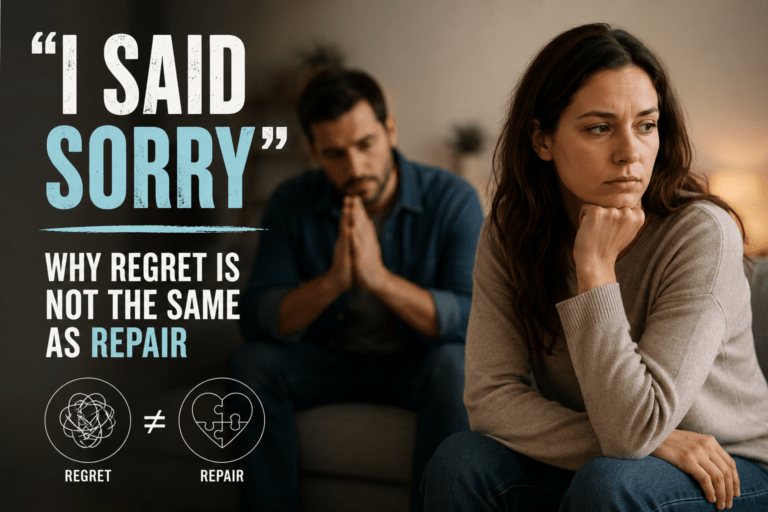
A man may apologise after a harmful incident and genuinely mean it. He may feel remorse, express regret, and want the relationship to feel better. Apologies can be important, but they do not undo a predictable pattern unless they are followed by consistent behavioural change.
If the same behaviour keeps returning, the apology can become part of the cycle. The affected partner may know the sequence: tension, reaction, harm, remorse, closeness, hope, and then the pattern begins again. Over time, even sincere apologies may become difficult to trust because they are attached to repetition rather than change.
This is often frustrating for men who believe their apology should create a reset. He may feel that he has taken responsibility because he said sorry. She may still feel unsafe because she is not only responding to the apology; she is responding to the pattern.
Rebuilding safety requires more than being sorry after harm. It requires becoming more predictable in the direction of safety. That means responding differently when disappointed, ashamed, jealous, rejected, criticised, tired, or afraid. It means showing that others can set boundaries, disagree, say no, take space, or make choices without facing the familiar consequence.
The Impact on Trust
Trust is not only damaged by severe incidents. It is also damaged by repeated smaller moments where someone learns that honesty is not safe, boundaries are not respected, privacy is questioned, feelings are dismissed, or disagreement leads to consequences.
When harm is predictable, trust often declines because the affected person begins to anticipate the next incident. She may stop believing promises, not because she wants to punish him, but because she has learned from experience. She may appear distant, guarded, sceptical, or emotionally unavailable because closeness has not consistently been safe.
A man may experience this as unfair, especially if he is currently trying. He may feel that his partner is holding onto the past or refusing to see the good in him. However, trust does not respond only to effort in the present moment. It responds to accumulated experience over time.
If the accumulated experience has taught her that harm is likely to return, then rebuilding trust requires a long enough pattern of safety to challenge what the relationship has taught her.
What Responsibility Looks Like
Responsibility begins by replacing “she knows what I’m like” with more honest and accountable questions. What has she had to learn about my behaviour in order to protect herself? What does she avoid because of how I might react? What does she no longer tell me? What parts of herself has she made smaller? What do the children monitor in me? What patterns have I expected others to manage instead of changing myself?
These questions are uncomfortable because they move the focus away from intention and towards impact. They also challenge the idea that being predictable makes behaviour less serious. If anything, predictable harm requires deeper accountability because it shows the behaviour is not a one-off mistake. It is a pattern that others have had to live around.
Taking responsibility means recognising that familiarity does not reduce harm. It means understanding that others may be tired of adapting, tired of hoping, and tired of hearing explanations for behaviour that continues. It means accepting that change will be measured not by how well he can describe the pattern, but by whether the pattern becomes safer over time.
Becoming Predictably Safe
For men doing behaviour change work, the goal is not simply to become less explosive or to apologise more quickly. The goal is to become predictably safe.
Predictable safety means the people around you know that your disappointment will not become punishment, your jealousy will not become monitoring, your shame will not become blame, your anger will not become intimidation, and your fear of rejection will not become pressure or control. It means your partner, ex-partner, and children do not have to study your mood in order to know how to move through the day.
This requires consistency in ordinary moments, not only effort after major incidents. It means respecting no the first time, allowing conversations to pause, speaking without contempt, accepting boundaries, telling the truth, seeking support without making others responsible for your emotions, and staying accountable when you do not get the reassurance, forgiveness, or outcome you want.
A safer relationship is not created by others learning how to manage you better. It is created when they no longer need to.
The Familiar Pattern Still Has to Change
“She knows what I’m like” may sound like self-awareness, but if it is used to excuse harm, it becomes another part of the problem. The fact that a partner can predict anger, pressure, control, withdrawal, jealousy, intimidation, or emotional punishment does not make those behaviours acceptable. It often means the harm has become embedded enough that others have had to adapt to it.
Familiarity is not consent. Adaptation is not agreement. Silence is not always peace. A person can know exactly what someone is like and still be harmed by having to live around it.
For men who want to change, the task is not to expect others to understand, manage, or tolerate the pattern. The task is to change the pattern so the people around you have more freedom, safety, dignity, and room to be themselves.
Predictable harm is still harm. Predictable safety is the goal.