“She Pushed My Buttons”: Why Blame-Shifting Keeps Men Stuck
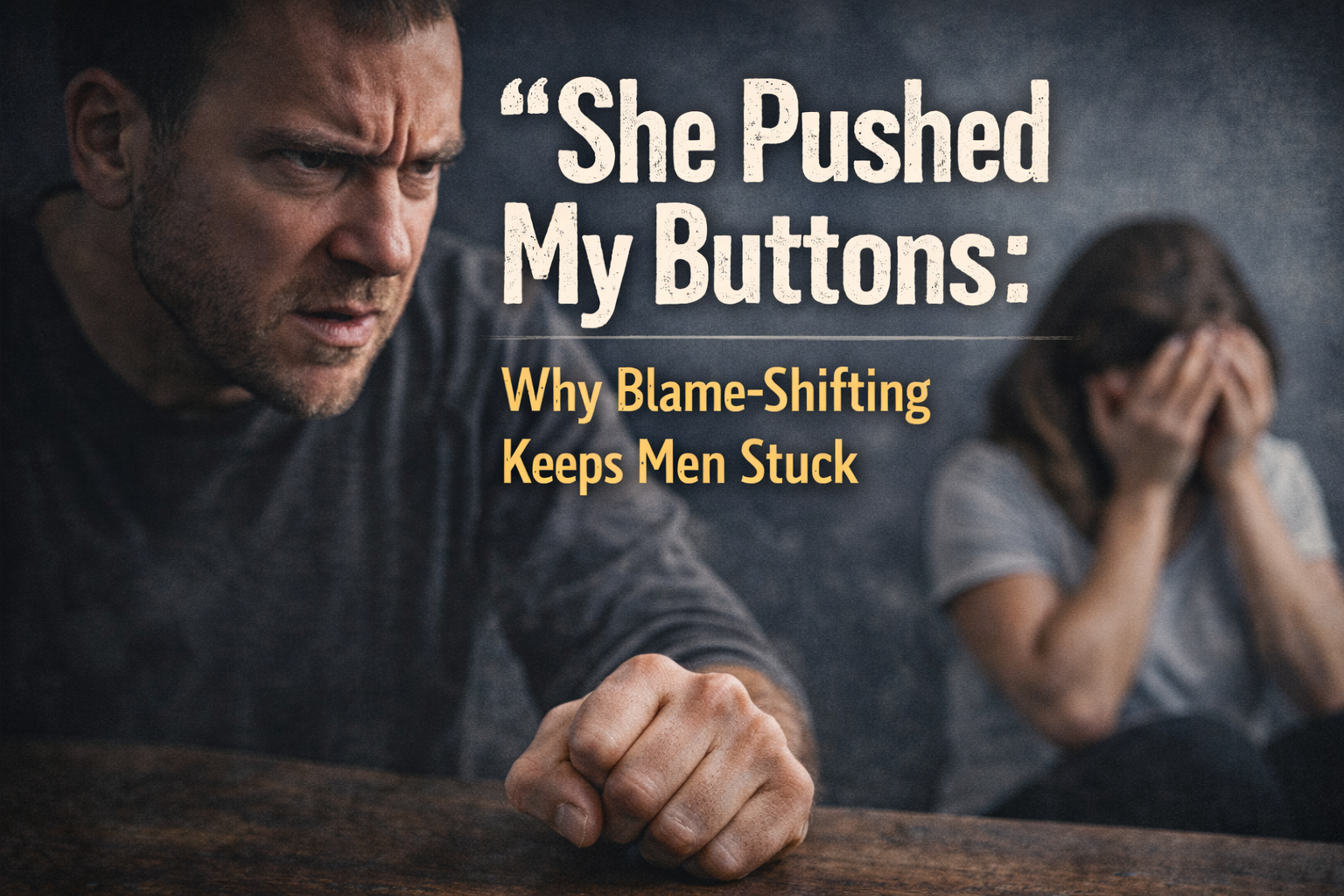
“She pushed my buttons.”
For many men, that phrase feels honest. It sounds like a way of saying, I didn’t react for no reason. It suggests there was pressure, frustration, provocation, or some kind of emotional build-up that helps explain what happened next. And often, there was conflict. There may have been criticism, disagreement, hurt feelings, tone, distance, rejection, or a conversation the man did not want to have.
But “she pushed my buttons” is still blame-shifting.
It takes the focus off the man’s choices and places it onto the woman’s behaviour. It turns her into the cause and him into the reaction. It makes his anger, intimidation, cruelty, or control sound like something that was activated in him, rather than something he is responsible for.
That is a serious problem.
Because as long as a man believes the real issue is what she said, how she said it, when she said it, or how far she pushed him, he will stay stuck. He may change the wording. He may sound more thoughtful. He may even feel ashamed afterwards. But he will not get to the heart of the problem, because he will still be locating the source of his behaviour outside himself.
And change rarely begins there.
The phrase sounds ordinary, but it does important work
“She pushed my buttons” is such a common phrase that it can pass without much scrutiny. It sounds everyday. Familiar. Almost harmless. But look more closely at what it does.
It says:
- My behaviour makes sense because of what she did.
- The real issue is how she affected me.
- Anyone would have reacted badly in that situation.
- I am not the primary problem here.
- If she had acted differently, this would not have happened.
This is why the phrase matters. It does not just describe frustration. It quietly transfers responsibility.
The more a man uses this kind of language, the more he trains himself to see his behaviour as something other people bring out in him. That makes it much harder to confront the reality that his responses belong to him.
Conflict is real. Responsibility is still his.
It is important to be clear about something: acknowledging blame-shifting is not the same as saying women are perfect, conflict never happens, or men never feel genuinely provoked.
Relationships can be difficult.
People can be insensitive, critical, defensive, dismissive, unfair, sarcastic, cutting, or hurtful. Couples can get caught in repetitive arguments. Old resentments can build. Communication can deteriorate. Both people can feel wounded.
None of that changes the central point. A man is still responsible for how he responds. He is responsible if he yells. He is responsible if he intimidates. He is responsible if he follows her from room to room. He is responsible if he smashes things, punches walls, threatens to leave, threatens to take the children, blocks the doorway, corners her, takes her phone, calls her degrading names, or demands she stay in a conversation that no longer feels safe. He is responsible if his anger becomes punishment. And he is responsible if his distress becomes control.
Disagreement is a normal part of a relationship. Even some conflict may be real. But conflict is not the same thing as coercion, intimidation, or abuse. A disagreement does not force a man to become frightening.
“Buttons” language can hide a sense of entitlement
When a man says, “She pushed my buttons,” he is often saying more than he realises. Sometimes underneath that phrase is a deeper belief that he should not have to tolerate certain feelings. He should not have to feel criticised. He should not have to feel ignored. He should not have to feel challenged. He should not have to feel disrespected. He should not have to feel disappointed, contradicted, embarrassed, or frustrated without something in him rising up to restore control.
That matters, because many harmful behaviours are not just expressions of anger. They are attempts to regain position. A man feels exposed, so he talks over her. He feels criticised, so he attacks her credibility. He feels disrespected, so he escalates. He feels powerless, so he makes the interaction intimidating. He feels hurt, so he looks for a way to make her feel it too.
This is why blame-shifting is never just about language. It reflects a way of thinking.
It says: My emotional state explains my behaviour more than my values, choices, or impact do.
That belief keeps men trapped in reactive patterns for years.
The button metaphor is misleading
The idea of “buttons” suggests something mechanical.
She pressed.
He reacted.
Simple.
Automatic.
Almost unavoidable. But men are not vending machines. They are not devices with hidden triggers that other people are responsible for managing carefully enough to prevent an outburst.
The button metaphor is seductive because it removes agency. It makes behaviour sound immediate and externally caused. Yet in many situations, men are making a series of choices, even if quickly. Choices to keep going. Choices to raise their voice. Choices to stay close when the other person wants space. Choices to keep texting, keep accusing, keep interrogating, keep demanding, keep punishing, keep insisting on the last word.
Even when emotion is strong, there are still decisions being made. And if a man cannot see those decisions, he cannot interrupt them.
That is one of the biggest costs of blame-shifting: it blinds him to his own pattern.
Blame-shifting protects the self-image, not the relationship
Many men do not blame-shift because they are sitting there consciously plotting how to avoid accountability. Often it is more defensive than that. Blame-shifting helps preserve a particular self-story.
I’m a decent man.
I’m not abusive.
I’m patient most of the time.
I only react when pushed too far.
I wouldn’t be like this if things were calmer.
This is really about the relationship, not me.
That story can feel very important. Because if the man stops blaming her behaviour, he may have to face a more confronting truth: that he is willing to become intimidating, controlling, punishing, or cruel under pressure. That his behaviour is not just a relationship problem. It is his problem.
That can be hard to face. But as long as protecting the self-image matters more than telling the truth, change stays shallow.
He may apologise for overreacting. He may promise to communicate better. He may ask her not to “push him there.” But if he still believes she is fundamentally the one who set the whole thing in motion, then his apology will keep circling back to her role in it.
That is not accountability.
That is image maintenance.
Women often end up managing the man’s “buttons”
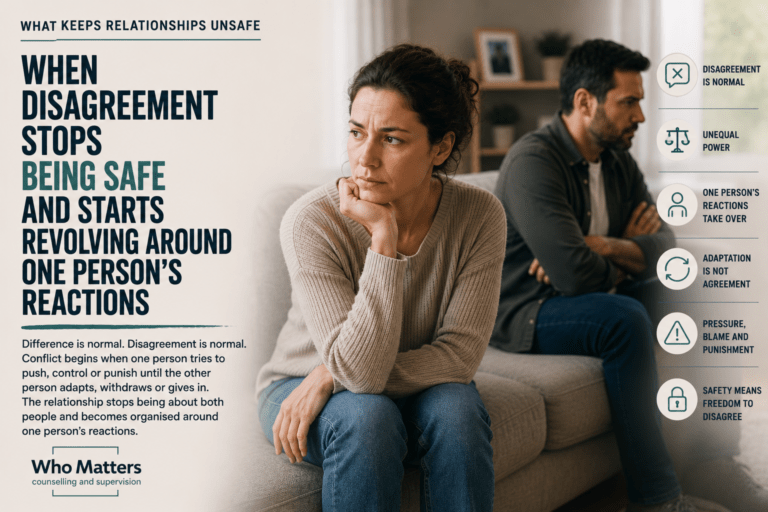
One of the clearest signs that blame-shifting has become embedded in a relationship is that the woman starts organising herself around his reactions.
She learns what not to say. What tone not to use. What topics to avoid. When not to bring something up. How to raise concerns gently enough, briefly enough, carefully enough. How to soften truths. How to delay needs. How to monitor his mood before speaking. How to drop things that matter because the cost of naming them feels too high.
This is not healthy conflict management. This is adaptation to volatility. And over time, it can create a relationship where one person is increasingly free to react, while the other becomes increasingly responsible for preventing the reaction.
That is deeply unequal.
It can also be hard for men to see, because they may interpret her carefulness as proof that she knows she has a part to play. In reality, she may simply be trying to stay safe, reduce escalation, or avoid another exhausting cycle.
Once a relationship starts revolving around a man’s “buttons,” his accountability has already been outsourced onto her.
The issue is not what he felt. It is what he did with it.
A man may genuinely feel hurt, angry, embarrassed, ignored, dismissed, or disrespected. Those feelings are real. The problem is not that he had them. The problem is what he authorised himself to do next.
Did he stay grounded enough to remain respectful? Did he take space without punishment? Did he communicate clearly without intimidation? Did he tolerate discomfort without turning it into blame, surveillance, threats, or emotional pressure? Or did he use his feelings as justification for behaviour that narrowed her freedom and increased her fear?
This is where many men get stuck. They keep arguing the legitimacy of the feeling, as though proving they were hurt will settle the question of whether their behaviour was acceptable.
It will not. A man can be genuinely hurt and still behave abusively. He can feel wounded and still be controlling. He can feel criticised and still choose cruelty. He can feel overwhelmed and still be responsible.
Once that becomes clear, the conversation changes.
“You know how I get” is not self-awareness
Blame-shifting often comes with a second layer: normalising the pattern.
A man says things like:
- “She knows how I get when I’m angry.”
- “She knows that topic sets me off.”
- “She knows not to keep going when I’m worked up.”
- “She should have left it alone.”
- “She knew exactly what she was doing.”
This can sound like awareness. But it is often a way of turning his pattern into her responsibility.
In effect, he is saying:
Because my reactions are predictable, you should adapt to them.
That is not self-awareness.
Self-awareness would sound more like:
I know what I’m like when I get defensive, and I need to make sure that never becomes your burden.
That is a very different posture.
One expects accommodation.
The other takes ownership.
Men often minimise the impact because they stay focused on the trigger
When men tell the story through the lens of what triggered them, the impact on the other person can disappear.
He is focused on the tone she used.
The timing.
The criticism.
The accusation.
The look on her face.
The thing she brought up in front of the kids.
The way she would not let it go.
The message she did not reply to.
The fact that she walked away.
Meanwhile, she may be remembering something else entirely. The moment his face changed. The way his body filled the room. How close he stood. How long he kept going. The names he called her. The fear of saying the wrong thing. The feeling that there was no safe response.
The children hearing it from the next room. The aftermath. The silence. The apology that still somehow blamed her.
This is one reason blame-shifting is so corrosive. It keeps the man emotionally centred in the story, while the person living with the impact becomes secondary.
Real accountability requires reversing that.
If her behaviour always explains his, he will never change
This is the practical problem with blame-shifting: it makes change impossible. If the problem is always her tone, her timing, her words, her attitude, her disrespect, her nagging, her criticism, her distance, her pushing, then the solution always sits with her.
She must communicate better.
She must be calmer.
She must not provoke.
She must understand him more.
She must pick the right moment.
She must not say it like that.
She must stop pressing the issue.
This can go on forever. And during that time, the man may sincerely believe he is trying. But he is trying to improve the environment around his behaviour, not the behaviour itself.
That is why he stays stuck.
He may learn new language.
He may become more articulate.
He may even reduce the obvious outbursts for a while.
But if he still believes someone else is the real driver of his reactions, he will keep rebuilding the same pattern under different conditions.
Accountability begins when the sentence changes
A lot turns on a small shift in language.
From:
“She pushed my buttons.”
To:
“I did not handle that safely.”
From:
“She knows how to trigger me.”
To:
“I use her behaviour to excuse responses I need to take responsibility for.”
From:
“She should have stopped.”
To:
“I should not need someone else to prevent me from becoming intimidating.”
From:
“She kept going.”
To:
“I chose to escalate rather than regulate myself.”
From:
“She disrespected me.”
To:
“I used feeling disrespected as permission to punish.”
That is the kind of shift that opens the door to real change.
Not because the wording is more polished, but because the responsibility has moved back where it belongs.
What growth actually requires
For men who want to change, this usually involves more than anger management in the narrow sense. It requires a deeper look at how they understand conflict, power, and emotional discomfort.
That may include learning to:
- notice the stories they tell themselves when they feel challenged
- separate feeling hurt from having a right to retaliate
- tolerate criticism without turning it into domination
- accept that another person’s tone does not justify coercion
- recognise when “being heard” has become forcing the issue
- take space without using withdrawal as punishment
- listen to impact without searching for provocation
- stop treating their partner as responsible for emotional regulation they need to develop themselves
This is demanding work.
But it is adult work.
And it is necessary work if a man wants to become safer, more honest, and more accountable in relationship.
Children learn from this too
Children growing up around blame-shifting often absorb dangerous lessons. They learn that anger is caused by other people. They learn that if someone erupts, the real question is who provoked them. They learn to scan for moods, avoid upsetting topics, and manage the emotional climate around the man.
They learn that accountability is negotiable if you can point to what someone else did first. And they may learn to doubt their own experience, because the story after every harmful incident becomes about the trigger rather than the harm.
So this is never just about one argument or one phrase.
It is about the kind of relational world a man creates around him.
The goal is not to pretend provocation never exists
Some men hear this conversation and think they are being told that no one ever says hurtful things, no one is ever difficult, and men are simply supposed to absorb everything silently.
That is not the point. The point is not that provocation is imaginary. The point is that provocation does not remove responsibility.
Mature relationship behaviour is not measured by whether you can prove you were annoyed, hurt, or antagonised. It is measured by what you do when you are.
That is where character shows up.
That is where safety is built or broken.
That is where accountability either deepens or disappears.
A better question to ask
When a man says, “She pushed my buttons,” the conversation often needs to move quickly past whether he felt provoked.
A more useful question is:
What did you give yourself permission to do because you felt provoked?
That question cuts through a lot.
It brings the focus back to choice.
To impact.
To behaviour.
To responsibility.
Because the truth is, many men stay stuck not simply because they get angry, but because blame-shifting allows them to keep misunderstanding the problem.
The problem is not that she knows where your buttons are.
The problem is that you keep treating your behaviour as if it belongs to her.