“I Was Triggered”: Why Distress Is Not Permission to Become Controlling
“I was triggered.”
For some men, this language feels thoughtful. More self-aware. More psychologically informed than saying, “I just lost it,” or, “You pushed my buttons.” And sometimes it does reflect something real. A man may have felt flooded, ashamed, panicked, rejected, abandoned, or emotionally overwhelmed. He may have been touched by something painful from his past. He may have felt his body move quickly into defensiveness, anger, or survival mode.
But even when distress is real, it is not permission to become controlling. It does not justify intimidation. It does not excuse monitoring, cornering, accusing, yelling, threatening, coercing, punishing, or forcing someone else to manage your emotional state.
Being triggered may explain part of what happened internally. It does not make harmful behaviour acceptable externally.
That distinction matters, because many men learn to describe their internal distress while still avoiding responsibility for what they do with it.
The language of triggers can be helpful or evasive
There is nothing wrong with recognising that something affected you deeply. In fact, part of mature self-awareness is being able to say:
- “That brought up something strong in me.”
- “I felt rejected and panicked.”
- “I noticed I went quickly into anger.”
- “I became defensive and overwhelmed.”
That kind of insight can be useful. It can help a man slow down and understand himself better. But the language of being “triggered” becomes a problem when it shifts from insight into excuse.
For example:
- “I was triggered, so that’s why I checked her phone.”
- “I was triggered, so I needed answers right then.”
- “I was triggered, so I raised my voice.”
- “I was triggered, so I kept texting until she replied.”
- “I was triggered, so I couldn’t just let it go.”
- “I was triggered, so I needed to know where she was.”
- “I was triggered, so I followed her from room to room.”
At that point, “triggered” is no longer being used to understand behaviour. It is being used to soften it. And softened language can hide very hard realities.
Distress is real. Control is still a choice.
This is one of the most important truths for men to face. You may not choose the first wave of emotion. You may not choose what gets activated in your nervous system. You may not choose the fact that you suddenly feel unsafe, ashamed, ignored, humiliated, or out of control. But you are still responsible for what you do next.
Do you step back, breathe, and ground yourself? Do you name that you are overwhelmed and take space safely? Do you seek support appropriately? Do you reflect before reacting?
Or do you move quickly to control the other person so that you can feel more settled? That is the key issue. Because many controlling behaviours are attempts to regulate distress through power over someone else.
A man feels anxious, so he interrogates. He feels insecure, so he monitors. He feels rejected, so he punishes. He feels ashamed, so he blames. He feels emotionally flooded, so he demands reassurance on his terms. He feels out of control inside, so he tries to control the environment, the conversation, the pace, the tone, the other person’s movement, attention, or availability.
This is common. It is also harmful.
“I was triggered” can sound therapeutic while still being abusive
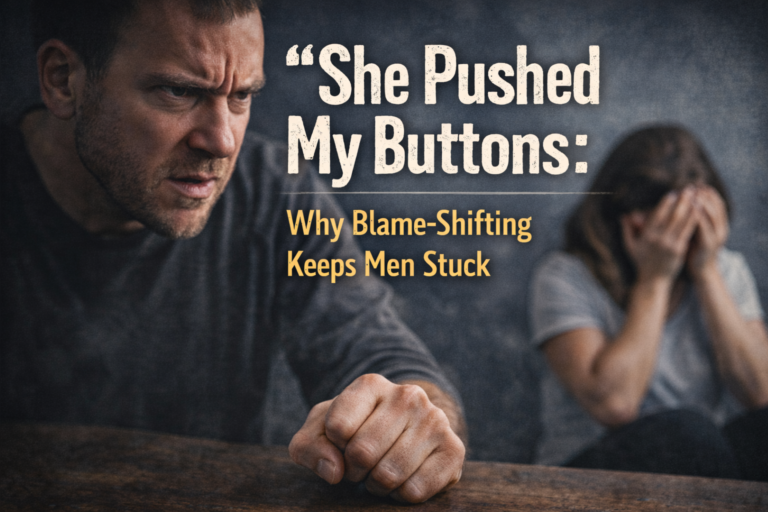
One reason this language can be confusing is that it can sound emotionally intelligent. A man is not saying, “She made me do it.” He is saying, “I was triggered.” That can appear more reflective. More modern. More accountable.
But language is not the same as accountability.
A man can speak in therapy language while still behaving in coercive ways. He can say he was “activated” while yelling at his partner for walking away. He can say he felt “abandoned” while bombarding her with messages. He can say he was “dysregulated” while demanding access to her phone. He can say he went into “survival mode” while blocking the doorway so the conversation cannot end. He can say his “attachment wound got triggered” while insisting she prove her loyalty, comfort him immediately, or stop having boundaries that make him uncomfortable.
The words may sound softer. The impact may still be frightening.
This is why it is so important not to confuse emotional language with changed behaviour.
A trigger is not a licence to override someone else’s boundaries
Many men do not think of themselves as controlling. They think of themselves as distressed. That may be true. But if distress repeatedly leads a man to override another person’s autonomy, then distress is not the main story anymore.
The story becomes:
- whose needs dominate the moment
- whose boundaries are allowed to stand
- whose emotions set the rules
- who has to adapt to keep things calm
- who loses freedom when one person feels upset
If a man is triggered and his partner now has to stop what she is doing, answer immediately, reassure him, explain herself, surrender privacy, stay in the conversation, tolerate accusations, or calm him down so things do not escalate, then his distress has become a mechanism of control.
That is not emotional honesty. That is pressure.
And it teaches everyone around him that his discomfort matters more than their safety or autonomy.
The impact on partners is often minimised
Men who describe themselves as triggered are often focused on how intense the feeling was for them. That is understandable. Distress can feel overwhelming from the inside. But the partner is often having a very different experience.
She may not experience him as hurt or activated. She may experience him as intimidating, relentless, suspicious, punishing, volatile, or impossible to settle. She may learn that his distress means:
- she cannot end a conversation
- she cannot take space
- she cannot say no without consequences
- she cannot have privacy without being accused
- she cannot disagree without escalation
- she must monitor his state and respond carefully
- she becomes responsible for preventing things from getting worse
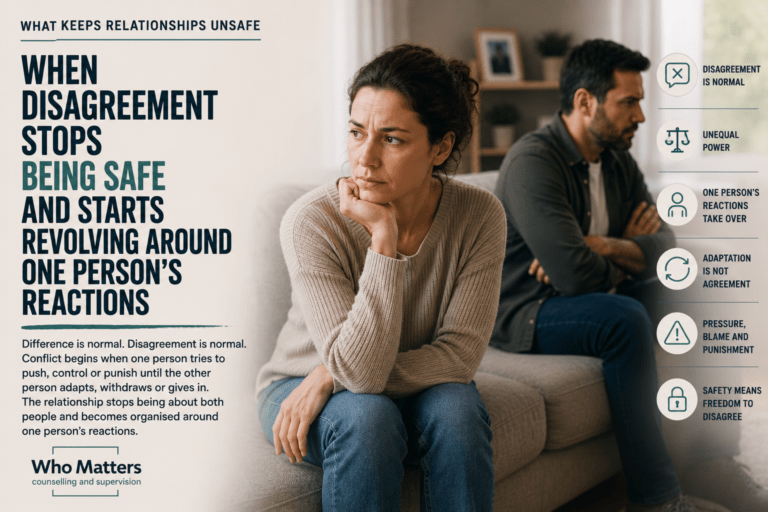
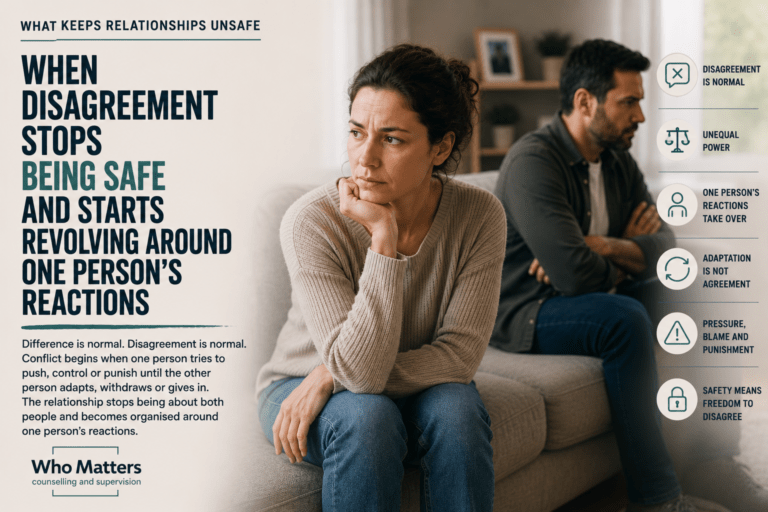
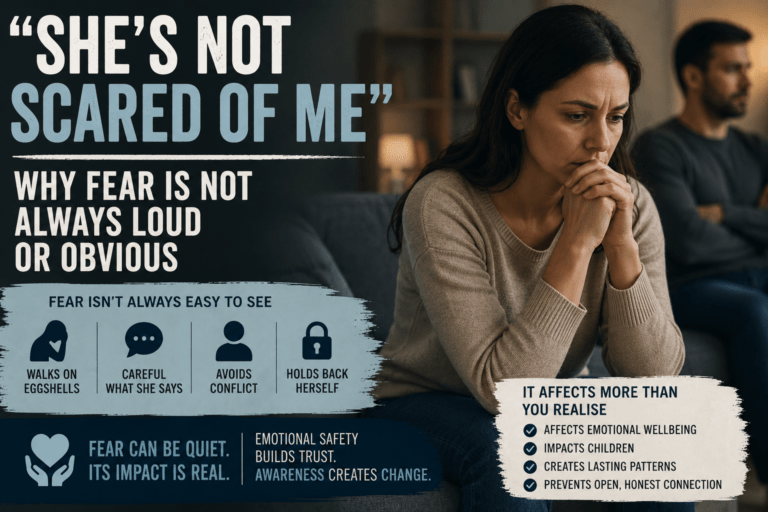
Over time, this creates an unsafe emotional environment. She may start organising herself around his triggers. She may shrink her own world to avoid setting him off. She may stop being honest because honesty costs too much. She may become hypervigilant, always scanning for signs that his mood is shifting.
He may describe this as sensitivity. She may experience it as fear.
Trauma-informed is not the same as consequence-free
This is an area where men can become confused, especially if they are learning more about mental health, trauma, attachment, or nervous system responses. Understanding trauma matters. Understanding triggers matters. Understanding shame, abandonment fears, childhood neglect, or past betrayal matters.
But a trauma-informed approach does not remove accountability.
It does not mean:
- “I have trauma, so people need to accept my reactions.”
- “I have attachment wounds, so my jealousy is understandable.”
- “I was dysregulated, so I’m not responsible.”
- “My past explains it, so my partner has to be more careful.”
- “I was activated, so my controlling behaviour should be viewed more gently.”
A trauma-informed approach says: your history matters, and so does your impact. Both things can be true.
You may have been hurt. You may also be hurting others.
You may not be trying to control. You may still be controlling.
You may feel terrified inside. You may still be creating fear around you.
The goal is not to shame men for having distress.
The goal is to stop distress being used as a shield against behavioural responsibility.
Not all intense emotion is coercive. The pattern matters.
It is important to say clearly: not every distressed reaction is abuse. People can become overwhelmed, reactive, tearful, defensive, or flooded without being controlling.
The issue is not simply intensity. The issue is what happens around that intensity. Does the man still respect boundaries? Can the other person leave the room? Can she say, “I’m not discussing this right now,” without being pursued? Can she disagree without being interrogated? Can she have separate thoughts, relationships, time, and privacy without his distress becoming her burden to solve?
Can he recover without punishing her? Can he take responsibility afterwards without turning the conversation back to how triggered he was?
That is where the difference becomes clearer.
The question is not: Was he distressed? The question is: What did his distress give him permission to do?
Many men use control to manage vulnerability
Underneath many controlling patterns is an inability to tolerate certain emotional states. A man may find it deeply difficult to sit with:
- uncertainty
- rejection
- embarrassment
- loss of closeness
- not being prioritised
- not getting reassurance straight away
- feeling misunderstood
- feeling powerless
- being told no
- not knowing what someone else is thinking or feeling
These experiences can feel intolerable. And rather than sitting with the vulnerability, reflecting on it, or regulating it responsibly, he may reach for control. Control creates temporary relief. If she answers, he feels calmer. If she explains herself, he feels less unsure. If she gives him access, he feels less anxious. If she backs down, he feels less ashamed. If she stays and reassures him, he feels less abandoned.
This is one reason controlling behaviour can become repetitive. It works in the short term for the person using it. But what works to reduce his distress may be deeply harmful to the person on the receiving end.
Relief for him may come at the cost of freedom, dignity, and safety for someone else.
Accountability begins where self-description stops
Some men become very good at describing themselves. They can explain their childhood. Their attachment style. Their wounds. Their fears. Their nervous system. Their trauma history. Their triggers. But self-description is not the same as change.
A man can understand himself quite well and still keep harming others. Accountability begins when he moves from:
- “Here is what I felt”
to - “Here is what I did”
From:
- “Here is why it makes sense that I reacted”
to - “Here is how my behaviour affected her”
From:
- “I need people to understand my triggers”
to - “I need to stop making my triggers other people’s problem”
That shift matters. Because if all the attention stays on the man’s internal world, the partner disappears from the story except as a trigger, a regulator, or a witness.
Real behaviour change brings her experience back into view.
What real responsibility sounds like
When a man is still using distress to excuse control, he might say:
- “I was triggered.”
- “You know that sets me off.”
- “I just needed reassurance.”
- “I couldn’t help it in that moment.”
- “My trauma got activated.”
- “I wasn’t trying to control you, I was panicking.”
- “I just needed to know where you were.”
When he is moving toward accountability, it starts to sound more like:
- “I was overwhelmed, but I am still responsible for how I acted.”
- “My distress does not justify pressuring you.”
- “I turned my anxiety into control.”
- “I made you responsible for calming me down.”
- “I overrode your boundaries because I wanted relief.”
- “I focused on my feelings and ignored your experience.”
- “I need to learn how to tolerate distress without becoming coercive.”
That is a very different posture.
Not performative guilt.
Not polished language.
Ownership.
Change means building tolerance, not just insight
Insight is useful, but it is not enough.
A man may genuinely understand that he gets triggered by distance, conflict, uncertainty, or perceived rejection. That is important. But the deeper work is learning how to respond differently when those moments arise.
That usually means building capacity to:
pause instead of pursue
feel anxiety without demanding immediate relief
hear “no” without escalating
accept space without interpreting it as abandonment
stay grounded when someone disagrees
tolerate uncertainty without moving into surveillance or accusation
notice shame without converting it into anger
repair harm without centring his own pain
This is difficult work. But it is adult work.
And it is essential if a man wants his relationships to feel safe rather than emotionally governed by his triggers.
Children notice this pattern too
Children may not know the language of trauma or triggers, but they quickly learn the rules of a household shaped by one person’s emotional volatility.
They learn when dad is “set off.”
They learn when mum is trying to keep things calm.
They learn to go quiet, be easy, not add stress, not ask for too much, not make things worse.
They may learn that someone else’s distress always outranks their own needs.
They may become anxious, watchful, over-responsible, or frightened of conflict.
So even when a man tells himself, “I was just triggered,” the impact can spread far beyond the moment.
The issue is not just whether he meant to scare or control anyone.
The issue is what people around him have to do in order to live with his distress.
The goal is not to feel nothing
Some men hear accountability and think they are being told to suppress emotion, disconnect from pain, or become robotic.
That is not the goal.
The goal is not less feeling.
The goal is more responsibility.
You are allowed to be hurt.
You are allowed to be activated.
You are allowed to have wounds.
You are allowed to need support.
What you are not allowed to do is use those realities as permission to dominate, pressure, corner, monitor, punish, or control.
A safe relationship does not require the absence of distress.
It requires that distress is handled without coercion.
The better question is not “Was I triggered?”
Often, you were.
The better question is:
What did I do when I was triggered?
Did you take ownership?
Did you respect boundaries?
Did you allow the other person freedom?
Did you create safety?
Did you repair honestly?
Or did your distress become the reason everyone else had to adapt to you?
That is where the real work is.
Because being triggered may be part of your story.
But it is not permission to become controlling.