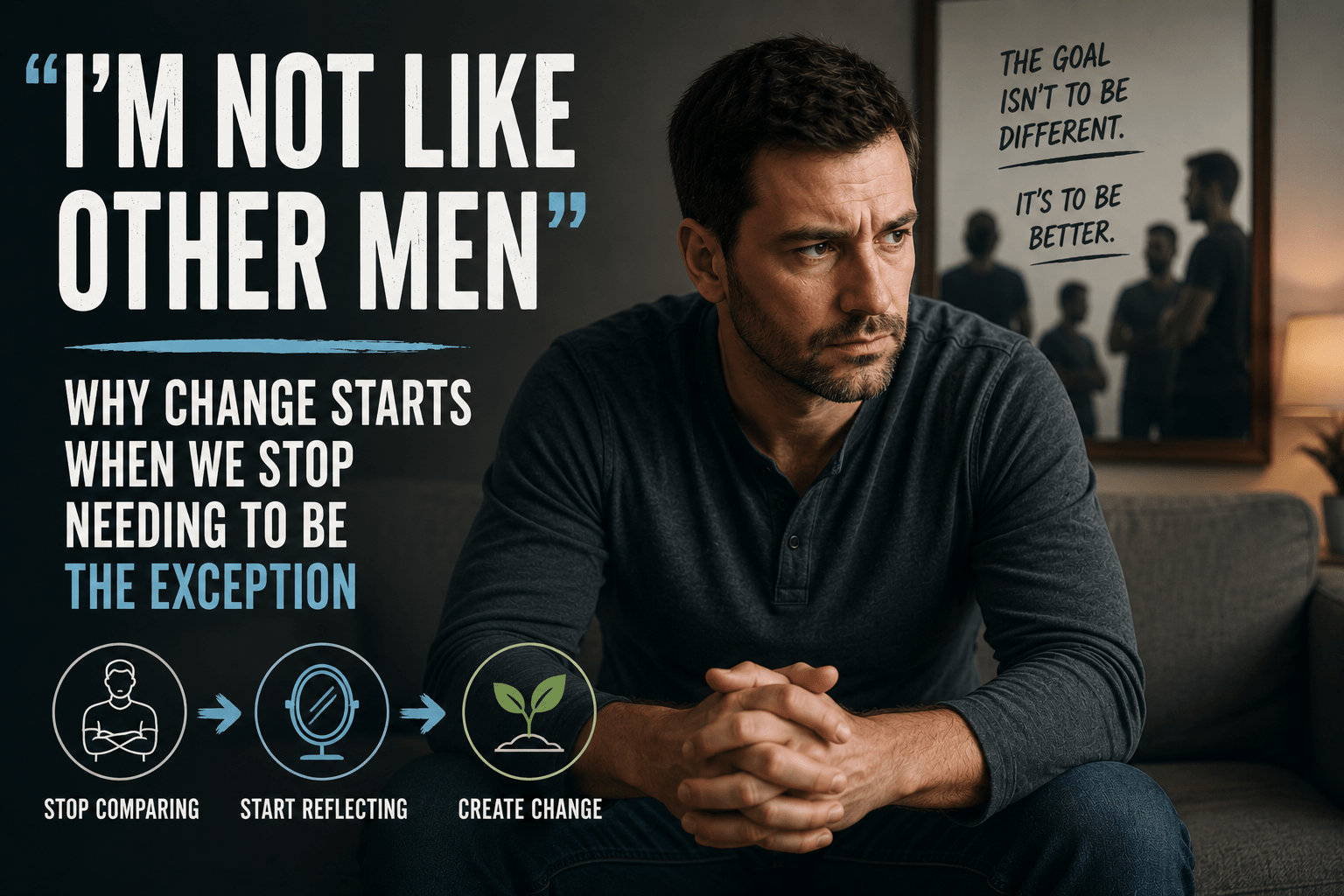
“I’m Not Like Other Men”: Why Change Starts When We Stop Needing to Be the Exception
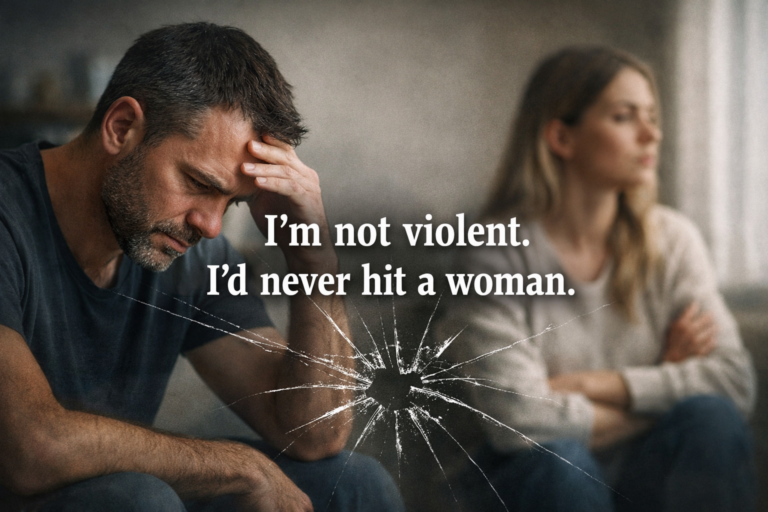
One of the most common ways men distance themselves from accountability is not by denying harm exists — but by insisting they are different from, or better than, the men who cause it.
It often sounds like:
- “I’m not abusive.”
- “I’m nothing like those guys.”
- “I would never hit a woman.”
- “I’m not some monster.”
- “At least I’m not violent.”
- “I’m one of the good men.”
Sometimes these statements are (partly) true.
Many men who engage in harmful relationship behaviours do not see themselves reflected in extreme stereotypes of abuse. They may not physically assault their partner. They may work hard, love their children, or see themselves as caring people. But the need to position oneself as fundamentally different from “other men” can quietly become a barrier to honest self-reflection.
Because once someone becomes invested in being the exception, accountability can start to feel like a threat to identity itself.
The Conversation Often Becomes About Identity Instead of Behaviour
When concerns are raised about harmful behaviour, some men respond not by examining the behaviour itself, but by defending who they believe they are.
The focus shifts from:
- “What impact did my behaviour have?”
to: - “What kind of man does this make me?”
This distinction matters. Because once accountability becomes associated with being labelled “an abusive man,” many men move quickly into self-protection.
They may:
- minimise behaviour
- compare themselves to more extreme examples
- become defensive
- focus on intentions instead of impact
- seek reassurance that they are “not that bad”
- argue over definitions instead of reflecting on behaviour
The discussion stops being about change and becomes about preserving identity.
Comparing Down Can Prevent Insight
Many men assess themselves against the worst examples they can imagine.
For example:
- “I don’t hit her.”
- “I’ve never broken her bones.”
- “I don’t control every aspect of her life.”
- “I’m not like those men on the news.”
But comparing down creates a distorted standard. The absence of extreme violence does not automatically mean a relationship feels emotionally safe. Partners can still experience fear, intimidation, emotional instability, coercion, controlling behaviour, verbal put-downs, emotional withdrawal, walking on eggshells, or pressure and unpredictability
A man does not need to see himself as a “monster” for his behaviour to be affecting others negatively. In fact, many harmful patterns occur in relationships where the man strongly believes he is fundamentally a decent guy.
Most Men Who Use Harmful Behaviour Do Not See Themselves as “Bad Men”
This is important to understand. Many men involved in behaviour change work are not sitting around consciously thinking “I want to control or frighten my partner.”. Often, they see themselves as stressed, misunderstood, reactive, hurt, trying their best, emotionally overwhelmed, or unfairly criticised
At the same time, their partners may experience them as intimidating, controlling, emotionally unsafe, unpredictable, dismissive, blaming and frightening during conflict
Both realities can exist simultaneously.
This is one reason behaviour change work requires moving beyond simplistic categories of “good men” and “bad men.” The more useful question is not, “Am I one of the bad men?”
It is, “What happens to people around me because of my behaviour?”
The Need to Be “Different” Can Block Vulnerability
Many men have deep fears about what accountability means. If they admit harmful behaviour, they may fear shame, rejection, humiliation, losing their relationships. They may fear being seen as weak, or at the other extreme, being seen as dangerous and becoming “one of those men”
As a result, they work hard to maintain psychological distance from men associated with abuse or control. But that distance can stop honest reflection. Because if harmful behaviour only belongs to “other men,” then there is little reason to examine smaller patterns in ourselves.
Patterns like:
- intimidation during arguments
- emotional withdrawal as punishment
- controlling communication
- entitlement
- blame-shifting
- monitoring behaviour
- jealousy framed as love
- using anger to regain control
- expecting others to manage emotional reactions
The problem is not only extreme violence. The problem is the broader spectrum of behaviours that create fear, instability, or inequality in relationships.
Accountability Is Not the Same as Self-Condemnation
Some men avoid accountability because they believe admitting harmful behaviour means declaring themselves irredeemably bad. But accountability is not the same as permanent self-condemnation. In fact, meaningful change usually becomes possible only when someone can tolerate seeing their behaviour clearly without collapsing entirely into defensiveness or shame.
That means being able to say:
- “I care about my family and my behaviour has harmed them.”
- “I did not intend to create fear and fear was created.”
- “I see myself as a decent person and I need to change harmful patterns.”
- “I don’t need to be the worst man alive before accountability applies to me.”
This kind of thinking requires emotional maturity because it holds complexity rather than escaping into extremes.
Change Often Begins When Defensiveness Softens
The men most capable of meaningful behaviour change are usually not the men most committed to proving they are exceptional. They are often the men willing to become curious about themselves.
Men willing to ask:
- “Why do I react this way?”
- “What happens to my partner during conflict?”
- “How do I respond when I feel criticised or powerless?”
- “What role does control play in my behaviour?”
- “Why do I need reassurance that I’m not like other men?”
- “What am I protecting when I become defensive?”
These questions create room for growth because they move away from identity protection and toward reflection.
Being “Better Than Some Men” Is a Low Standard
One of the hidden dangers in comparing ourselves to extreme examples is that it lowers the standard for accountability. If the benchmark becomes: “At least I’m not violent.” then many harmful behaviours remain invisible. But healthy relationships require more than the absence of extreme violence.
They require:
- emotional safety
- respect
- consistency
- accountability
- emotional regulation
- equality
- non-coercive communication
- the ability to tolerate conflict without intimidation or control
The goal should not be to merely avoid becoming “one of the bad men.” The goal should be becoming someone whose presence consistently creates safety for others.
Real Change Requires Letting Go of the Need to Be Exceptional
Many men enter counselling hoping to prove they are different from other men who use harmful behaviour. But real transformation often begins when that need starts to loosen. Because once someone no longer needs to protect the identity of being uniquely “good,” they can finally begin looking honestly at patterns that need changing.
And that honesty matters far more than labels.
The most important question is not:
“Am I like other men?”
It is:
“Am I willing to look honestly at the impact of my behaviour — even when it challenges how I see myself?”
Because change rarely begins with defending identity. It usually begins with curiosity, humility, and accountability.