When Reassurance Becomes Control
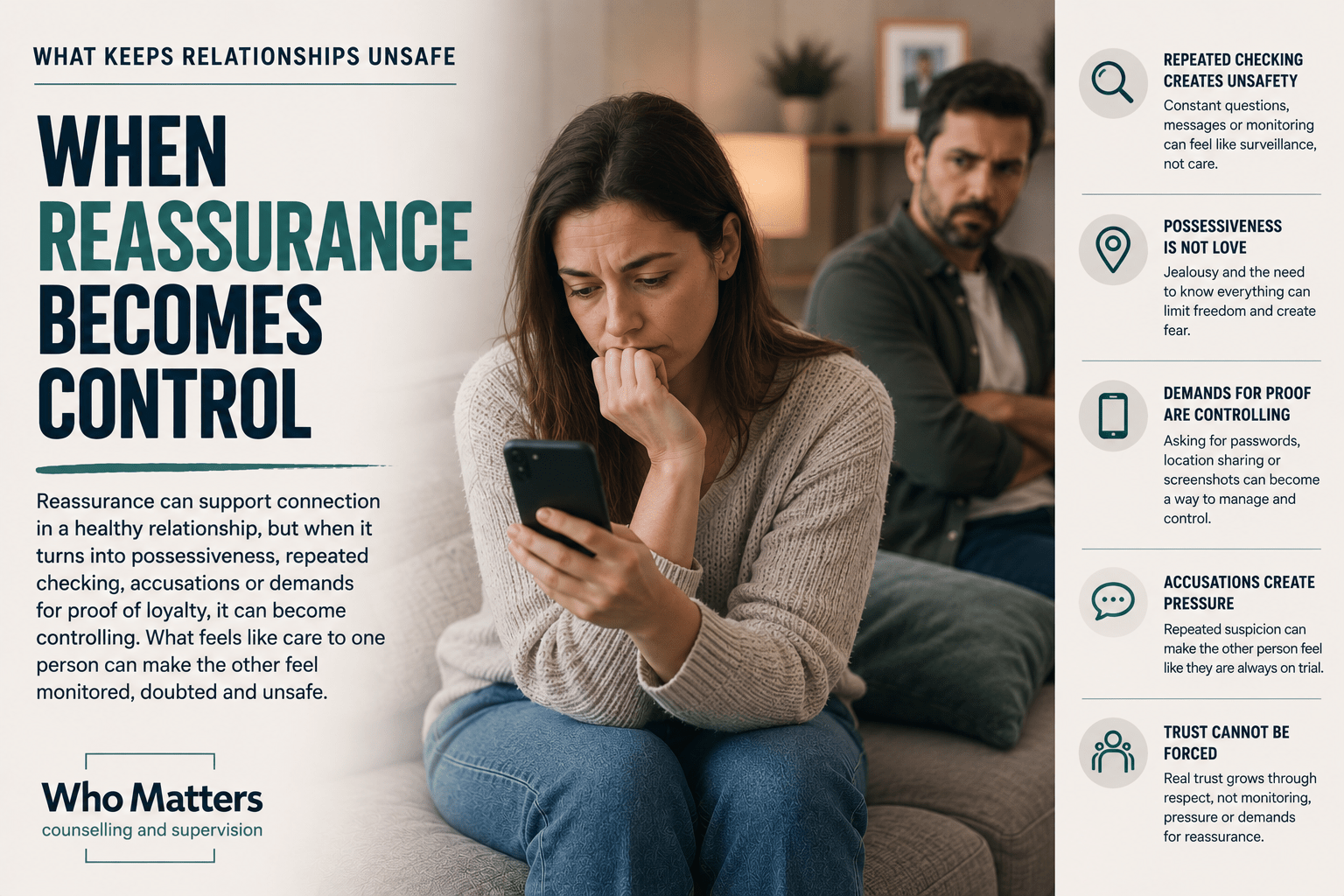
Reassurance is a normal part of relationships. People sometimes need to hear that they matter, that the relationship is okay, that a difficult moment can be repaired, or that their partner still cares. In a healthy relationship, reassurance can support connection because it is offered and received freely, without pressure, fear, or obligation.
However, reassurance becomes unsafe when it stops being a request for connection and starts becoming a demand for proof. This can happen when one person’s insecurity, jealousy, fear of abandonment, shame, or need for certainty begins to organise the relationship. Instead of reassurance being one part of mutual care, it becomes something the other person is expected to provide repeatedly in order to prevent suspicion, anger, withdrawal, interrogation, or emotional consequences.
For men who use controlling behaviours, this can be a difficult pattern to recognise because it may not feel like control from the inside. It may feel like anxiety. It may feel like love. It may feel like needing clarity, honesty, commitment, or respect. But the impact on the other person may be very different. She may feel monitored, doubted, pressured, accused, or made responsible for managing his emotional state.
This distinction matters. Wanting reassurance is not automatically harmful. Making another person repeatedly prove their loyalty, innocence, love, or commitment can become controlling.
Reassurance Is Healthy When It Remains Free
In a safer relationship, a person can ask for reassurance without demanding it. They can say they are feeling insecure, disconnected, worried, or vulnerable, while still respecting the other person’s boundaries, privacy, and emotional capacity. They can receive comfort without turning it into an entitlement.
Healthy reassurance might involve saying, “I’m feeling a bit disconnected and would like to spend some time together,” or “I noticed I’m feeling insecure, and I’m going to take responsibility for that rather than putting it all on you.” It may also involve asking for a conversation, expressing vulnerability, or naming a fear without turning that fear into an accusation.
The difference is that the other person remains free. She is free to respond with care, but she is also free to have limits. She can say she is tired, not ready to talk, needing space, or unable to provide reassurance in that moment. Her response may be disappointing, but it is not treated as evidence that she has done something wrong.
This is where safety is created. Reassurance is healthy when it strengthens connection without reducing freedom.
When Reassurance Becomes a Demand for Proof
Reassurance becomes controlling when one person repeatedly requires the other to prove that they are loyal, honest, loving, faithful, available, or committed. The request may begin with insecurity, but it can quickly become a pattern where the partner is placed on trial.
This may look like repeated questions about where she has been, who she has spoken to, why she took time to reply, why she dressed a certain way, why she seemed distant, why she changed her tone, why she did not want sex, or why she wants time alone. It may include checking her phone, asking to see messages, expecting location sharing, questioning social media activity, or needing constant updates to feel settled.
A man may describe this as wanting honesty or transparency. He may say, “If you have nothing to hide, why does it matter?” or “I just need reassurance because I’ve been hurt before.” These statements may sound reasonable to him, especially if he feels anxious or afraid. But the impact is that his partner is no longer being trusted; she is being required to manage his suspicion.
Over time, this can make the relationship feel like surveillance rather than intimacy. The person being questioned may begin explaining ordinary choices in unnecessary detail, keeping evidence of where she has been, avoiding certain people, replying quickly to avoid tension, or changing her behaviour so he does not become insecure.
That is not reassurance. That is adaptation to control.
Possessiveness Is Not Proof of Love
Possessiveness is often confused with love, commitment, or protectiveness. A man may believe that his jealousy shows how much he cares, or that his need to know everything comes from fear of losing the relationship. He may see his partner’s independence as threatening because it reminds him that she has a life, mind, body, relationships, and choices that do not belong to him.
In a safe relationship, closeness does not require ownership. Partners may care deeply about each other while still respecting privacy, friendships, separate interests, emotional space, and individual decision-making. Love does not require one person to become smaller so the other person feels secure.
Possessiveness becomes unsafe when a man starts treating his partner’s independence as something that needs to be monitored, limited, questioned, or approved. He may become uncomfortable when she spends time with friends, goes out without him, dresses in a way he dislikes, speaks to certain people, has privacy on her phone, or makes decisions without first managing his feelings.
The issue is not that he has feelings. Jealousy and insecurity can be real. The issue is what he does with those feelings. If his insecurity leads to pressure, suspicion, restrictions, accusations, or emotional punishment, then the relationship is being shaped by control rather than trust.
Repeated Checking Creates Unsafety
Repeated checking can be one of the clearest signs that reassurance has become control. This may include repeated texts, calls, questions, location requests, follow-up questions, or attempts to verify information. It can also include checking stories against each other, looking for inconsistencies, asking for screenshots, or expecting the partner to account for small gaps in time.
The man may experience the checking as a way to calm himself. He may believe that if she answers one more question, provides one more explanation, or gives one more piece of evidence, he will finally feel settled. But reassurance gained through checking rarely lasts. It often creates only temporary relief, followed by another doubt, another question, and another demand.
This pattern can become exhausting for the other person. She may feel that no answer is enough, no explanation is complete, and no amount of reassurance actually resolves the suspicion. She may start to feel as though she is always one question away from being accused again.
Repeated checking also changes the emotional climate of the relationship. Instead of feeling trusted, she may feel watched. Instead of feeling close, she may feel managed. Instead of being able to relax, she may begin anticipating the next question before it is asked.
A relationship cannot feel safe if one person is constantly required to prove they are not doing something wrong.
Accusations Can Become a Form of Pressure
Accusations are often presented as questions, but they can still function as pressure. A man may ask, “Are you sure nothing happened?” or “Why are you being weird?” or “Who are you really talking to?” or “Why would you need privacy if you weren’t hiding something?” Although these may be framed as attempts to understand, they can communicate distrust and create fear.
When accusations are repeated, the partner may begin to feel that she is defending herself against a conclusion that has already been made. She may provide explanations, reassurance, evidence, affection, or apologies, not because she has done anything wrong, but because she wants the questioning to stop.
This can create a harmful reversal. The person who is being accused becomes responsible for repairing the emotional state of the person making the accusation. His insecurity becomes the centre of the relationship, while her experience of being doubted, pressured, or controlled becomes secondary.
For men doing behaviour change work, this is an important pattern to examine. Feeling suspicious does not make suspicion accurate. Feeling insecure does not give someone the right to interrogate. Feeling afraid of betrayal does not justify treating a partner as though she is guilty until she proves otherwise.
A safer response requires slowing down and recognising that a feeling is not the same as evidence, and a fear is not the same as a fact.
Demands for Loyalty Can Reduce Freedom
In controlling relationships, loyalty is often defined in a way that benefits the person seeking control. A man may expect his partner to prioritise his comfort over her friendships, family, privacy, work, parenting decisions, social life, or emotional boundaries. He may describe this as respect, commitment, or putting the relationship first.
The problem is that loyalty can become a test she is always at risk of failing. If she spends time with others, she may be accused of not caring. If she wants privacy, she may be accused of hiding something. If she disagrees, she may be accused of being against him. If she sets a boundary, she may be accused of abandoning him. If she does not provide enough reassurance, she may be accused of causing his distress.
Over time, this can make her choices less free. She may still technically be able to see friends, go out, say no, or have privacy, but she knows there may be emotional consequences. This is often where control operates: not through a direct rule, but through the predictable cost of independence.
A safe relationship allows loyalty and freedom to exist together. A partner can care deeply and still have privacy. She can be committed and still say no. She can love someone and still maintain friendships. She can reassure a partner without surrendering her independence.
Past Hurt Does Not Justify Present Control
Many men who seek reassurance through control have their own histories of hurt. They may have been betrayed, abandoned, humiliated, rejected, or exposed to instability in previous relationships or earlier life. These experiences may help explain why certain feelings are intense, but they do not excuse behaviours that make another person unsafe.
A man may say, “I’m like this because I’ve been hurt before,” and that may be partly true. However, the current partner should not have to live under suspicion because of someone else’s past behaviour. She should not have to give up privacy, independence, friendships, or emotional freedom to prove she is not the same as someone who hurt him before.
This does not mean his pain does not matter. It means his pain needs to be managed responsibly. Support, counselling, self-reflection, emotional regulation, and honest communication may all be part of healing. Control cannot be.
When past hurt becomes the justification for present monitoring, accusation, or possessiveness, the relationship becomes organised around his wound rather than mutual safety.
“I Just Need Reassurance” Can Hide Entitlement
The phrase “I just need reassurance” can sound vulnerable, and sometimes it is. But it can also hide entitlement when the expectation is that the other person must provide reassurance on demand, regardless of her own needs, feelings, boundaries, or exhaustion.
A man may expect reassurance immediately. He may expect it repeatedly. He may expect it after he has been hurtful. He may expect his partner to comfort him when she is the one who has been harmed. He may expect her to soften her boundaries because his distress feels urgent.
This becomes unsafe when his need for emotional relief overrides her right to space, dignity, and choice. If she has to reassure him to prevent sulking, anger, repeated questioning, accusations, or emotional withdrawal, then reassurance is no longer freely given. It has become part of a pressure system.
A safer approach requires him to take responsibility for self-soothing and support-seeking. It is reasonable to want connection. It is not reasonable to make another person responsible for removing every uncomfortable feeling.
Digital Reassurance and Surveillance
Technology can make reassurance-seeking more constant and more intrusive. Text messages, read receipts, social media, location sharing, online status, photos, call histories, and messaging apps can all become tools for monitoring. A man may check whether his partner is online, question why she has not replied, ask who liked a photo, expect her to share her location, or become suspicious about deleted messages or private conversations.
These behaviours are often framed as normal in modern relationships, but they can quickly become controlling. The fact that technology makes monitoring easy does not make it healthy. Constant access to someone’s digital life does not create trust; it often creates more suspicion and less freedom.
Digital safety includes the right to privacy. A partner should not have to provide passwords, screenshots, location access, or constant replies to prove loyalty. Healthy trust is not built through surveillance. It is built through respectful behaviour, honesty, consistency, and the ability to tolerate uncertainty without controlling the other person.
For men who struggle with jealousy or insecurity, this may mean making deliberate choices not to check, not to ask for proof, not to monitor online activity, and not to treat delayed replies as evidence of wrongdoing. These choices may feel uncomfortable at first, but they are part of becoming safer.
The Impact on the Person Being Questioned
Being repeatedly asked to reassure, explain, prove, or defend can have a significant emotional impact. The affected person may become anxious, guarded, frustrated, resentful, numb, or emotionally exhausted. She may begin to doubt herself, even when she has done nothing wrong, because the constant questioning creates an atmosphere of suspicion.
She may also begin to change how she lives. She may avoid seeing certain people, stop posting online, reply more quickly than she wants to, keep evidence of her whereabouts, tell him more information than she feels comfortable sharing, or stop doing things that are likely to trigger accusations. These adaptations may reduce conflict in the short term, but they do so by reducing her freedom.
The relationship may then appear calmer, which can mislead the man into thinking the problem has improved. In reality, the calm may exist because she is working harder to prevent his insecurity from becoming her problem.
This is one of the central harms of controlling reassurance-seeking. It trains the other person to live under assessment.
Reassurance After Harm
Reassurance becomes particularly complicated when a man has used abusive, controlling, intimidating, or unfaithful behaviour himself. He may want reassurance that he is still loved, that the relationship can recover, that he is not a bad person, or that his partner is not going to leave. These feelings can be intense, especially when he begins to recognise the impact of his behaviour.
However, after harm has occurred, reassurance cannot be demanded from the person who has been harmed. She may not be ready to comfort him. She may not be able to offer certainty. She may still be afraid, angry, distant, confused, or unsure. Expecting her to reassure him too quickly can become another burden placed on her.
In this context, accountability means accepting uncertainty without using pressure. It means allowing her to have her own pace, her own feelings, and her own boundaries. It means seeking support elsewhere for shame, fear, or grief rather than making her responsible for regulating those emotions.
A man who wants to rebuild trust must learn to tolerate not being reassured immediately. Trust is not restored because he feels anxious. It is rebuilt through consistent safety over time.
What Safer Reassurance Looks Like
Safer reassurance begins with honesty about feelings without turning those feelings into accusations or demands. A man might recognise, “I am feeling insecure, but that does not mean she has done something wrong.” He might ask for connection without insisting on proof. He might say, “I would like to talk when you have capacity,” rather than pressuring his partner to resolve his discomfort immediately.
It also involves respecting limits. If she says she does not want to discuss something right now, safer behaviour means accepting that boundary. If she says she does not want to share her phone, safer behaviour means respecting her privacy. If she says she needs space, safer behaviour means not following, messaging repeatedly, or escalating.
Safer reassurance also requires building a wider support system. A partner cannot be the only place a man takes his insecurity, shame, jealousy, or fear. Counselling, trusted supports, reflective practice, journaling, exercise, time-out strategies, and learning to self-regulate may all help him manage feelings without turning them into control.
Most importantly, safer reassurance does not reduce the other person’s freedom. It allows connection without surveillance, vulnerability without accusation, and care without coercion.
Questions for Men Who Want to Change
If reassurance has become part of a controlling pattern, it may help to reflect honestly on what happens when you feel insecure. Do you ask for reassurance in a way that leaves the other person free to say no, or do you create pressure until you feel better? Do you treat your partner’s privacy as a threat? Do you ask repeated questions even after she has answered? Do you interpret delayed replies, independent plans, or emotional distance as evidence of disloyalty?
It may also be useful to ask whether your partner or ex-partner has become more careful because of your insecurity. Has she stopped seeing certain people, stopped sharing openly, started over-explaining, changed her phone habits, or begun reassuring you before you even ask? Does she seem free to say, “I am not discussing this again,” without you punishing her emotionally?
These questions are not about shaming yourself for having insecurity. They are about recognising whether insecurity has become a pathway to control.
Trust Cannot Be Forced Through Proof
The desire for certainty is understandable, but no amount of proof can create genuine trust if the relationship is organised around suspicion. Checking, questioning, monitoring, and demanding reassurance may create short-term relief, but they usually damage the very trust they are meant to protect.
Trust requires enough freedom for both people to exist as separate human beings. It requires privacy, boundaries, honesty, consistency, and the ability to tolerate discomfort without turning it into control. It also requires accepting that love is not proven by someone surrendering their independence.
When reassurance is freely offered, it can support closeness. When it is demanded, repeated, tested, or extracted through pressure, it becomes unsafe.
For men who want to change, the work is not to stop having feelings. It is to stop making those feelings someone else’s responsibility to manage. It is to learn that insecurity can be acknowledged without becoming accusation, that fear can be supported without becoming surveillance, and that love can be held without becoming possession.
Reassurance becomes safe when it protects connection without taking away freedom.