Why Emotional Safety Includes the Freedom to Disagree
Emotional safety is often described as the ability to be open, honest, vulnerable, and connected in a relationship. That is true, but it is incomplete if it does not include the freedom to disagree. A relationship is not emotionally safe if one person can only speak honestly when their honesty is acceptable, reassuring, convenient, or aligned with what the other person wants to hear.
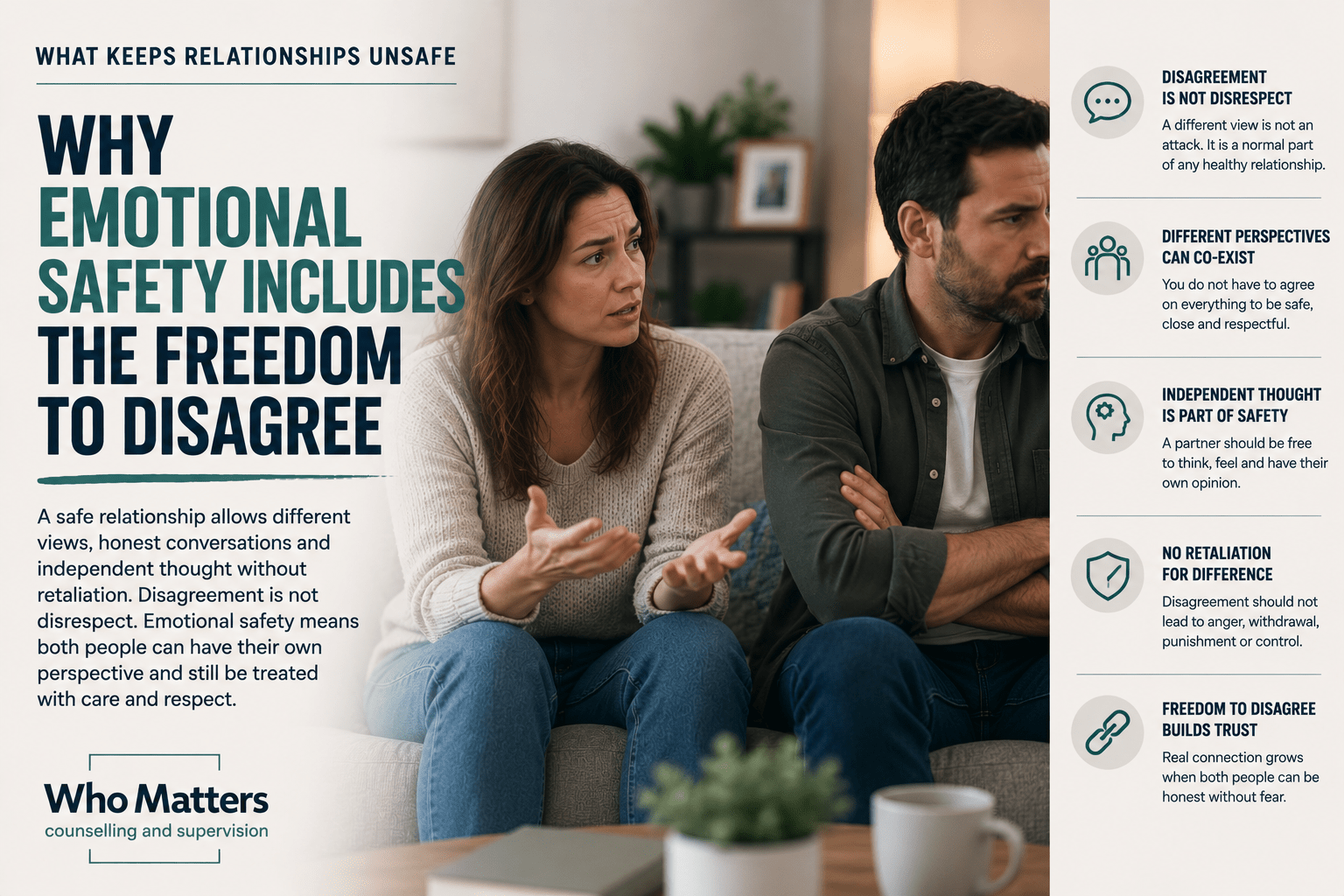
Disagreement is one of the clearest tests of emotional safety because it reveals whether both people are allowed to have their own mind. It shows whether different perspectives can exist without retaliation, pressure, humiliation, withdrawal, intimidation, or emotional punishment. It also shows whether closeness depends on agreement, or whether the relationship has enough respect to hold difference without turning it into conflict.
In a safer relationship, two people do not need to see everything the same way. They may have different memories, feelings, preferences, needs, values, boundaries, and interpretations. They may not resolve every difference immediately, and sometimes they may never fully agree. Emotional safety means those differences can be spoken without one person being made to pay a price for having them.
For men doing behaviour change work, this is an important distinction. A partner or ex-partner disagreeing with you is not automatically disrespect. Her having a different perspective is not an attack. Her saying no is not control. Her needing space is not punishment. Emotional safety requires learning to tolerate difference without trying to overpower it.
Disagreement Is Not the Same as Disrespect
One of the ways relationships become unsafe is when disagreement is interpreted as disrespect. A man may hear a different view as criticism, rejection, defiance, disloyalty, or a challenge to his authority. He may respond by arguing harder, correcting details, becoming cold, withdrawing affection, questioning motives, raising his voice, using sarcasm, or making the conversation about how unfairly he feels treated.
The problem is not that he has feelings in response to disagreement. It is understandable that disagreement can sometimes bring up discomfort, shame, fear, defensiveness, or disappointment. The issue is what he does with those feelings. If his discomfort becomes pressure, punishment, or control, then the relationship stops being emotionally safe.
Disrespect involves contempt, degradation, humiliation, threats, intimidation, or deliberate harm. Disagreement is simply the reality that two people do not have the same view. When these are confused, the person who disagrees may become responsible for preventing the other person’s reaction. She may learn to soften her words, avoid certain topics, agree too quickly, or stay silent because having a different perspective has become too costly.
A relationship does not become respectful because one person stops disagreeing. It becomes respectful when both people can disagree without fear.
Different Perspectives Can Co-Exist
In emotionally safe relationships, different perspectives are allowed to co-exist. This does not mean every perspective is equally accurate or that harm becomes a matter of opinion. It means both people are allowed to describe their experience without being pressured into surrendering it.
A partner may say, “That hurt me,” even if the other person did not intend harm. She may say, “I remember it differently,” even if he is certain of his version. She may say, “I am not ready to move on,” even if he feels impatient. She may say, “I need space,” even if he wants closeness. She may say, “I do not agree,” without that difference becoming a threat to the relationship.
For men who have used controlling or abusive behaviours, this can be difficult because disagreement may feel like a loss of control. The urge may be to explain, persuade, debate, correct, or push until the other person sees it the same way. This can be especially strong when he feels ashamed or misunderstood. However, emotional safety is not created by winning agreement. It is created by respecting the other person’s right to their own experience.
Sometimes a man will say he is “just trying to explain” when the impact is that his partner feels worn down. Explanation becomes pressure when it does not leave room for the other person to say, “I understand what you are saying, and I still see it differently.”
Independent Thought Is Part of Safety
Emotional safety includes the right to independent thought. A partner should not have to align her feelings, opinions, memories, values, friendships, parenting views, or future plans with his in order to avoid consequences. She should be able to think differently without being accused of betrayal, selfishness, disrespect, or not caring.
This matters because control often targets the internal world before it targets behaviour. A person may not only be pressured to act differently; she may be pressured to see things differently, feel differently, remember differently, or agree with his interpretation of events. Over time, this can make her doubt her own judgement and rely more heavily on what is acceptable to him.
Independent thought is also important after harm has occurred. A man may want his partner or ex-partner to see his progress, accept his explanation, forgive him, believe his intentions, or agree that the relationship is improving. She may not see it that way. Emotional safety requires him to allow her to hold a different assessment, even if it is painful for him.
This is particularly important in separation, co-parenting, or child protection contexts, where one person may try to define the story in a way that protects their image. A safer response is not to force agreement about the narrative. It is to remain accountable for behaviour and allow others to have their own perspective on its impact.
Retaliation Can Be Emotional, Not Only Physical
When people think about retaliation, they often imagine obvious acts of revenge, aggression, or physical intimidation. In relationships, retaliation can be much quieter. It may involve sulking, withdrawing affection, refusing practical help, becoming cold, sending repeated messages, making accusations, withholding cooperation, using the children as leverage, threatening legal action, humiliating the person later, or creating a mood that others have to manage.
These behaviours communicate that disagreement has a cost. The person may technically be allowed to disagree, but she learns that doing so will lead to consequences. Over time, this can reduce her freedom as effectively as a direct rule.
A man may not recognise these behaviours as retaliation because he experiences them as hurt, disappointment, or needing space. These feelings may be real, but the pattern still matters. If his withdrawal or coldness teaches others not to raise concerns, then it is not simply emotional regulation. If his repeated messages teach someone that boundaries will not be respected, then it is not just persistence. If his accusations teach her that independent thought will be punished, then emotional safety is being eroded.
The test is not only whether he intended to retaliate. The test is whether the other person becomes less free to disagree because of what happens afterwards.
Agreement Is Not the Goal
Many unsafe relationship patterns are built around the belief that resolution requires agreement. A man may believe the conversation cannot end until his partner understands him, agrees with him, reassures him, apologises, or accepts his version of events. He may see her refusal to agree as stubbornness, avoidance, immaturity, disrespect, or proof that she does not care.
This can turn ordinary disagreement into pressure. The conversation may continue long after the other person has reached her limit. The same point may be repeated in different ways. Her words may be picked apart. Her memory may be challenged. Her feelings may be debated. She may eventually agree, apologise, or stop responding, not because she has changed her view, but because she wants the pressure to stop.
A safer relationship does not require agreement before people are allowed to rest, pause, or move on. Sometimes the most respectful outcome is, “We see this differently, and we are not going to force a resolution right now.” This does not mean avoiding responsibility or refusing to repair harm. It means recognising that forced agreement is not the same as repair.
In emotional safety, the goal is not to make two people think the same. The goal is to make room for honesty without punishment.
The Difference Between Influence and Pressure
Relationships involve influence. People affect each other, learn from each other, challenge each other, and sometimes change their views through discussion. Influence becomes unsafe when it turns into pressure and one person no longer feels free to hold their own position.
The difference is often shown in whether the other person can say no to the conversation. Can she pause it? Can she say she has heard enough? Can she maintain her view without being punished? Can she disagree without being accused of not caring? Can she decide not to explain further without the issue escalating?
Healthy influence respects the other person’s autonomy. It allows time, space, and genuine choice. Pressure tries to force a particular outcome, often by using persistence, guilt, emotional intensity, intimidation, or consequences.
For men who want to change, this distinction is important. You may have a genuine point to make. You may feel misunderstood. You may want your partner to see something differently. But if the way you pursue being understood leaves her exhausted, anxious, cornered, or less free, then the process has become unsafe, regardless of whether your point has some validity.
Why Dissent Matters in Intimate Relationships
Dissent is the ability to disagree, object, question, refuse, or hold a different view. In intimate relationships, dissent is essential because closeness without freedom becomes control. If a person cannot dissent safely, their agreement becomes less meaningful.
A partner’s yes matters more when her no is safe. Her affection means more when it is not required to prevent punishment. Her reassurance means more when it is freely offered rather than demanded. Her apology means more when she is not pressured into giving it. Her willingness to repair means more when she is allowed to have limits.
This is why emotional safety and autonomy are connected. The relationship becomes safer when both people can remain separate, even while they are close. They can care about each other without owning each other’s thoughts. They can influence each other without controlling each other. They can seek repair without forcing agreement.
When dissent is unsafe, a relationship may still appear close, but the closeness may be maintained through compliance, fear, guilt, or emotional management. That is not the same as intimacy.
Children Learn Whether Disagreement Is Safe
Children notice how disagreement is handled in the home. They learn whether people are allowed to have different feelings, whether questions are welcomed or punished, whether one person’s mood controls the room, and whether speaking honestly leads to repair or consequences.
If a child sees one parent punished for disagreeing, they may learn that safety means silence. If they see a parent become intimidating, cold, or emotionally overwhelming when challenged, they may learn to manage that parent rather than express themselves. They may also learn that the person with the strongest reaction gets the most power.
A safer home allows children to see disagreement handled with respect. This does not mean children need to be involved in adult issues. It means the emotional climate of the home should not teach them that difference is dangerous.
For fathers, this is an important part of behaviour change. Children do not only need to be told they are loved. They need to experience a home where people can have thoughts, feelings, boundaries, and differences without fear.
Accountability Means Allowing Other People Their Reality
For men who have used harm, allowing disagreement can be especially difficult when the disagreement is about the harm itself. A partner or ex-partner may describe events in a way that feels painful to hear. She may name behaviour as abusive, controlling, frightening, manipulative, or unsafe. She may not accept his explanation. She may not agree that he has changed. She may not be ready to rebuild trust.
The urge may be to correct her, defend himself, explain his intent, or argue for a more favourable version of the story. While some clarification may be appropriate in certain contexts, repeated attempts to control the narrative can become another form of harm.
Accountability means allowing the person affected by your behaviour to have her own reality. It means understanding that your intention does not erase her experience. It means being willing to hear impact without immediately making the conversation about whether you are being judged fairly.
This does not require a man to agree with every detail of another person’s perspective. It does require him to stop using pressure, argument, withdrawal, intimidation, or emotional consequences to make her surrender it.
What Safer Disagreement Looks Like
Safer disagreement begins with recognising that another person’s different view is not something to defeat. It may still need to be discussed, especially when decisions affect children, finances, safety, or shared responsibilities. But the discussion should not remove the other person’s freedom.
In practice, safer disagreement means accepting pauses, respecting no, allowing privacy, not demanding immediate reassurance, and not using emotional consequences when someone does not agree. It means speaking without contempt, listening without preparing a defence, and acknowledging impact even when intent was different.
It also means being able to say, “I see this differently, but I am not going to pressure you to agree with me.” For men who have relied on persistence, argument, intensity, or emotional withdrawal to get resolution, this may feel unfamiliar. It may also feel uncomfortable because it requires tolerating uncertainty and difference.
That discomfort is part of the work. Emotional safety grows when one person’s discomfort no longer becomes the other person’s responsibility to fix through agreement.
Questions for Men Who Want to Change
If you are trying to understand whether disagreement is safe in your relationships, it may help to reflect on what happens when someone sees things differently from you. Consider whether you can allow a different perspective to exist without correcting it, whether you can stop a conversation before you feel fully understood, and whether others can say no or ask for space without pressure or emotional consequences.
It is also worth asking whether your partner, ex-partner, or children have become careful about expressing disagreement. Do they soften their words, avoid certain topics, agree quickly, hide their opinions, or wait for the right mood before speaking honestly? If they do, the issue may not be that they are poor communicators. It may be that disagreement has not felt safe.
These questions are not about becoming passive or having no views of your own. They are about learning to hold your perspective without using it to take away someone else’s.
Freedom to Disagree Is Part of Love
A relationship is not emotionally safe because two people agree all the time. It is emotionally safe when they can disagree without fear of retaliation, punishment, humiliation, pressure, or control.
The freedom to disagree protects honesty. It protects consent. It protects trust. It protects each person’s right to have their own thoughts, feelings, boundaries, and reality. Without that freedom, agreement may simply become adaptation.
For men who want to change, one of the most important measures of safety is whether the people close to you can think differently from you and still feel respected. They should not have to choose between honesty and peace. They should not have to surrender their perspective to protect your mood. They should not have to agree in order to be treated with care.
Emotional safety includes the freedom to disagree because love without freedom is not safety. It is control.