“Everyone Fights”: How Harm Gets Hidden Inside the Language of Normal Conflict
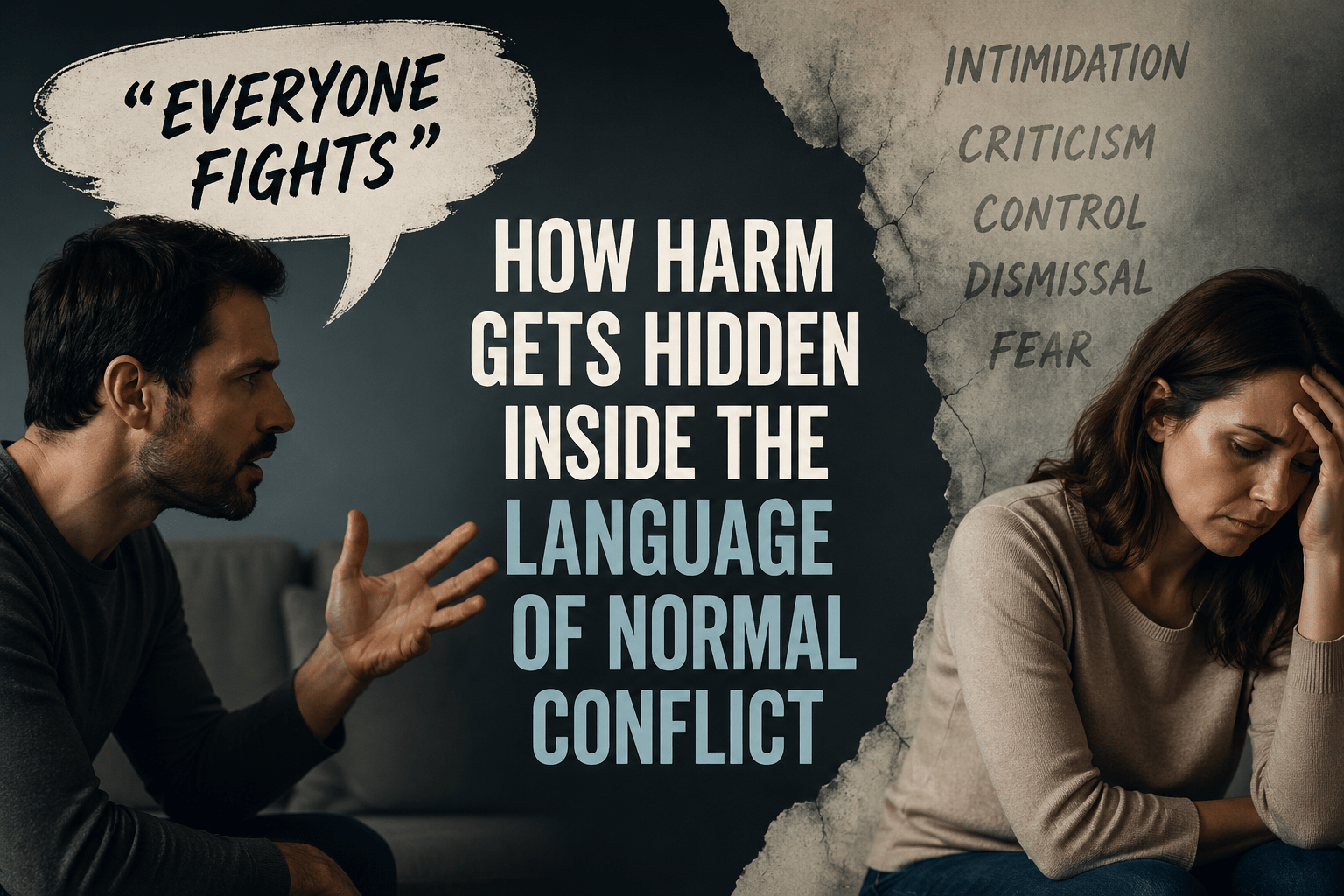
“Everyone fights.”
It’s one of the most common phrases men use when talking about conflict in relationships. On the surface, it sounds reasonable—even reassuring. Conflict is a normal part of any close relationship. Disagreements happen. Emotions rise. People say things they later regret.
But this phrase often does more than normalise conflict—it quietly protects harmful behaviour from scrutiny.
Because when everything gets labelled as “just fighting,” there’s no longer a clear line between healthy disagreement and harmful conduct. And that’s where real problems begin.
When “Normal” Becomes a Shield
Saying “everyone fights” can act as a kind of conversational shield. It shifts the focus away from what actually happened and moves it toward a general truth:
- “All couples argue.”
- “Relationships are hard.”
- “No one’s perfect.”
All of that may be true. It’s also irrelevant if the behaviour in question includes:
- Intimidation
- Verbal degradation
- Persistent criticism
- Controlling actions
- Emotional withdrawal used as punishment
- Threats (explicit or implied)
These aren’t just expressions of conflict—they’re patterns that create fear, instability, or power imbalance.
When those behaviours are reframed as “just a fight,” their impact gets minimised.
The Critical Difference: Conflict vs Harm
Not all conflict is equal. In fact, there’s a fundamental distinction that often gets blurred:
Healthy Disagreement
- Both people can express themselves (calmly)
- Disagreement stays focused on the issue
- There’s room for repair and accountability
- Neither person feels unsafe
- Power remains relatively balanced
Harmful Interaction
- One person dominates, intimidates, or shuts down the other
- The focus shifts to blame, character attacks, or control
- Repair is absent, resisted, or conditional
- The other person feels anxious, fearful, or diminished
- Power is uneven—and used that way
The phrase “everyone fights” collapses these two categories into one. And once that happens, it becomes much harder to recognise when something has crossed a line.
Why This Language Persists
Men often don’t use this phrase to deliberately avoid accountability. More often, it reflects:
1. Learned Normalisation
If someone grew up around yelling, tension, or control, those patterns can feel “standard.” Without alternative models, harmful dynamics can seem like just part of being in a relationship.
2. Emotional Simplification
“Fight” is a broad, vague word. It doesn’t require precision. It avoids having to say:
- “I scared her.”
- “I kept pushing until she gave in.”
- “I wouldn’t let it go.”
- “I made it about winning.”
Specific language demands reflection. The use of generalised language avoids it.
3. Shared Responsibility Framing
“Everyone fights” implies mutual contribution. It subtly suggests:
“We were both part of it.”
But not all behaviours in a conflict carry equal weight. One person raising their voice in frustration is not the same as another person using intimidation or coercion.
The Cost of Blurring the Line
When harmful behaviour is hidden inside the language of “normal conflict,” several things happen:
- Accountability gets diluted
If it’s just a fight, there’s nothing specific to take responsibility for. - Patterns go unexamined
Repeated behaviour becomes background noise instead of something to change. - The partner’s experience gets minimised
If she felt unsafe, but it’s framed as “just arguing,” her reality is effectively dismissed. - Change becomes unlikely
You can’t change what you haven’t clearly named.
A More Honest Question
Instead of asking:
“Was that just a normal fight?”
A more useful question is:
“What was my behaviour doing in that moment?”
That shifts the focus from generalisation to impact.
It invites reflection like:
- Was I trying to understand—or to win?
- Did I escalate or de-escalate?
- Did my behaviour create safety—or pressure?
- Did she feel heard—or managed?
These are uncomfortable questions. But they’re the ones that lead somewhere different.
Moving Beyond the Script
Letting go of “everyone fights” doesn’t mean expecting perfection or eliminating disagreement. It means raising the standard of what’s acceptable within conflict.
It means recognising that:
- Anger doesn’t justify intimidation
- Frustration doesn’t excuse control
- Disagreement doesn’t require domination
And most importantly, it means understanding that how you behave in conflict is part of who you are in the relationship.
Final Reflection
“Everyone fights” can be misleading. Because what matters isn’t whether disagreement exists.
What matters is what you do with it.
If the language you use hides the impact of your behaviour, it will also hide the need to change it.
And real change only starts when things are named clearly.