When Disagreement Stops Being Safe and Starts Revolving Around One Person’s Reactions
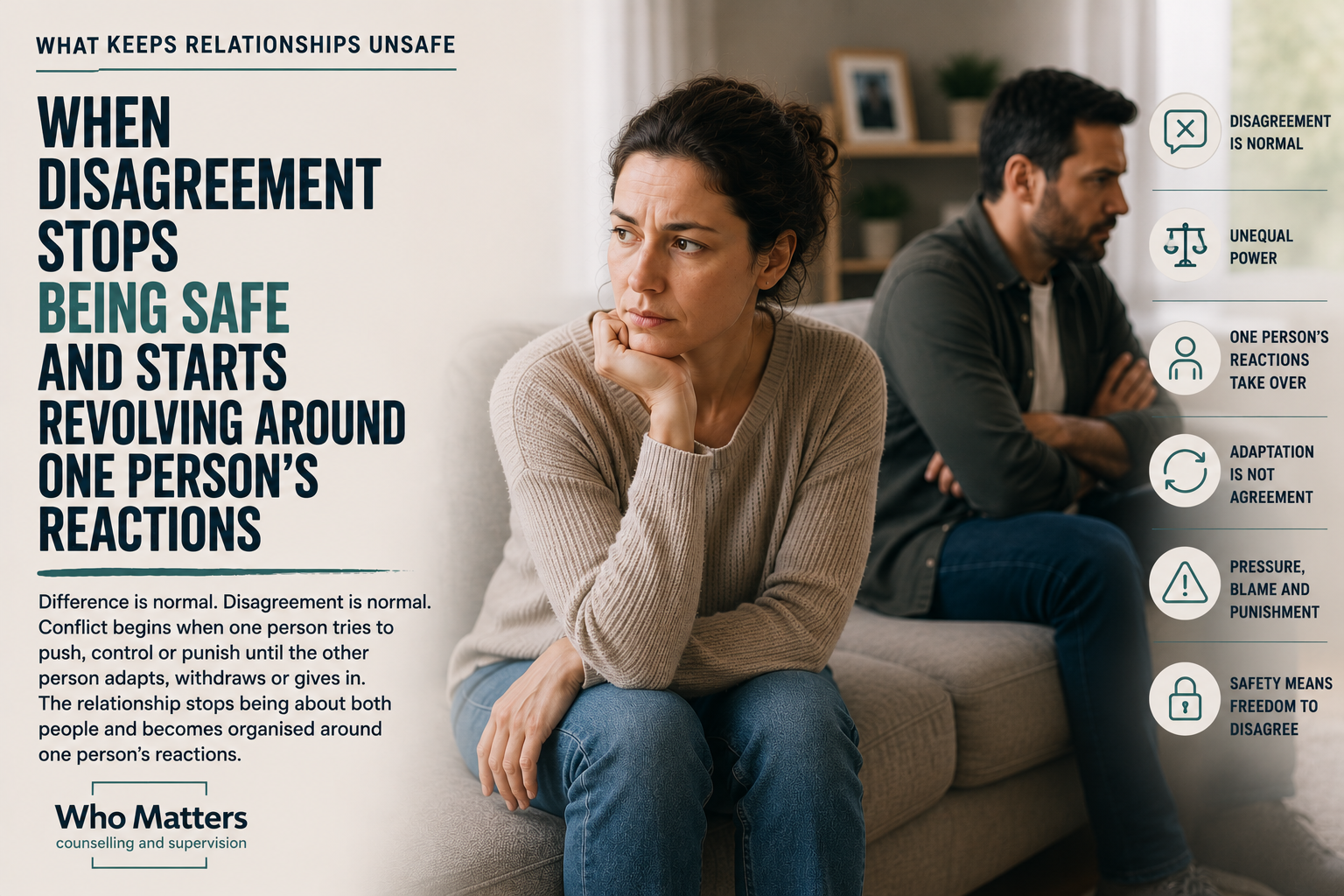
All relationships involve difference. Two people will not always see things the same way, want the same thing, remember events in the same way, or respond emotionally in the same way. Difference is not the problem. Disagreement is not the problem either. In a safe relationship, disagreement can exist without either person needing to dominate, pressure, punish, or force the other person to agree.
Disagreement allows both people to remain separate and free. One person can say, “I see this differently,” without the other person treating that difference as a threat. A partner can have a different memory, preference, feeling, boundary, or opinion without the conversation turning into a battle over whose reality is allowed to exist.
Conflict begins when disagreement is no longer allowed to remain as disagreement. It starts when one person cannot tolerate difference and begins trying to push their perspective, needs, feelings, or version of events onto the other person. This may happen through arguing, pressure, blame, interrogation, sulking, withdrawal, intimidation, threats, guilt, emotional punishment, or repeated attempts to wear the other person down.
In unsafe relationships, this pattern often becomes organised around one person’s reactions. The issue is no longer simply that two people disagree. The issue is that one person’s anger, defensiveness, jealousy, shame, distress, withdrawal, or need for control becomes so difficult to deal with that the other person begins adapting around it.
This distinction matters. If every tense or painful interaction is described as “relationship conflict”, the power dynamic underneath can be missed. What may look like two people struggling to communicate may actually be one person becoming less free because the other person does not tolerate disagreement, boundaries, independence, or a different perspective.
Difference Is Not the Problem
Difference is part of being in relationship with another person. Partners may differ in how they think about parenting, money, sex, family, work, rest, communication, friendships, privacy, alcohol, technology, household responsibilities, or the future of the relationship. They may also differ in how quickly they process things, how much space they need, what hurts them, what they remember, or what they are ready to repair.
None of this automatically means the relationship is unsafe. A safe relationship does not require two people to agree on everything. It requires both people to be able to remain respectful, responsible, and free when they do not agree.
In a safer relationship, one person can say, “I do not see it that way,” and the other person can feel disappointed, frustrated, or misunderstood without turning those feelings into pressure. One person can say no, ask for space, or raise a concern without the other person treating it as disrespect, betrayal, rejection, or an invitation to take control of the conversation.
This is important because many unsafe patterns begin when one person experiences difference as something that must be corrected. Instead of allowing two perspectives to exist, he may try to convince, debate, challenge, overwhelm, or emotionally pressure the other person until she gives in, becomes quiet, apologises, or stops raising the issue.
When this happens repeatedly, disagreement is no longer a safe relational space. It becomes something the other person learns to avoid.
Disagreement Allows Freedom
Disagreement is healthy when both people are still allowed to have their own mind. This does not mean both people will always feel comfortable. It means the discomfort of difference does not become a reason to control the other person.
A partner may disagree about what happened in a conversation. She may feel hurt by something he sees as minor. She may want more space than he wants to give. She may not want sex when he does. She may not want to continue a conversation late at night. She may make a parenting decision, social plan, or life choice that he would not have chosen. In a safe relationship, these moments may require discussion, negotiation, repair, or reflection, but they do not require surrender.
Disagreement becomes unsafe when one person is not allowed to stop explaining, when every boundary becomes a debate, or when the other person’s “no” is treated as a problem to overcome. It also becomes unsafe when one person’s distress becomes so central that the other person has to abandon their own position in order to calm things down.
In this kind of pattern, the issue is not that the couple has differences. The issue is that only one person is allowed to have difference without consequences.
When Disagreement Becomes Conflict
Disagreement becomes conflict when one person starts trying to force resolution on their own terms. This can happen loudly, through yelling, swearing, insults, threats, or intimidation. It can also happen quietly, through persistence, coldness, emotional withdrawal, repeated questioning, guilt, or a calm but relentless insistence that the other person must accept his version of events.
The shift may be subtle at first. A partner raises a concern, and he immediately focuses on how she said it. She asks for space, and he insists they need to resolve it now. She says she is hurt, and he argues about whether she should feel that way. She says no, and he asks again in a different way. She disagrees, and he keeps explaining until she becomes exhausted.
Over time, the pattern teaches her that disagreement is costly. She may still technically be allowed to disagree, but she knows what will follow. There may be hours of discussion, emotional distance, defensiveness, accusations, interrogation, sulking, tension in the house, repeated texts, or pressure to reassure him that he is not a bad person.
At that point, the disagreement has become more than a difference of perspective. It has become a struggle over whether she is allowed to have a perspective of her own.
When One Person’s Reaction Becomes the Organising Force
One of the clearest signs that a relationship is becoming unsafe is when everyone begins organising around one person’s reactions. His mood determines when things can be raised. His defensiveness determines how honest she can be. His anger determines whether the children need to be quiet. His jealousy determines what information she shares. His shame determines whether she ends up comforting him instead of being heard.
This does not always look like domination from the outside. Sometimes it looks like sensitivity, hurt, anxiety, stress, or a strong need to talk things through. Sometimes the man may genuinely experience himself as overwhelmed, rejected, misunderstood, or afraid of losing the relationship. Those feelings may be real, but they still do not give him the right to make the relationship revolve around his reaction.
In an unsafe pattern, the original issue often disappears. She may raise a concern about his behaviour, but the conversation becomes about how hurt he feels that she raised it. She may say she needs space, but the focus shifts to his fear of abandonment. She may say she does not feel safe, but the discussion turns into whether she is being unfair, dramatic, unforgiving, or too focused on the past.
The more this happens, the more the relationship becomes shaped around preventing his reaction rather than addressing the actual issue.
Adaptation Is Not Agreement
When one person adapts to another person’s reactions, it can be mistaken for agreement, forgiveness, calm, or improvement. She may stop raising certain issues. She may become quieter. She may say “it’s fine” more often. She may agree to things more quickly. She may stop asking questions, stop expressing disappointment, or stop challenging his version of events.
From his perspective, this may look like things are getting better. There are fewer difficult conversations, fewer obvious arguments, and less visible resistance. But the absence of disagreement does not necessarily mean safety has increased. It may mean she has learned that disagreement is not worth the cost.
Adaptation can take many forms. A partner may wait for the “right time” to speak, soften every concern with reassurance, avoid certain topics, give in sexually to avoid tension, keep the children quiet, hide ordinary information, stop seeing particular friends, answer messages quickly, or explain herself in excessive detail. She may become skilled at predicting what will upset him and preventing it before it happens.
These behaviours are not the same as free agreement. They may be strategies for reducing risk, avoiding punishment, or keeping the peace in a relationship where honesty has become unsafe.
The Pattern Matters More Than One Incident
Unsafe dynamics are often difficult to identify because individual incidents can be argued about endlessly. One person may focus on who raised their voice first, who used the wrong words, who became emotional, who walked away, who brought up the past, or who did not explain themselves clearly enough. Those details may have some relevance, but they can also distract from the broader pattern.
The more important question is often: who is becoming less free over time?
If one person is becoming more careful, more compliant, more anxious, more isolated, more silent, or less honest, the relationship needs to be understood through that pattern. If one person’s reactions consistently determine what can be discussed, when it can be discussed, and how much honesty is allowed, then the issue is not simply disagreement. It is unequal power.
This is especially important when a man points to his partner’s emotional reactions as evidence that the problem is mutual. She may cry, yell, shut down, become angry, or say things she later regrets. Those behaviours can still matter. But they do not automatically mean the relationship is equal. A person’s response after prolonged pressure, fear, silencing, monitoring, intimidation, or emotional exhaustion must be understood in context.
The goal is not to excuse harm from anyone. The goal is to avoid flattening the relationship into “both people are in conflict” when one person has been adapting to the other person’s reactions for a long time.
Unequal Power Changes the Meaning of Behaviour
The same behaviour can mean different things depending on the history and power dynamics around it. A question like “Where are you going?” may be practical in a safe relationship, but in a relationship with jealousy, monitoring, accusation, or punishment, the same question may carry an entirely different meaning. A request to “talk now” may be reasonable in one relationship and coercive in another if the other person is not free to pause, leave, sleep, or say they have reached their limit.
Silence can also have different meanings. Sometimes silence is a healthy pause that allows someone to regulate themselves. At other times, silence is used as punishment, withdrawal, or a way to make the other person anxious enough to repair the relationship on his terms. The behaviour cannot be understood properly without looking at the pattern around it.
This is why intention is not enough. A man may say he was only asking a question, only trying to talk, only expressing his feelings, or only wanting reassurance. Those explanations may describe part of his experience, but they do not settle the question of safety. The impact on the other person, and the history of what usually happens when she does not comply, must also be considered.
In relationships where there has been violence, intimidation, coercive control, emotional abuse, or repeated punishment of boundaries, everyday behaviours do not occur in a neutral context. They are experienced through the memory of what has happened before.
“We Both Do It” Can Hide the Power Difference
In many unsafe relationships, men describe the dynamic as mutual. They may say, “We both argue,” “We both say hurtful things,” “She knows how to push my buttons,” or “We are both as bad as each other.” Sometimes there may be behaviours from both people that need attention, but this language can also obscure the power difference.
A more useful question is not whether both people have reacted badly at times, but whether both people are equally free. Can both people say no without consequences? Can both people leave a conversation safely? Can both people make independent choices without punishment? Can both people raise concerns and expect to be heard? Can both people have privacy? Can both people disagree without being worn down? Can both people end the relationship without fear of retaliation?
If one person can do these things and the other person cannot, the relationship cannot be understood as equal conflict.
It is also useful to ask who changes their life more. If one person is giving up friends, hiding information, managing the children’s behaviour, avoiding topics, softening concerns, changing routines, limiting choices, or constantly monitoring the other person’s mood, then the relationship is being shaped by unequal power, even if both people sometimes become upset.
Emotional Consequences Can Become Control
Not all consequences are physical or verbal. Some of the most powerful consequences in a relationship are emotional. A man may withdraw warmth, become cold, sulk, stop helping, refuse affection, become distant with the children, present himself as the victim, or create a mood in the house that everyone else has to manage.
Because these behaviours can be quiet, they are often harder to name. He may say he was just upset, needed space, or did not want to argue. Those things can be legitimate in some situations. Everyone is allowed to need time and space. The issue is whether the pattern functions as punishment or control.
Healthy space creates calm and allows both people to return to the issue with more respect. Punitive withdrawal creates anxiety and teaches the other person to comply, apologise, reassure, or stop raising concerns in order to restore peace.
If his withdrawal teaches his partner that disagreement leads to emotional consequences, then the withdrawal is not simply self-regulation. It has become part of the power dynamic.
Children Notice Who the Household Revolves Around
When a household revolves around one person’s reactions, children often notice. They learn who must be kept calm, which topics create tension, which parent adjusts the most, and what everyone needs to do to prevent things from becoming uncomfortable or unsafe.
Children may become quiet, overly compliant, protective, anxious, angry, or unusually alert to changes in mood. They may learn to manage the emotional climate of the home rather than simply live in it. They may also learn distorted lessons about relationships, such as believing that love means placating someone, that safety means staying small, or that the person with the strongest reaction gets the most power.
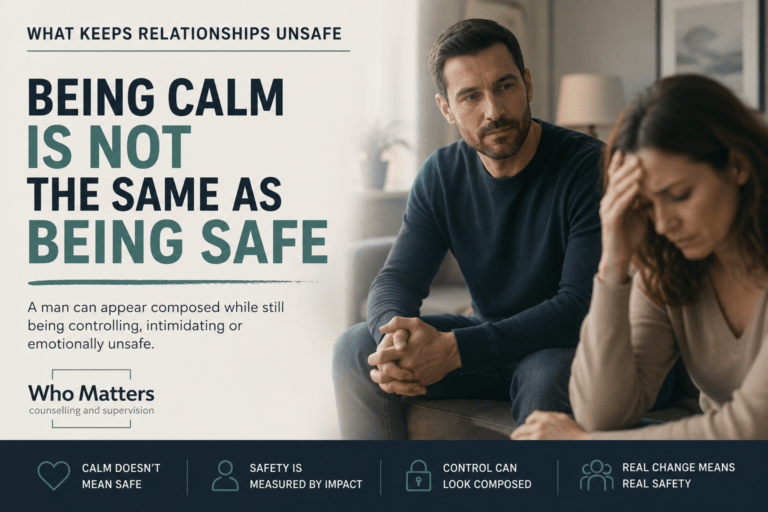
This is why the issue is not just whether children witness obvious arguments. A home can be physically calm and still emotionally unsafe if everyone is organised around one person’s mood, anger, distress, jealousy, or control.
For fathers, this can be difficult to face, but it is central to behaviour change. Children do not only need a father who loves them. They need a father whose behaviour supports emotional safety, stability, freedom, and respect in the home.
What Accountability Looks Like
For men who want to change, accountability begins with looking beyond whether there was a disagreement and asking what role their reactions play in the relationship. It means considering whether others can be honest without managing your response, whether your partner or ex-partner feels free to disagree, and whether your emotions have become the centre of the family’s decision-making.
This requires a shift from defending intention to examining impact. Instead of asking, “Did I mean to control her?”, it may be more useful to ask, “Has she become less free around me?” Instead of asking, “Was I calm?”, ask, “Did my behaviour create pressure or fear?” Instead of asking, “Why won’t she communicate properly?”, ask, “What has happened when she has tried to be honest with me?”
Accountability also means accepting that the other person’s caution may make sense. If she has spent months or years adapting to your reactions, she may not immediately trust a new response. She may still soften her words, avoid topics, or brace for consequences. That does not necessarily mean she is refusing to move forward. It may mean she is waiting to see whether the pattern has genuinely changed.
What Safer Disagreement Requires
The goal is not to avoid disagreement. Avoiding disagreement can simply create another form of silence, where one person keeps the peace by not being honest. The goal is to create enough safety that disagreement does not become pressure, punishment, control, or intimidation.
Safer disagreement requires both people to remain free. It means no threats, no humiliation, no pressure to keep talking, no repeated attempts to wear someone down, no using children as leverage, no monitoring, no retaliation, and no making the other person responsible for regulating your emotions.
It also means allowing the issue to remain the issue. If your partner raises a concern, the task is not to make your hurt, shame, anger, or defensiveness the centre of the conversation. Those feelings may need attention, but they should not erase the concern she raised.
Safer disagreement involves being able to pause without punishing, listen without preparing a defence, disagree without dominating, apologise without demanding immediate trust, and accept boundaries without retaliation. It requires a willingness to stay responsible for your behaviour even when you feel misunderstood, rejected, criticised, or ashamed.
Most importantly, safer disagreement gives the other person more room to be honest. If your behaviour change is real, the people around you should not have to work as hard to manage you.
Questions to Consider
If you are trying to understand whether disagreement in your relationship has become unsafe, it may help to reflect on who the relationship tends to revolve around during tense moments. Consider whether one person’s mood determines what can be discussed, whether one person regularly gives in to avoid consequences, whether concerns are redirected toward managing one person’s reaction, and whether the household becomes organised around keeping one person calm.
It is also worth asking whether both people can say no, take space, disagree, make choices, raise concerns, and have privacy with the same level of freedom. If one person can do these things and the other person pays a price for doing them, then the issue is not simply communication. It is power.
These questions can be uncomfortable, especially for men who see themselves as loving, stressed, misunderstood, or trying their best. Genuine change, however, requires more than good intentions. It requires understanding how your behaviour affects the freedom and safety of others.
The Measure Is Freedom, Not Agreement
A relationship is not safe because two people always agree. It is safe when two people can disagree without either person needing to dominate, punish, pressure, or control the other.
Sometimes a relationship looks calmer because one person has stopped trying to be heard. Sometimes there are fewer difficult conversations because the cost of honesty has become too high. Sometimes what appears to be agreement is actually adaptation.
The real measure is whether both people have more freedom, dignity, and safety. Can both people speak honestly? Can both people disagree? Can both people set limits? Can both people make choices without fear? Can both people exist in the relationship without organising themselves around one person’s reactions?
When disagreement revolves around one person’s reaction, the relationship becomes smaller for everyone else. When safety increases, people no longer have to shrink to keep the peace.
For men who want to change, this is one of the central tasks: to become someone whose reactions do not control the relationship. That does not mean having no feelings. It means taking responsibility for those feelings in a way that leaves the people around you free to have their own.